The Relic at the Center of the Republic
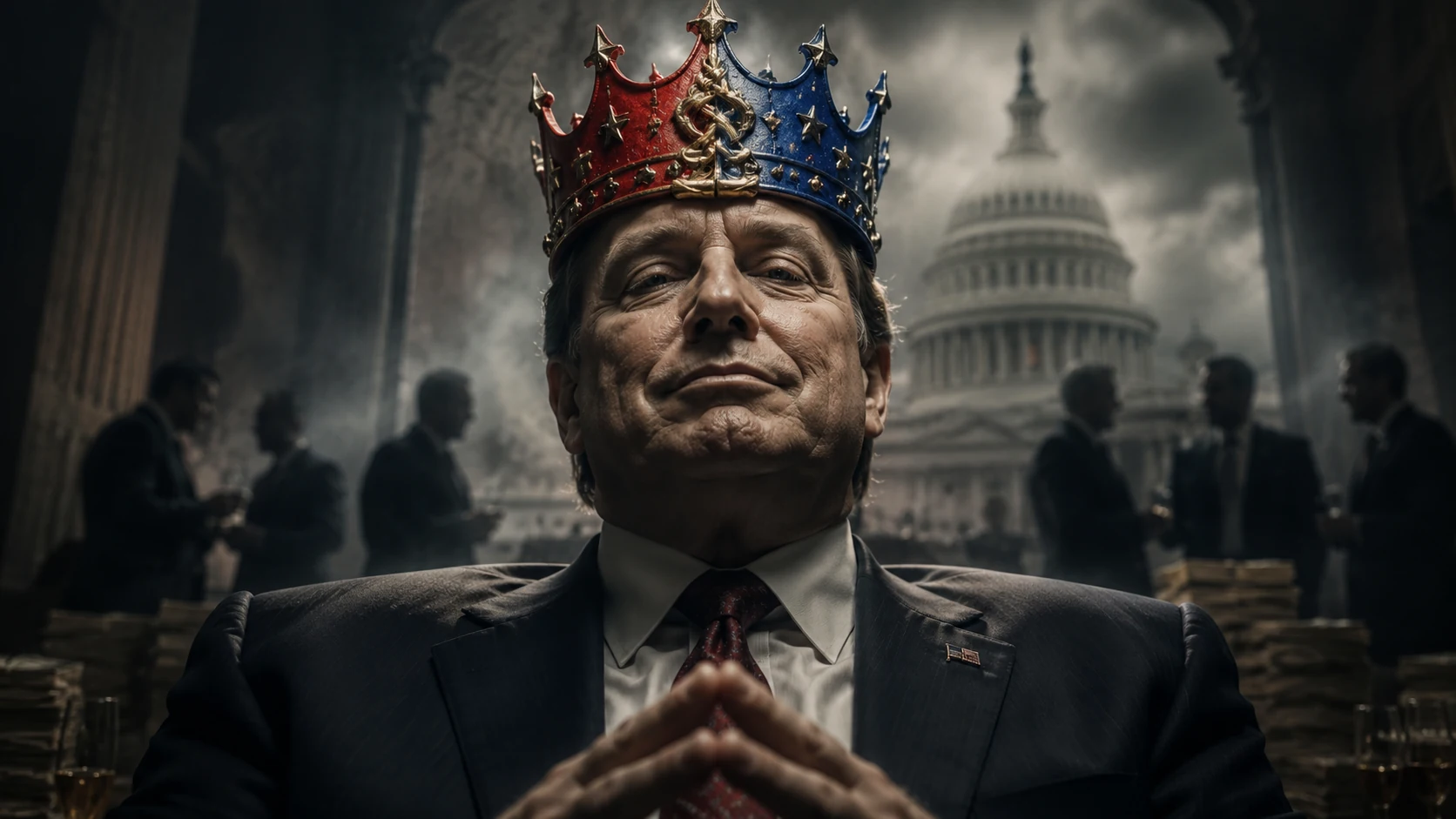
The founders feared party as the Crown’s old disease; the Uniparty is its modern form — two rival banners guarding one captured system.
LIBERTY OR DEATHWIRE! ⬩ COMMENTARY ⬩ AMERICA 250 SERIES
For America's 250th, the Freedom Plane lifts the founding charters into the air — heir to the Freedom Train that once carried them by rail. Read the manifest closely and something is missing by design: the men who built the republic wrote no political parties into it, and warned that the spirit of party would one day consume the experiment. We have fallen for it again — and for something worse.
Author’s Note: This essay is built on documents — many of them — and without a thread that can read like a gallery. So here is the thread, plainly: everything below is organized around a single, deliberate absence.
For America’s 250th, the Freedom Plane carries the founding charters aloft, and I read them here as a manifest — a list of what a free people chose to carry. The first section walks the charters themselves, which trace one idea down the centuries: that power must answer to something above its own will. The Exhibit Highlights that follow turn that idea into labor you can see — oaths sworn, a constitution drafted in secret, votes tallied, rights marked up — a country argued and signed into being. Look across all of it and you find the thing the founders left out on purpose: the political party. It appears in none of these papers, and they warned, nearly to a man, that it would one day consume the republic.
From there the essay follows that warning into the present — to the two-party reflex we mistook for democracy, and to the thing now hiding behind both parties. The documents are not decoration; they are the evidence, every one of them public and reproduced below with links to the originals, so you can check me against the record. That, in the end, is the whole point. Read them yourself.
“If a nation expects to be ignorant and free... it expects what never was and never will be.”
With Eternal Vigilance,
Andrew B. Raupp ✍️
Citizens Rule Book: A Palladium of Liberty (Download) #Infowars 🇺🇸
On March 6th, the founding charters of the United States left the ground — and the country has been looking up at them ever since.
The Freedom Plane is the heir to an old American habit. In 1947, with the country uneasy and the world dividing, a train hung with the nation’s charters set out across more than three hundred cities — the Declaration under glass, the Constitution beside it, a thirteenth-century Magna Carta riding the same rails as the Gettysburg Address. The men who organized it made one rule: no one would view the documents through a segregated line. Cities that refused to integrate the queue were struck from the route. The papers, it turned out, had standards.
In 1976, for the Bicentennial, the train rode again — steam-hauled across forty-eight states, a moving reliquary of the American story, drawing millions onto platforms to file past the things their freedom was written on.
Now, for the 250th, the charters fly. Same idea, faster vehicle: lift the founding documents above the country so the country can look up at them. The project bills itself as a manifest of liberty. And a manifest is the right word — a list of what is carried, and what is not. Read this one closely and you find an absence at the center of it. Not an oversight. A decision, made by the founders themselves, that we have spent two and a half centuries forgetting.
⬩ THE MANIFEST ⬩
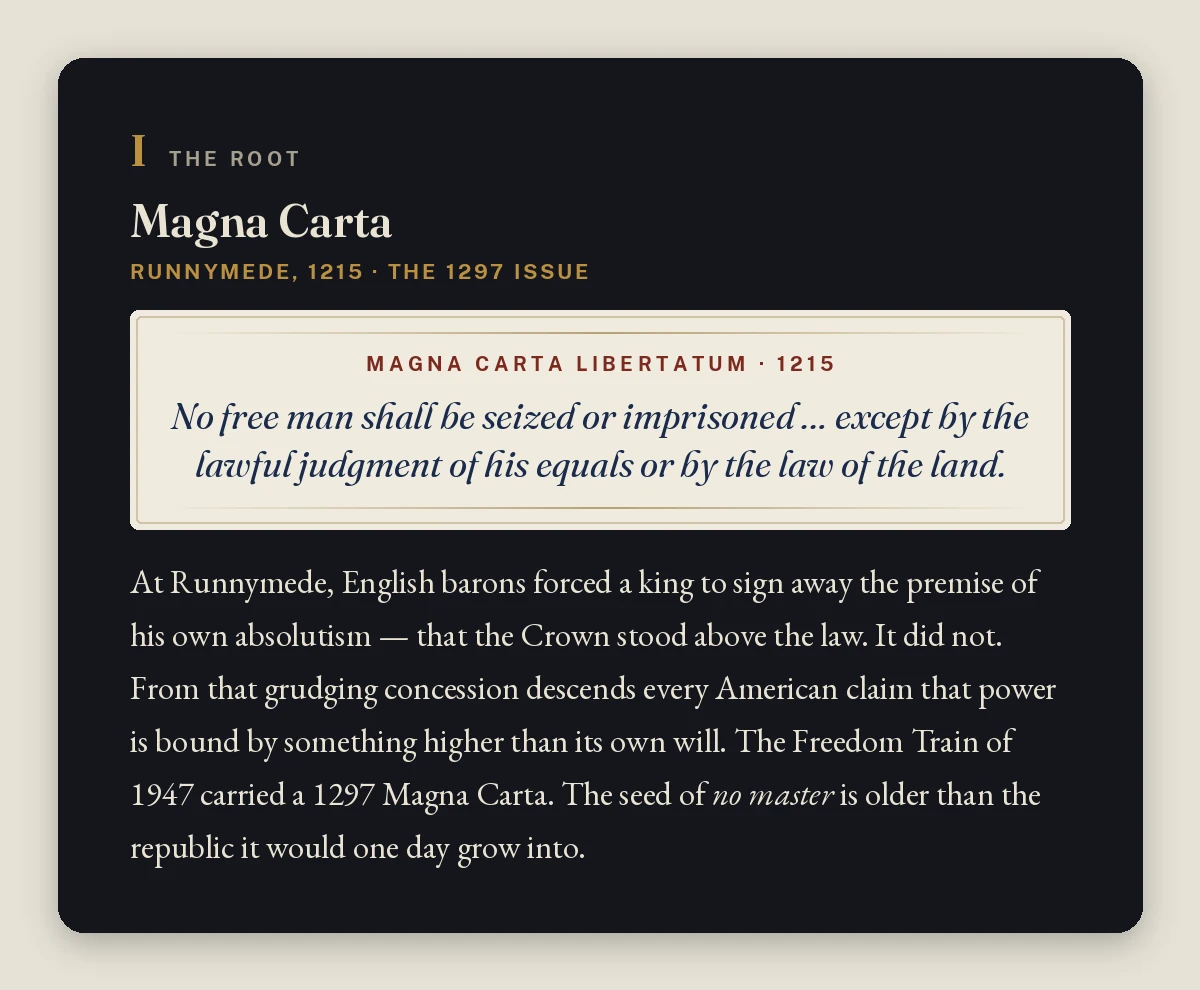
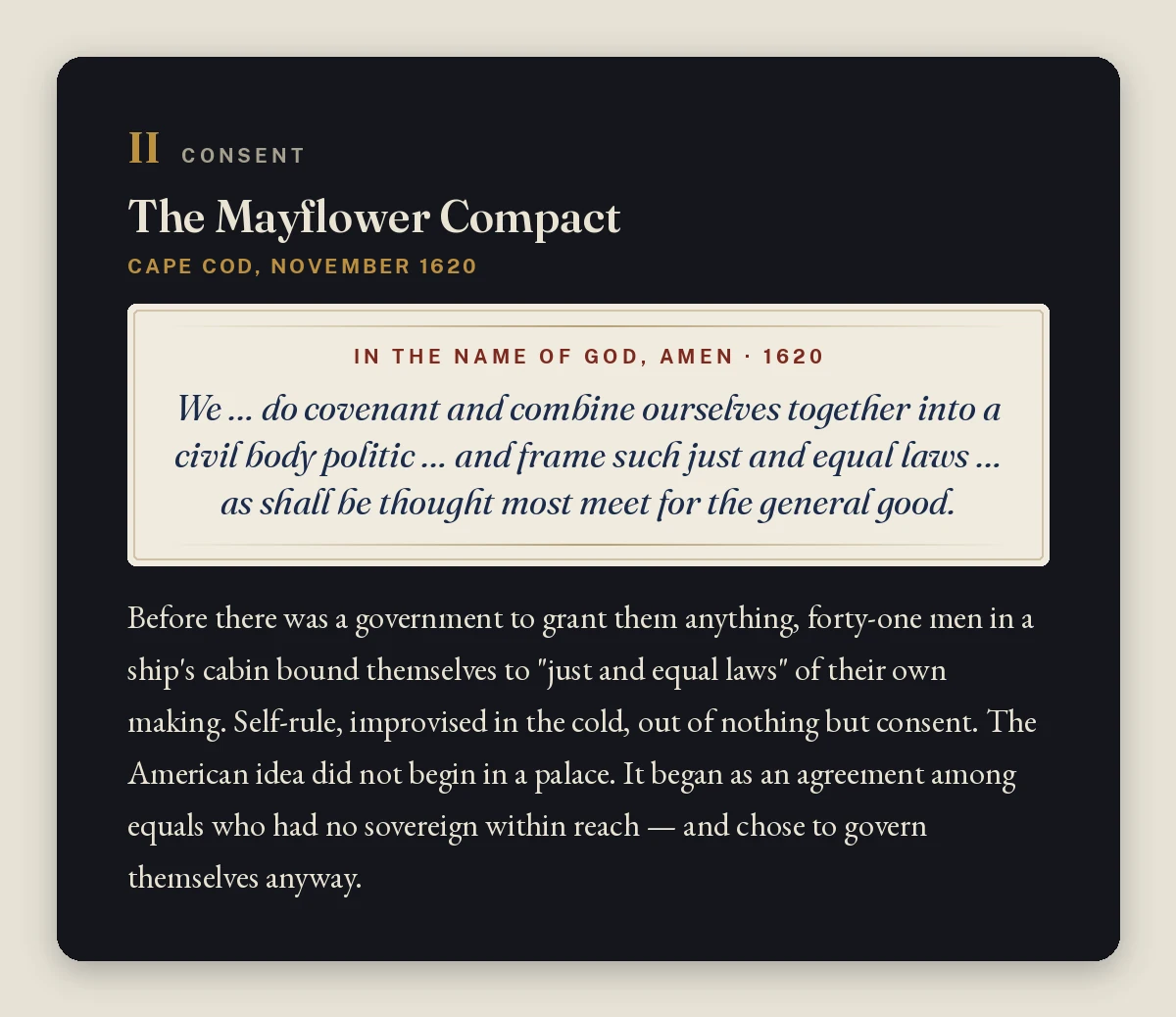
A manifest is read item by item. Here are the cargo's first entries — the descent of a single idea, that power must answer to something above itself. The rest of the hold we open as the argument requires it.
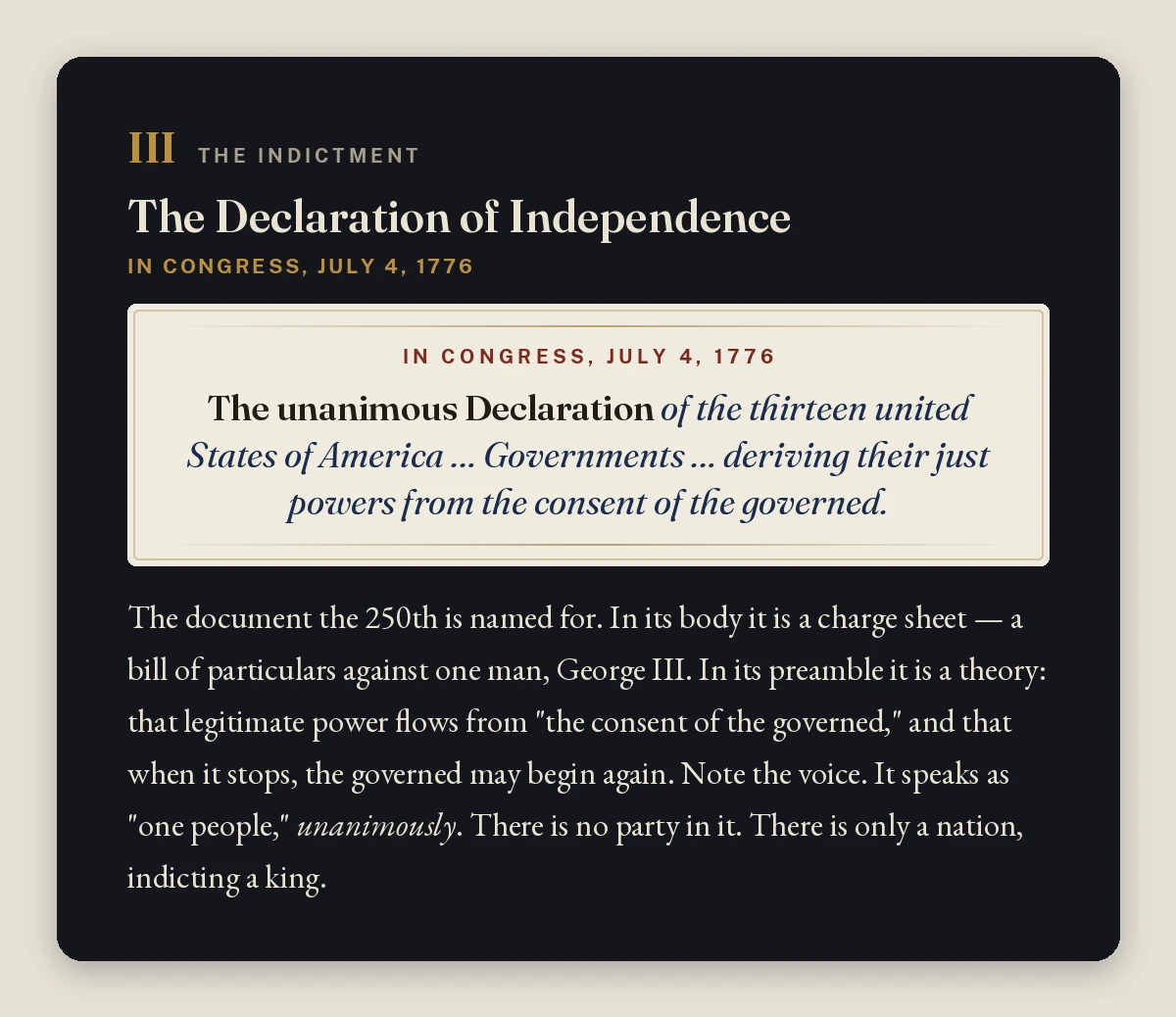
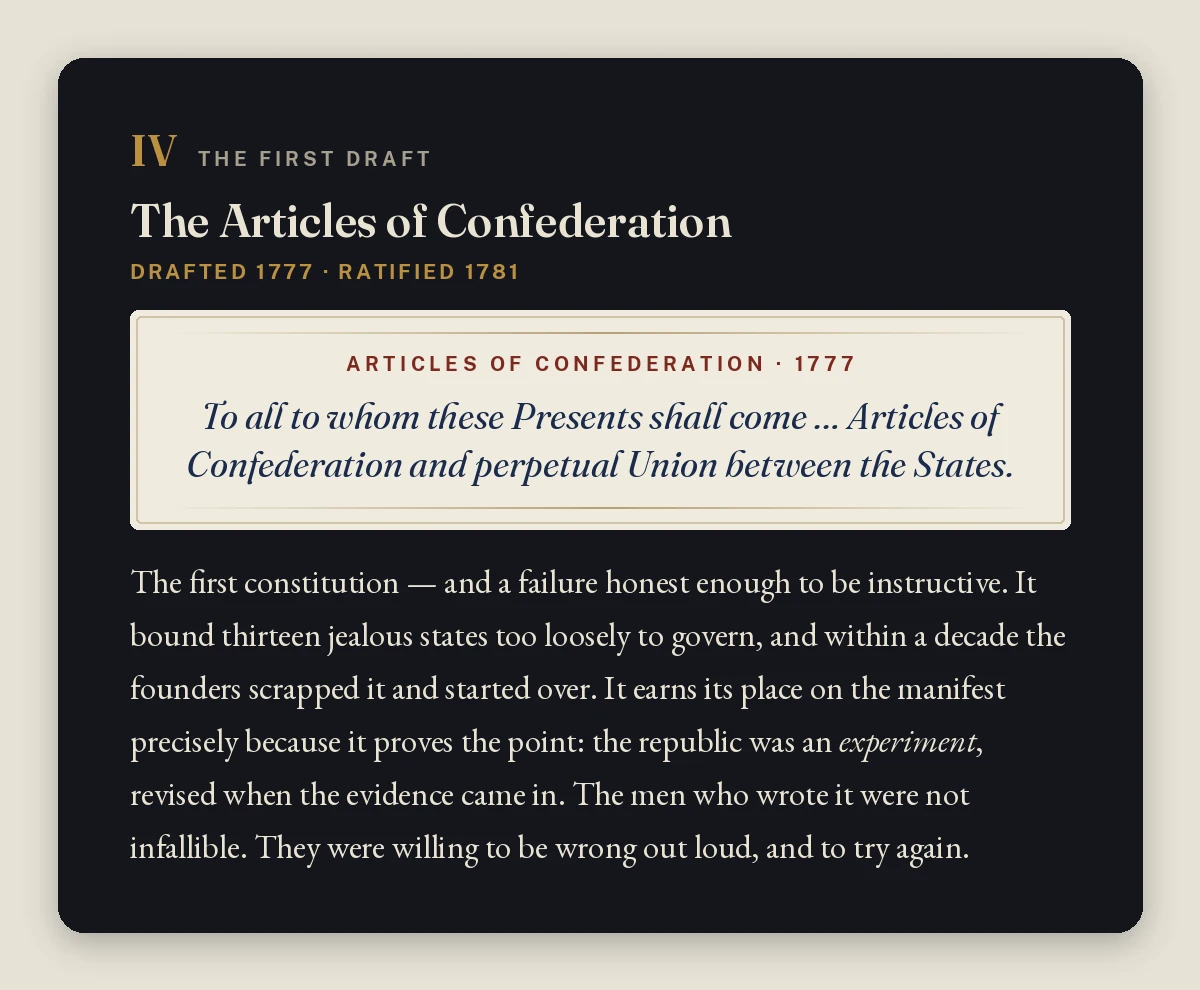
⬩ EXHIBIT HIGHLIGHTS ⬩
Those four charters are the bloodline of the idea. But this particular flight carries cargo no earlier tour could assemble — specific objects, several never shown in public, that record the republic not as a finished monument but as the labor of arguing, voting, swearing, and signing a free country into being.
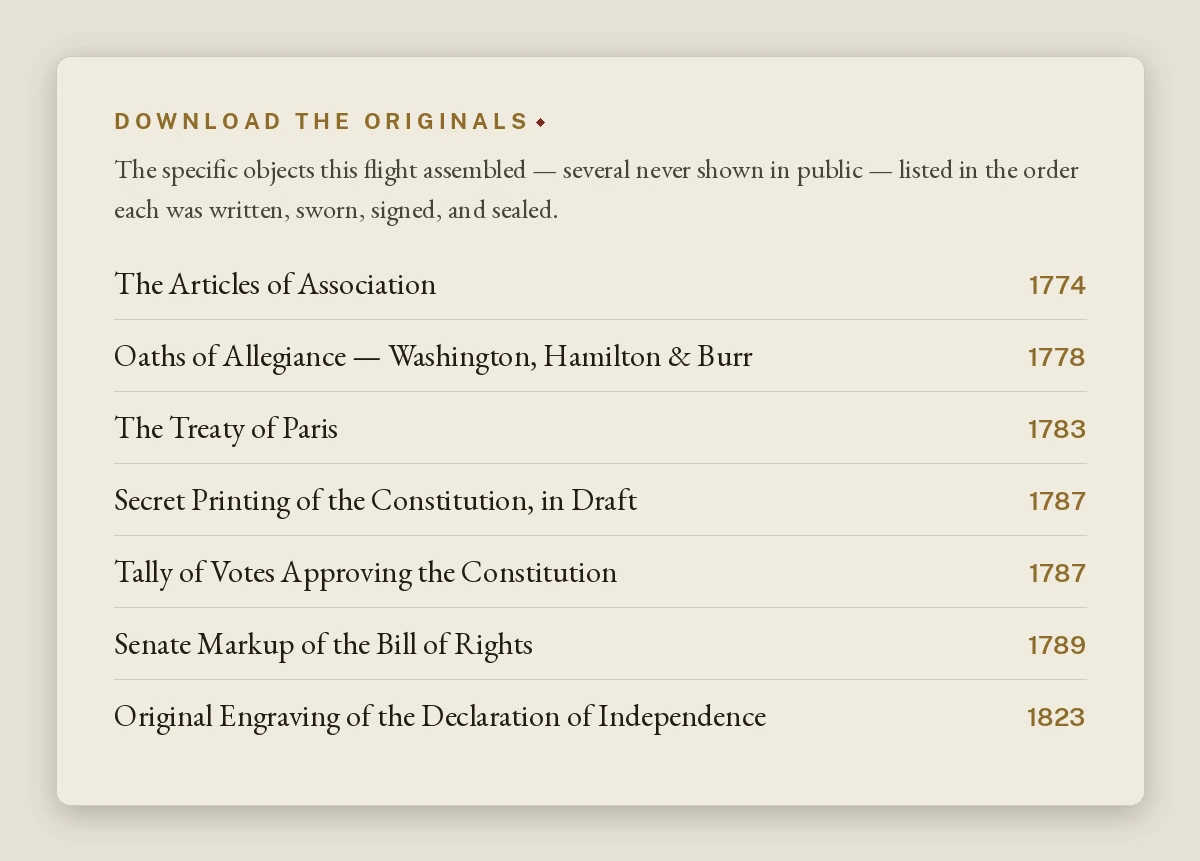
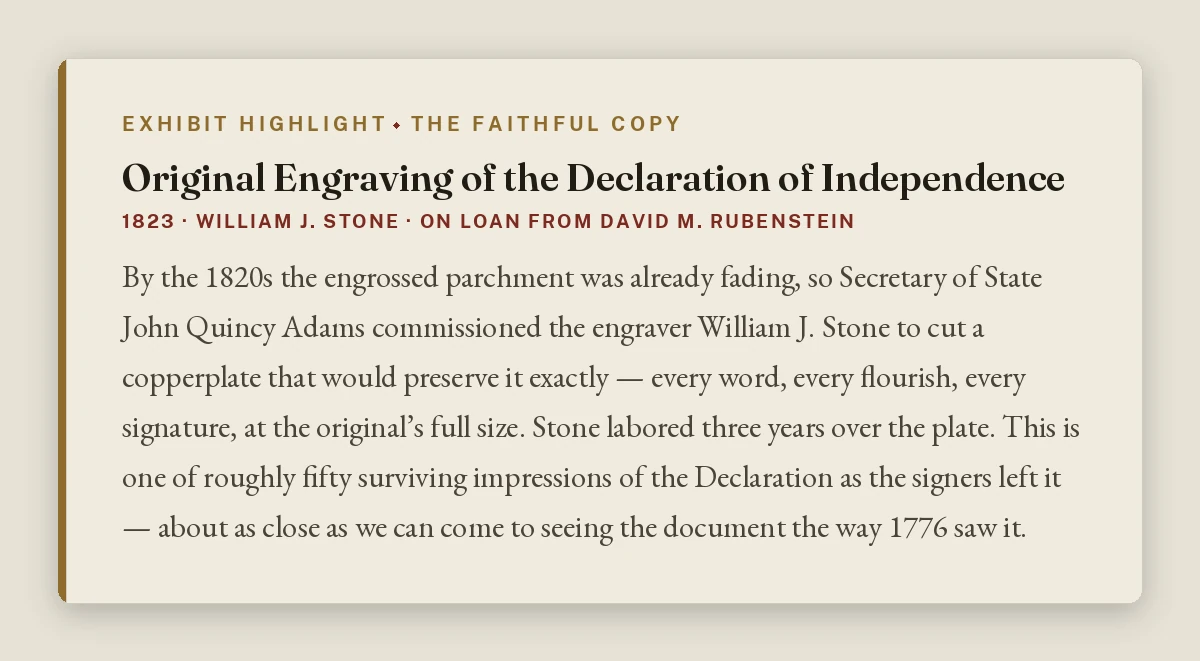
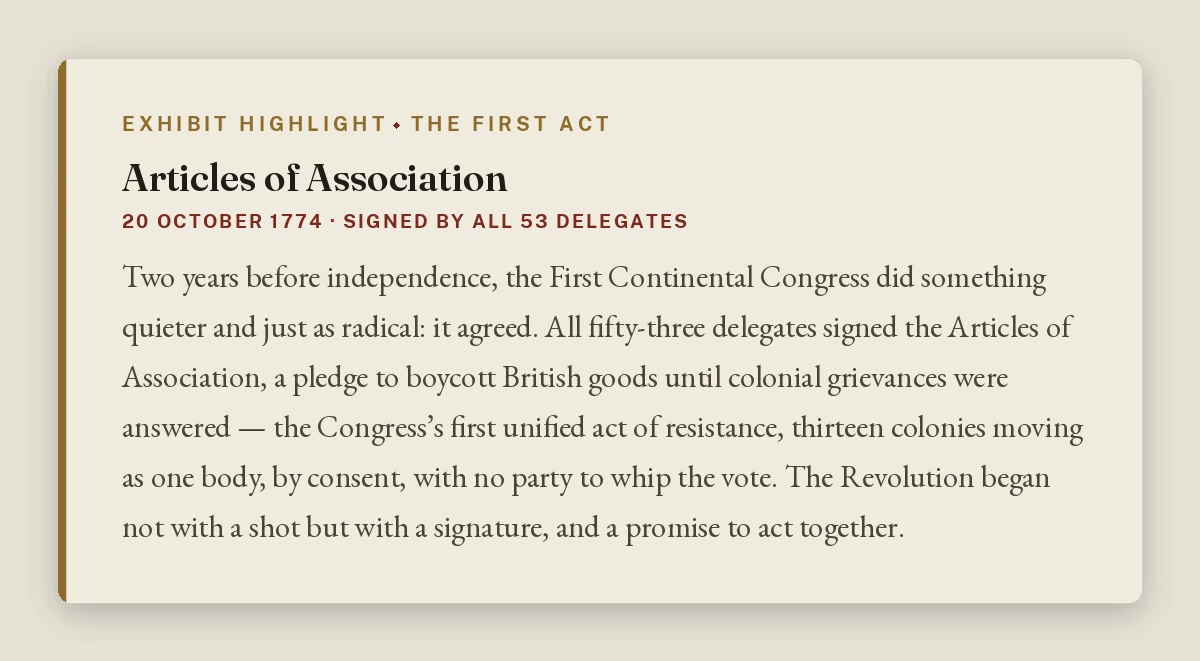
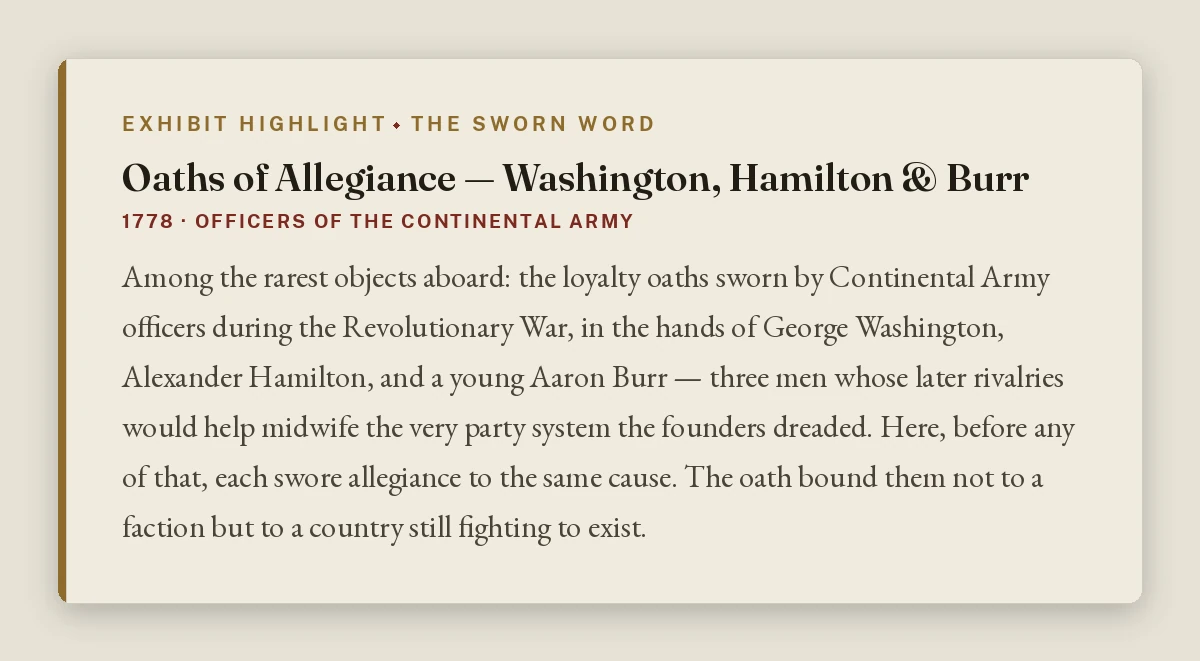
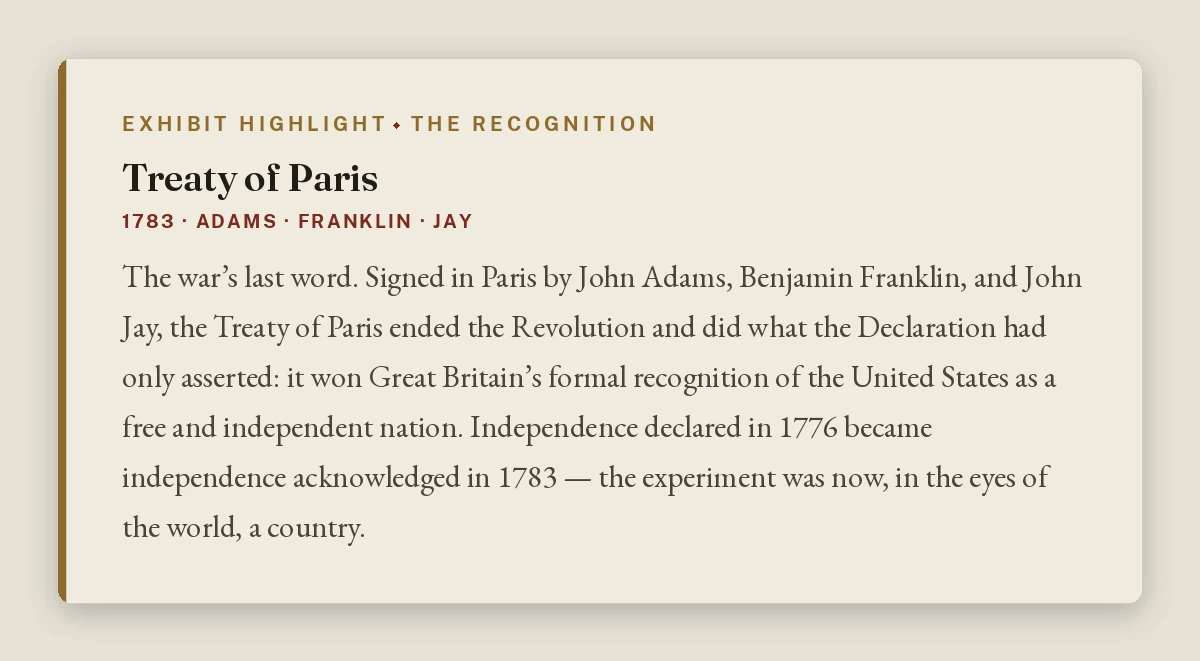
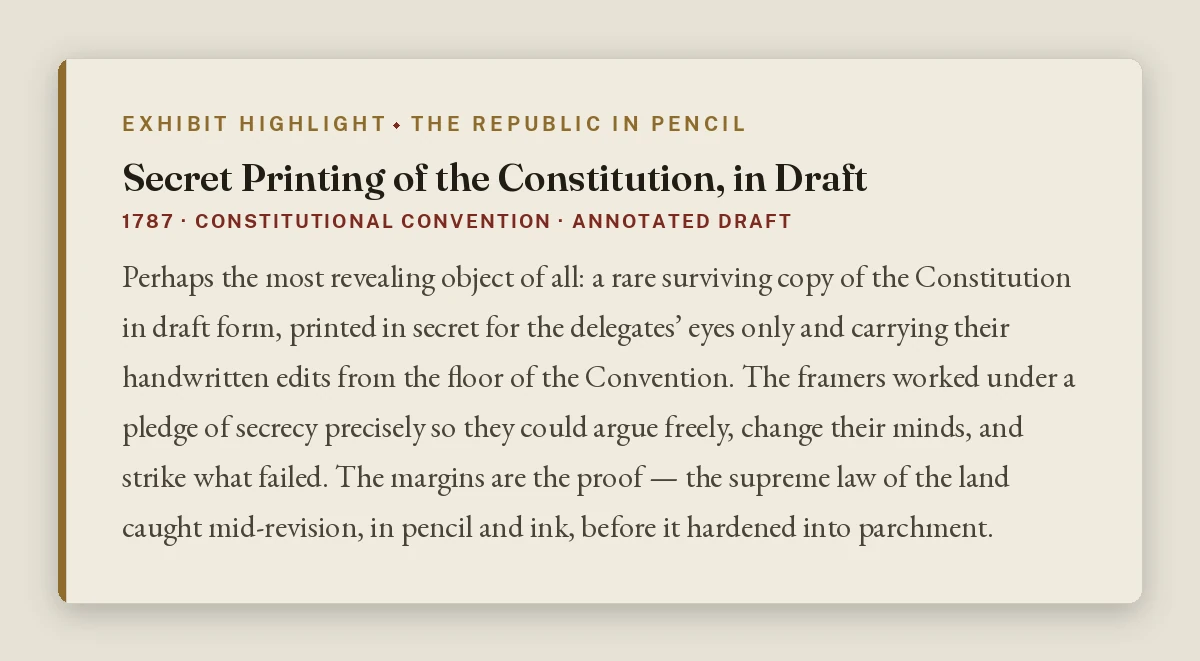
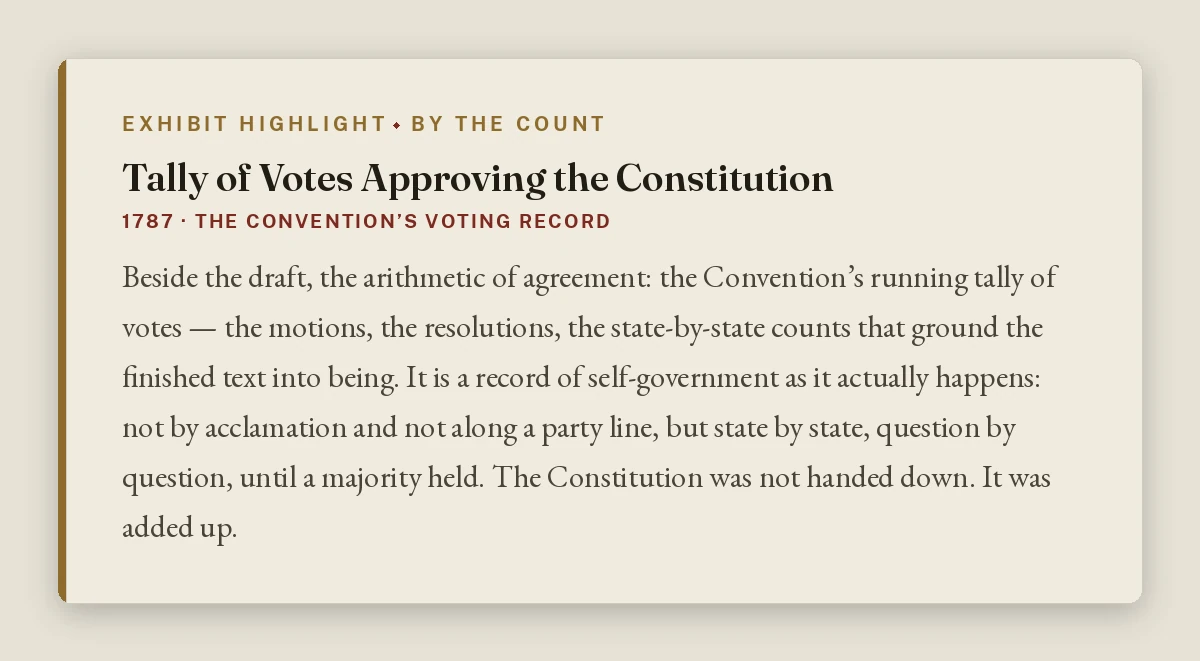
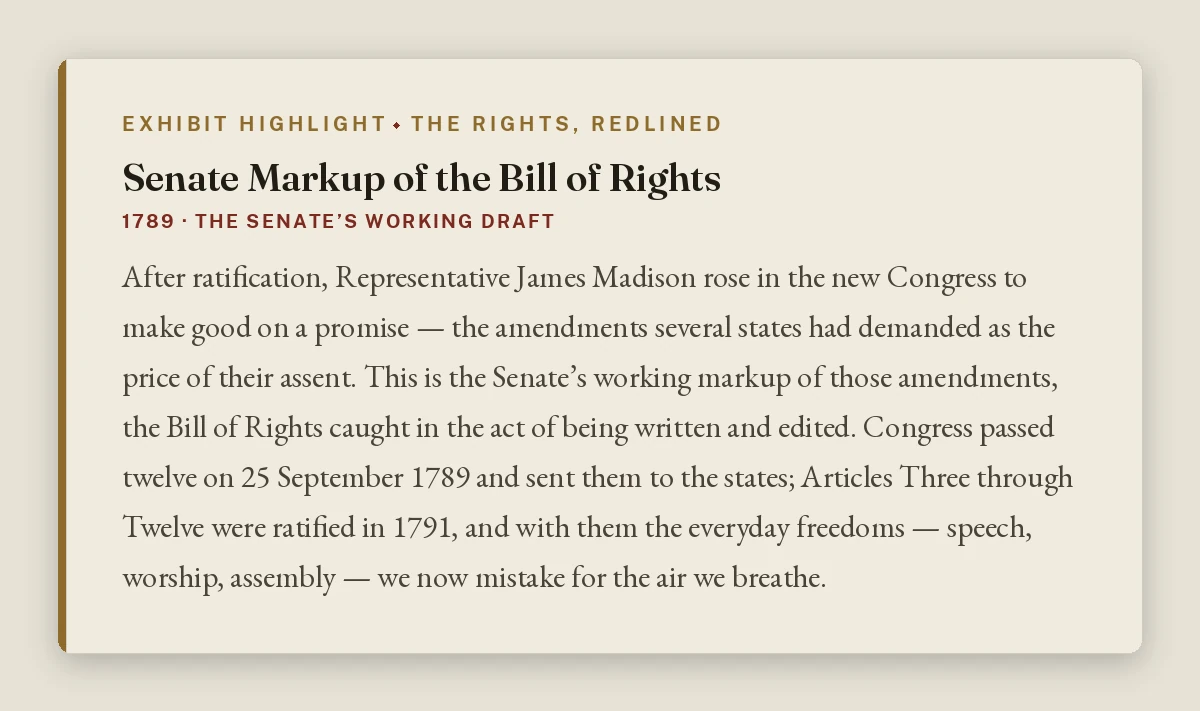
Look hard at all of it — the resolutions, the tallies, the secret draft caught in pencil, the oaths in three famous hands. It is among the most strenuous self-government in human history, and nowhere in any of it is there a political party. And that absence is no accident.
The Unwritten Party
Walk the manifest end to end and a pattern surfaces. Where the founders speak of power, they speak of dividing it. Where they speak of faction, they speak of fearing it. And where you look for the machinery of party — the apparatus that now organizes nearly every act of American political life — there is nothing. A silence the length of the republic.
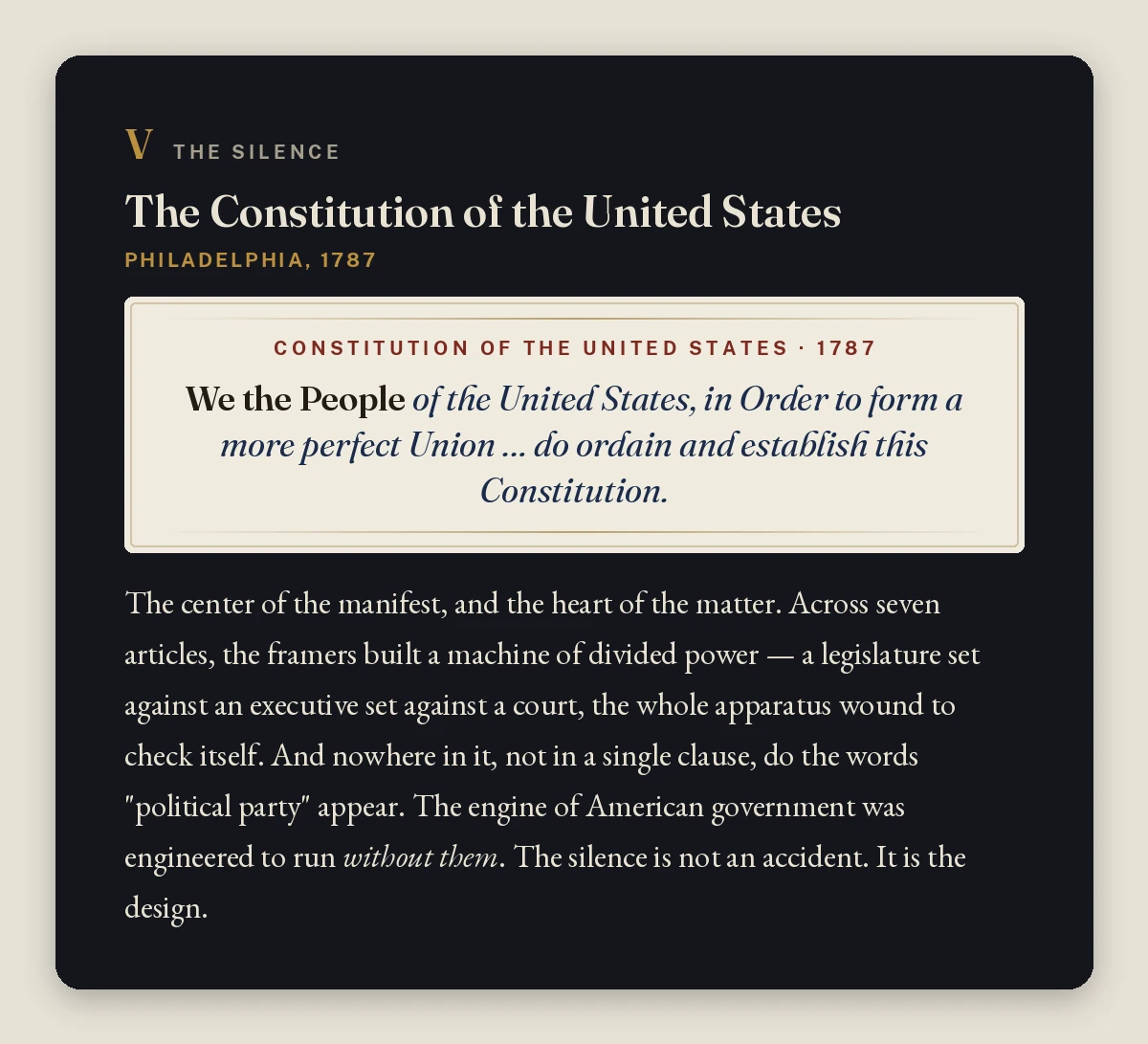
It was not naïveté. The men who designed the United States had read their history, and history told them what factions did to republics: they devoured them. They had also just spent a generation watching it up close. The party politics of the British court — the cabals and “connexions” clustered around the Crown, the patronage and placemen, the corruption that ministerial faction bred — was, to the American revolutionary, not democracy but disease. It was the Old World’s sickness. Party was a relic of the very court they had crossed an ocean and fought a war to be free of. To carry it into the new republic would be to smuggle the contagion aboard the ark.
So they warned. Not one of them, but nearly all.
“There is nothing which I dread so much as a division of the republic into two great parties, each arranged under its leader...”
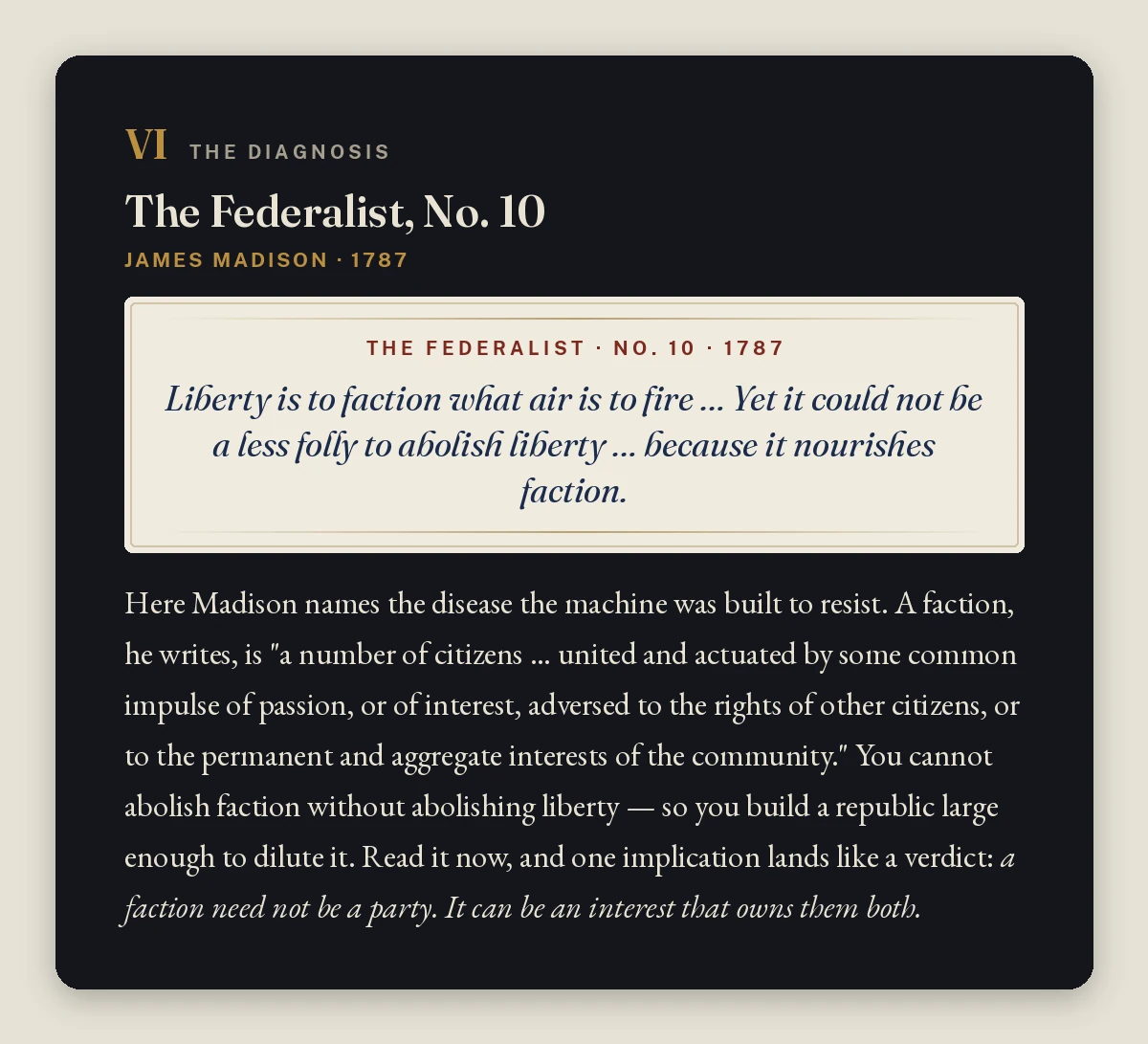
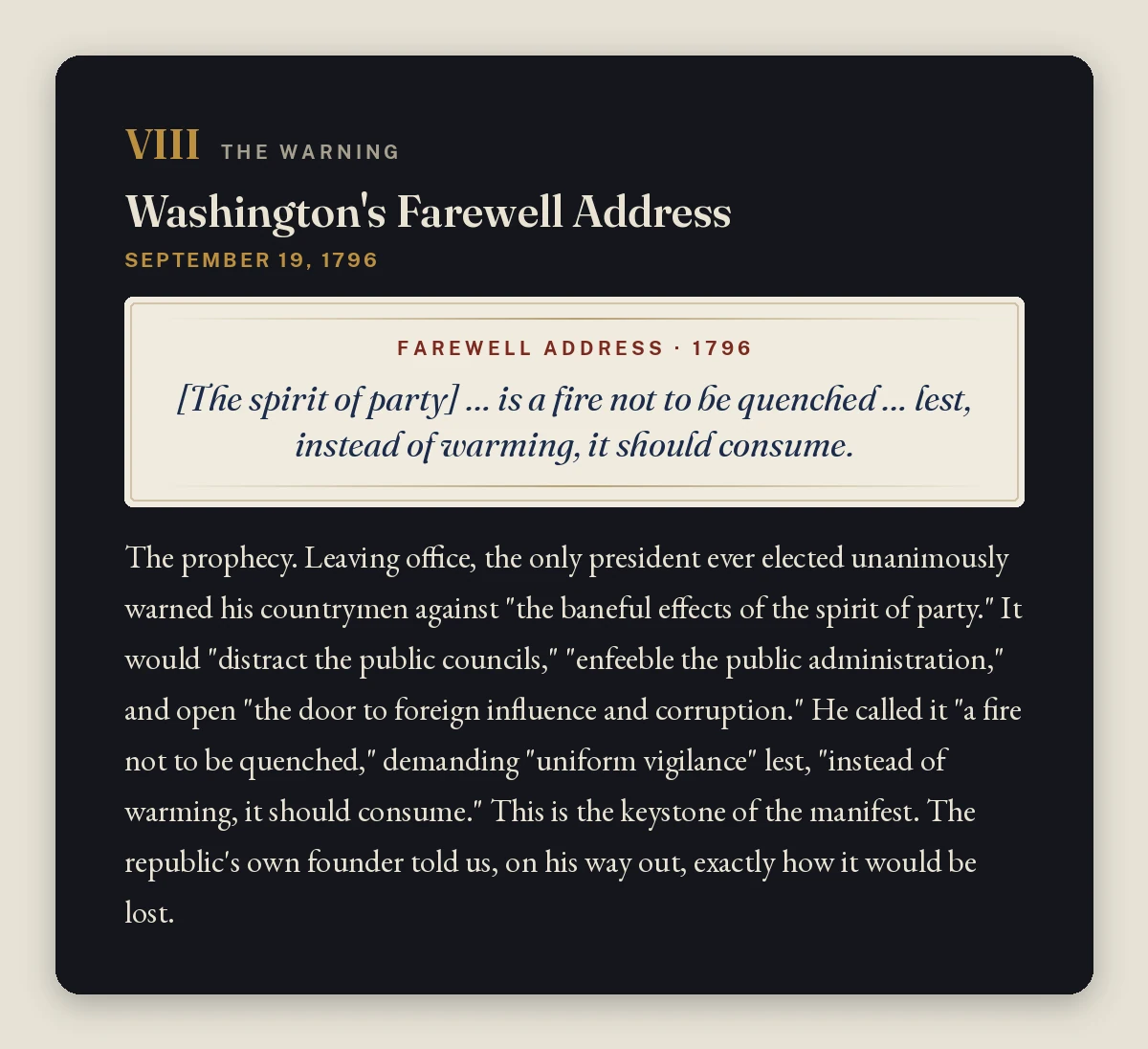
Adams named the dread plainly: a division of the republic into two great parties "concerting measures in opposition to each other," he wrote, "is to be dreaded as the greatest political evil." Madison built an entire constitutional theory around containing faction. Hamilton warned of the demagogue who rides it to power. And Washington, with more authority than any of them, made the warning his parting gift to the country he had midwifed.
Then they did the very thing they had warned against. Within a decade — Hamilton's Federalists against Jefferson and Madison's Republicans — the founders themselves split into the first two parties, and the binary they dreaded was born in their own hands. By 1800 it was total. Even Jefferson, who had helped build a party to win, stood at his first inaugural and tried to wish it away: "We are all Republicans, we are all Federalists." He knew. They all knew. And it happened anyway.
How We Fell
That is the oldest American story, older than the parties themselves: we are warned, and we proceed.
Two hundred and twenty-five years later, the two-party reflex is so total that we mistake it for the thing itself. We say “democracy” and picture a choice between two. We sort ourselves, brand ourselves, and inherit our opinions in bulk — red or blue — as though the founders had written the duopoly into the documents now flying overhead. They wrote the opposite. The binary is not the constitution of the republic. It is the relic they told us to leave at the dock, picked up again, and worn now like a birthright.
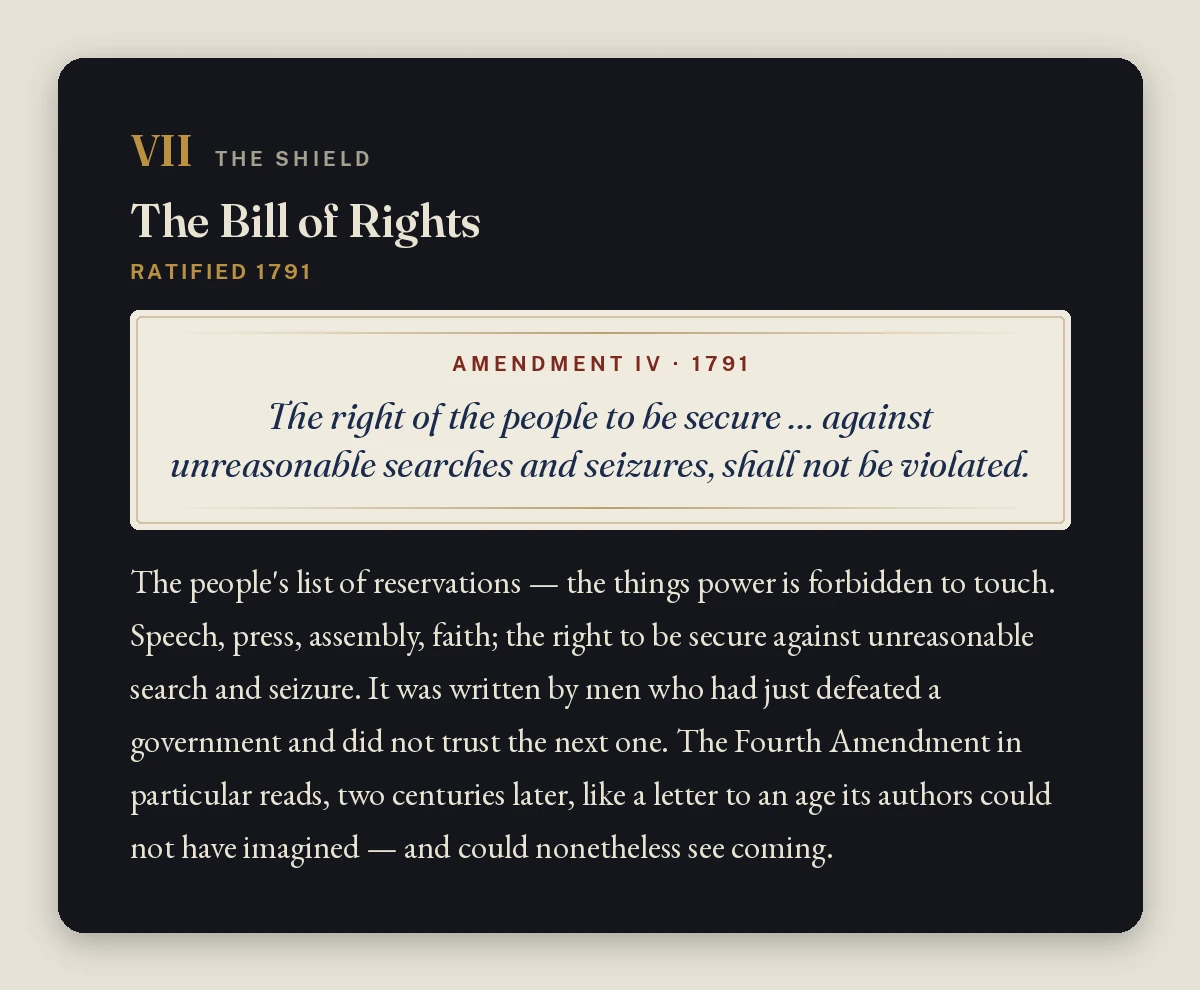
Before we carry the warning into our own century, set two of the founders’ papers side by side — the wall they built around the citizen, and the alarm they left ringing on their way out the door.
The Capture
And here the warning turns from history into the present tense.
Look past the daily theater — the two parties locked in furious, televised combat over the culture — and watch instead where they agree. On the architecture of power, the consensus is nearly seamless. Perpetual military engagement and an ever-rising defense budget: bipartisan. The mass-surveillance apparatus stood up after September 11 and renewed, administration after administration, by majorities of both parties: bipartisan. Bailouts for the largest institutions when they fail; subsidy and forbearance for the largest firms; the steady financialization of American life: bipartisan. The performance is red against blue. The governance is something else.
Call it what it is becoming: a Uniparty — not a formal merger but a convergence, two brands of a single establishment that quarrels loudly about everything except the distribution of real power, on which it is quietly agreed.
And behind it, fused to it, a newer power the founders had no word for. A handful of technology firms now hold what no faction in Madison’s imagination could: the surveillance of an entire population, the infrastructure on which the state itself runs, the private governance of speech and information, and the compute on which the coming age of machine intelligence will be built. The line between these firms and the government that is meant to regulate them has worn through — a revolving door, a shared appetite for data, a security state that cannot function without the platforms and platforms that profit from the state. When corporate power and state power merge and turn their joined instruments on the public, older writers had a blunt name for the arrangement. Add the machine, and you have the shape of the thing: a technofascism — soft-handed and frictionless, governing through convenience rather than force.
This is not a red problem or a blue problem. It is exactly the danger Madison described and could not quite picture: a faction that is neitherparty, because it has captured both. “A common impulse of interest,” he wrote, “adversed to the rights of other citizens, and to the permanent and aggregate interests of the community.” He thought he was describing a mob, or a moneyed clique. He was also, without knowing it, describing a cartel of platforms and the political class that serves it.
“… potent engines, by which cunning, ambitious, and unprincipled men will be enabled to subvert the power of the people …”
GEORGE WASHINGTON, FAREWELL ADDRESS, 1796
The American Experiment was always a single wager: that a people could govern themselves without a master. Capture is the way that wager is lost — not with a coup, but with a slow transfer of the decisions that matter from the ballot to the boardroom, until self-government becomes a costume worn over an arrangement no one voted for. That is the threat to the experiment, and it is not hypothetical, and it does not announce itself. It asks only that we keep watching the theater and never read the manifest.
The Obvious Objection
The honest objection deserves a hearing, because it is strong.
Parties are not merely relics; they are load-bearing. In a continental republic of hundreds of millions, parties are how ordinary people combine into something powerful enough to hold the powerful to account. They organize participation, structure choice, and build the coalitions without which a citizen is just a single voice shouting at a marble building. “Democracy,” the political scientist E. E. Schattschneider wrote, “is unthinkable save in terms of parties.” And the Uniparty frame carries a real failure of its own: it can flatten differences that are not small at all — on rights, on the courts, on who is protected and who is left exposed — into a cynical sameness. Taken to the end, that cynicism dissolves the very participation self-government depends on. If everything is captured, why vote? That conclusion is itself a kind of capture.
All true. But notice what the objection concedes, and what it does not. It does not deny the convergence; it asks us to weigh it against real and remaining differences. Fair. The answer is that both things hold at once — the differences are genuine, and they are bounded, and the consensus is firmest precisely where concentrated power has the most at stake. The point was never that the parties are identical. It is that we have let the most consequential decisions drift beyond the reach of either party’s voters, and then mistaken the loud fight over what remains for the whole of our self-government.
The cure is not nihilism. The founders gave it a name: vigilance. Not the abandonment of the ballot, but its enlargement — a citizenry awake enough to see the faction that hides behind both parties, and to refuse it. The opposite of capture is not despair. It is attention.
Read Them Again
Which is why the manifest matters, and why it should be more than a postcard from a runway.
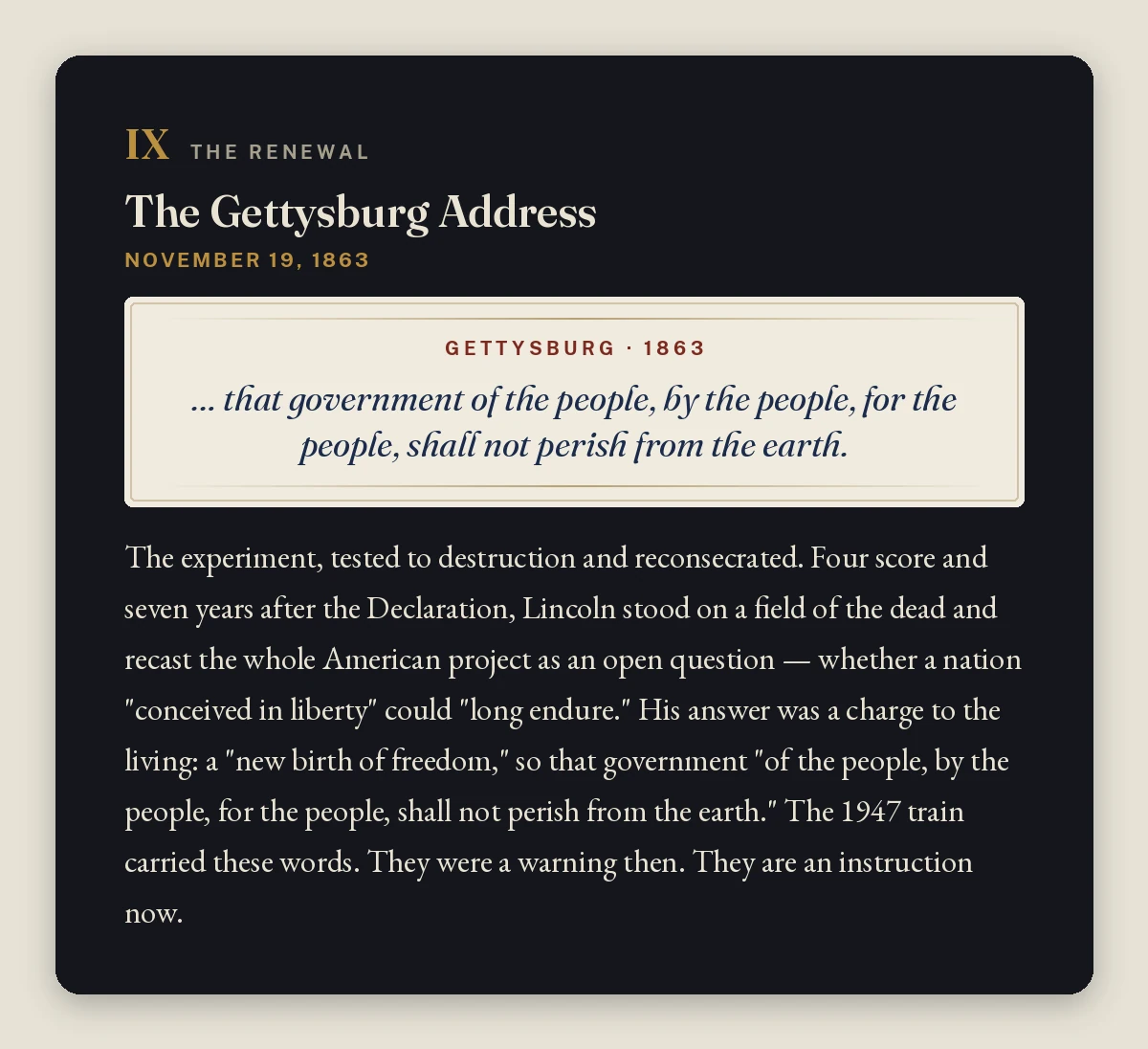
Go and look at the documents this week — on the Freedom Plane, in the Archives, in a printout taped to a kitchen wall. But do not look the way we look at relics, with the soft reverence we reserve for things safely dead. Look at them the way you would read a letter addressed to you, because that is what they are. The Constitution’s silence on party is advice. The Bill of Rights’ fourth article is a warning we are presently ignoring. Washington’s Farewell is not a benediction. It is an alarm, still ringing, that we have learned to sleep through.
The plane is the right symbol, for a reason its organizers may not have intended. These papers were meant to fly above party — above the faction the founders feared, above the cabal they could not foresee. For two hundred and fifty years they have stayed up there, higher than our quarrels, waiting for us to look up.
So look up. The fire Washington warned of is not to be quenched; it demands, he said, a uniform vigilance, lest instead of warming it consume. The documents are in the air. The question they carry is the one they have always carried, and it has never been more pointed than this Fourth of July: whether a free people, having been warned, will once again proceed — or whether, this time, they will read the manifest, and govern themselves.
The experiment is not finished. It is being tested. It always is. That is the only condition under which freedom has ever existed.
Citizens Rule Book: A Palladium of Liberty (Hardcopies) 🇺🇸
⬩ NOW, YOU ⬩
I wrote this as a concerned citizen, not a pundit, and for a single reason: to direct you to the documents. Everything here rests on them. The founders built a republic and warned us, in plain words, to keep the spirit of party from consuming it. We forgot the warning. But the cure they named was never despair, and never a shinier party — it was vigilance: a people awake enough to see the faction hiding behind the noise, and clear enough to refuse it.
That work is now yours. Read the charters for yourself — they are public, they are free, and they are reprinted right here. Reach your own verdict, not the one a party hands you. Hold power to the founders’ standard, whoever holds it. The experiment was never finished and it was never safe; it survives only in the hands of people willing to pay attention. Be one of them.
Keywords
First published June 30, 2026. Originally published in Liberty or Deathwire.