
The Forgotten Science of Electricity-Free Cooling
Three Hundred Years Later, Salt Is Cooling the Future Again
In this essay
Author’s Note: We have mistaken comfort for progress, and dependence for sophistication. We press a button and call it mastery, though we could not mend the machine, name its parts, or last a single week without it. Whoever cannot make cold, or keep his food, or light his own dark is no busier than his grandfather was — but he is markedly less free. He has traded a hundred small competencies for one great reliance; and reliance, however pleasant, is the first quiet step toward servitude.
Let no one mistake this for a quarrel with the engine or the wire. Keep what works. But do not be so dazzled by the new that you burn the ladder you climbed up on. The knowledge in these pages — salt and ice, brine and stone, the plain honest physics of drawing heat out of the world — is no relic to be admired behind glass. It is a birthright. It cost those before us centuries of labor to win, and it costs us nothing but curiosity to keep.
So learn the old arts — not out of fear, but out of dignity. Try the experiment. Pack the ice with salt. Read the disused patent, raise the forgotten roof, revive the abandoned method, and then teach it to a child. Every skill you reclaim is a small republic restored within your own four walls — a measure of your sovereignty taken back from a world that has grown fat on our helplessness.
The hand that can provide for itself bows to no one. Let us be, once again, a people who know how things are done.
With Eternal Vigilance,
Andrew B. Raupp ✍️
Citizens Rule Book: A Palladium of Liberty (Download) #Infowars 🇺🇸
For three centuries, a pinch of an ordinary mineral was the only way human beings could reach into the world and pull the heat out of it. We built machines to replace it — but the old chemistry never left, and today it is quietly returning to the cutting edge.
Every winter, somewhere along a freeway in a cold country, a truck lays down a glittering line of salt to melt the ice. The chemistry is simple and the goal is warmth: dissolve the ice, clear the road, keep the world moving. Salt, here, is a thawing agent. It unmakes cold.
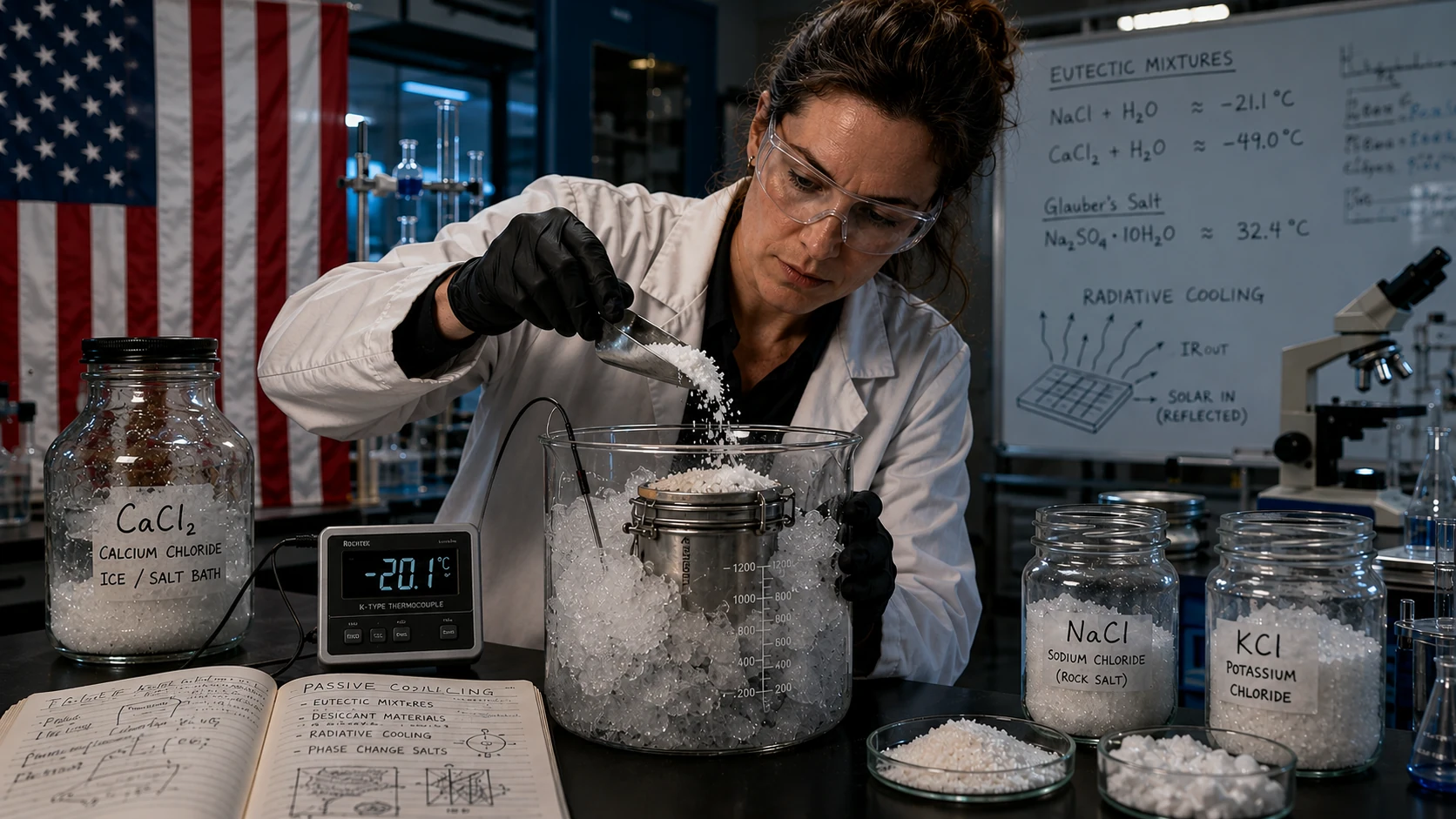
Take that same salt indoors. Pack it into a bucket of crushed ice, plunge in a sealed canister of sweetened cream, and turn the crank. Within minutes the bucket drops to twenty degrees below freezing — cold enough to scorch bare skin, cold enough to set custard into ice cream. Same mineral. Opposite-seeming magic.
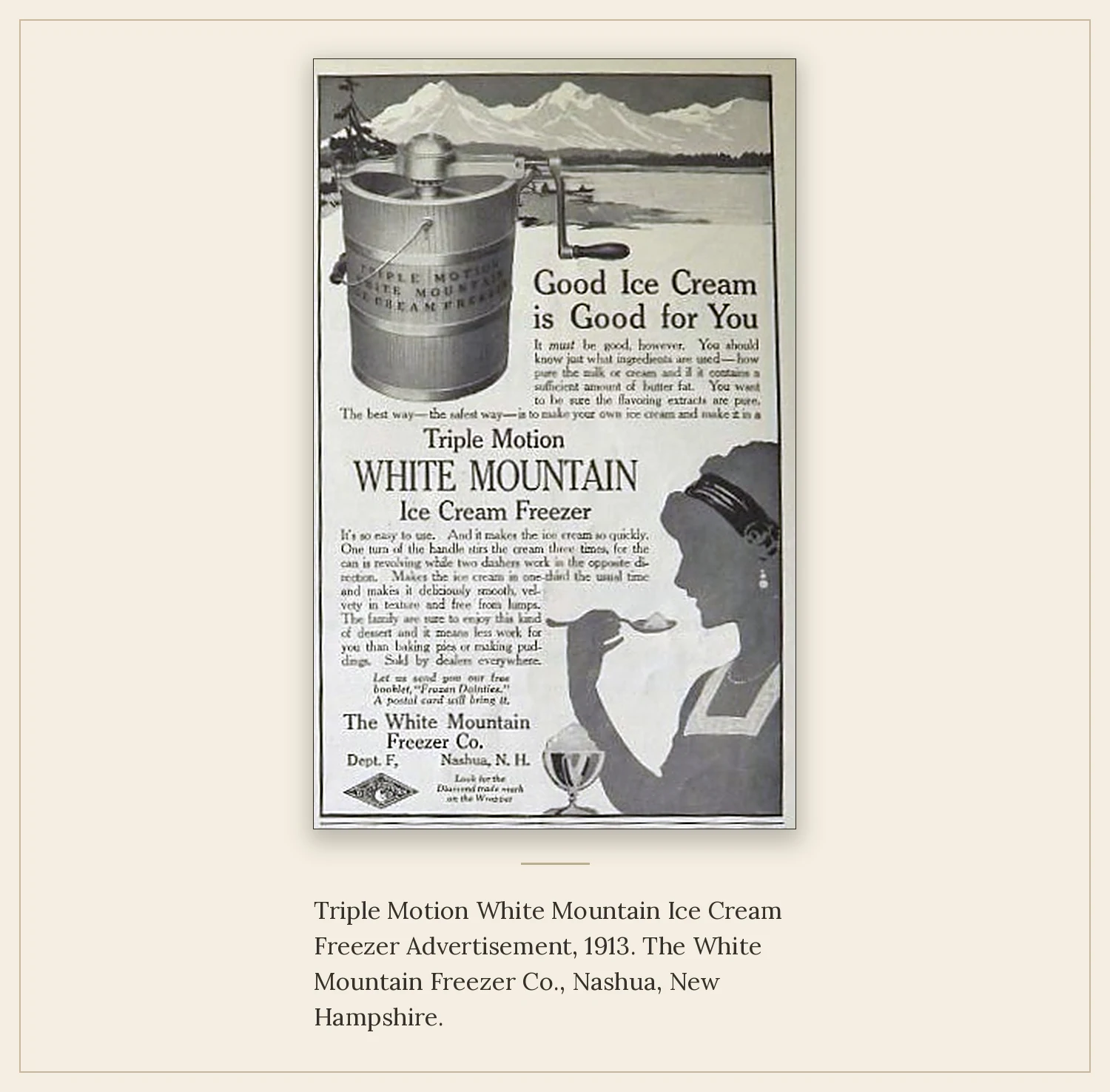
That paradox is not a trick. It is one of the oldest and most useful pieces of practical chemistry our species ever stumbled into, and for roughly three hundred years it was load-bearing. Before the compressor and the coil, before the hum behind the kitchen wall, salt and ice were how the modern world learned to be cold. The knowledge built industries, fed cities, calibrated the first reliable thermometers, and put frozen dessert on a king’s table. Then mechanical refrigeration arrived and took the work over so completely that we now keep salt in a shaker and think of it as a thing that makes food taste better.
That is the story most people know. It is also only half of one — because the passive, salt-driven way of making cold never actually died. It went quiet, moved to the margins, and kept getting better. Today it is back at the frontier.
The heat thief
To understand why salt makes cold, start with what cold actually is. There is no such thing as cold the way there is such a thing as heat. Cold is an absence — the simple fact of heat having left. To chill something, you do not add coldness to it. You take its warmth away and carry that warmth somewhere else.
Pure ice will hold the line at thirty-two degrees Fahrenheit. As it melts, it absorbs heat from whatever touches it, which is why a glass of iced tea sweats and cools. But the melting stops the descent. Ice in a bucket cannot pull the air around it much below freezing, because the moment liquid water forms it warms back toward thirty-two and the system reaches a truce.
Salt breaks the truce. Sprinkle it onto ice and it dissolves into the thin film of meltwater on every crystal’s surface, and a dissolved solute lowers the temperature at which water can freeze. Suddenly the ice finds itself above its new, depressed melting point, so it keeps melting — and melting absorbs heat. The salt forces the ice to go on stealing warmth from its surroundings long past the point where plain ice would have quit. With ordinary table salt the bath bottoms out near twenty-one degrees below zero Celsius — about six below zero Fahrenheit — a hard floor chemists call the eutectic point. Swap in a hungrier salt like calcium chloride, the same compound spread on the iciest winter roads, and the mixture can plunge toward forty or fifty below.
It is the same physics on the highway and in the ice cream bucket. The difference is only what sits nearby to be robbed. On a road, the salt depresses the freezing point so that ice melts away at temperatures that would otherwise keep it solid; the warmth comes from the asphalt and the air, and the result is a clear lane. In a sealed bucket, the warmth comes from the cream — and the result is dessert. Salt does not choose. It simply opens a door that heat is always, everywhere, trying to walk through, and the heat obliges.
Making cold on demand
For most of human history, cold was something you found, not something you made. You hauled blocks from frozen lakes in January and buried them in straw, praying they would last to August. You stored snow in stone pits. Cold was seasonal, geographic, and stubbornly tied to luck.
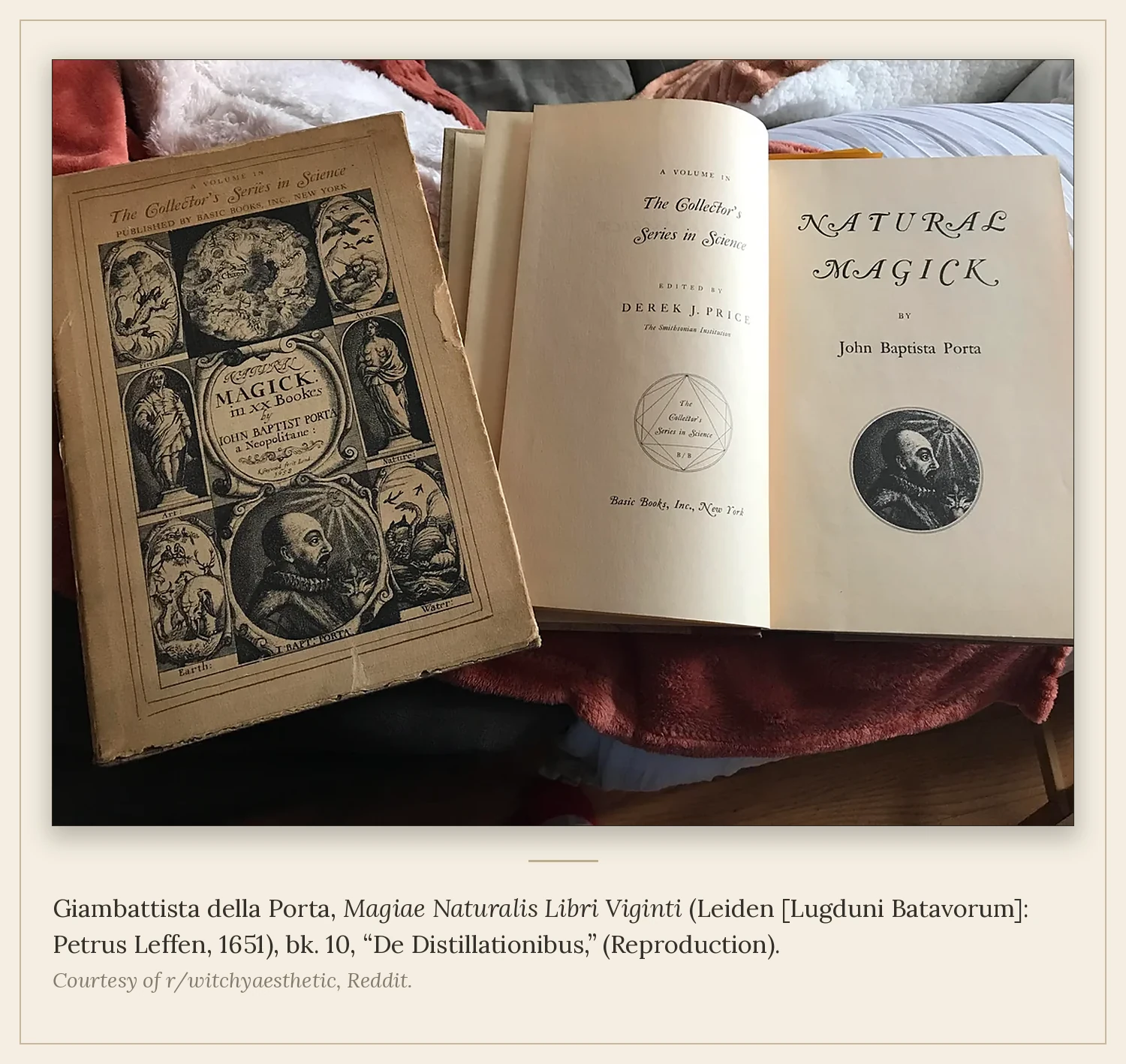
The salt trick changed the proposition entirely. In 1558 a Neapolitan polymath named Giambattista della Porta published Magia Naturalis — Natural Magick — and described how to chill wine to a slush in high summer by burying a flask in snow that had been strewn with saltpeter. It read like a parlor stunt: a chemist’s party trick, performed for amused aristocrats. But buried in the spectacle was a genuinely new power. For the first time, a person could conjure a temperature far below freezing whenever they pleased, indoors, in any season, from a handful of cheap minerals and a little ice.
By the late seventeenth century that power had a delicious application. Confectioners discovered that a metal pot of cream and sugar, nestled in a churn of salted ice and agitated by hand, would freeze into something smooth and astonishing. Ice cream was, in a real sense, a chemistry experiment that happened to be edible. The early recipes betray how new the secret still was: one of the first written in English, set down in the 1660s by the wife of an English ambassador, lays out the cream and the flavorings in loving detail and then forgets the single step that makes the whole thing work — the salt in the ice. It would not have frozen. By 1843 a New England woman named Nancy Johnson had patented the hand-cranked freezer, an inner canister turning inside an outer bucket of salt and ice, and the dessert escaped the palace for the parlor.
The same salt-and-ice bath did quieter, more consequential work too. When Daniel Fahrenheit set out to build a temperature scale that anyone could reproduce, he needed a fixed, repeatable cold point — and he found it in a slurry of ice, water, and salt, which holds doggedly at one temperature no matter how you stir it. He called that point zero. Every fever measured, every oven set, every weather report read for the next three centuries inherited its starting line from a bucket of brine.
The salted icehouse
Here the popular story of salt and cold tends to overreach, and it is worth being precise, because the truth is more interesting than the legend.
The nineteenth century ran on natural ice. A Boston merchant named Frederic Tudor — mocked in the local papers as a man shipping frozen pond water to the tropics, in a venture they hoped would not prove too slippery a speculation — spent years and several fortunes proving the world wanted cold. In 1806 his first cargo of New England ice crossed to Martinique. Much of it melted; almost all of his early shipments lost money; he landed in debtors’ prison twice. But he was right. Within decades the New England ice trade reached Havana, New Orleans, London, and Calcutta, and in the years before the Civil War American ships carried more tonnage of ice than of any commodity but cotton.
It is often said this empire was built on salt. It was not. It was built on sawdust. Tudor’s breakthrough was insulation — packing the blocks in the waste shavings of New England’s lumber mills, free for the hauling, which slowed melting far better than hay or straw. Icehouses were lined with sawdust, peat, charcoal, cork, even felted cattle hair. Salt had no role in keeping the great blocks frozen on their journeys south. The thing we most associate with cold was, in the era of natural ice, almost beside the point. Almost. Because salt’s true industrial throne was elsewhere, and it was a throne worth having.
The brine cars
The problem with plain ice is the floor it cannot break. A boxcar packed with ice will not fall much below the high thirties Fahrenheit — perfect for lettuce, butter, and milk, which only need to stay cool, but useless for meat, which needs to stay frozen. And meat was where the money was.
In the years after the Civil War, Chicago’s packing houses dreamed of shipping dressed beef — slaughtered, cut, and chilled — instead of driving live cattle east to be killed near the table. The economics were overwhelming if the meat could survive the trip. It could not, until the salt trick scaled up. Engineers built railcars with ice bunkers at each end, and into those bunkers they shoveled not just ice but ice and rock salt, the same eutectic chemistry as the ice cream churn, blown to industrial size. The brine bath dragged the car’s interior down toward six below zero, cold enough to carry a side of beef from the Union Stock Yards to the Atlantic coast. Gustavus Swift’s fleet did exactly this; so did Armour and Hammond. A national appetite reorganized itself around it. Chicago became the slaughterhouse of America on the strength of crushed ice and salt.
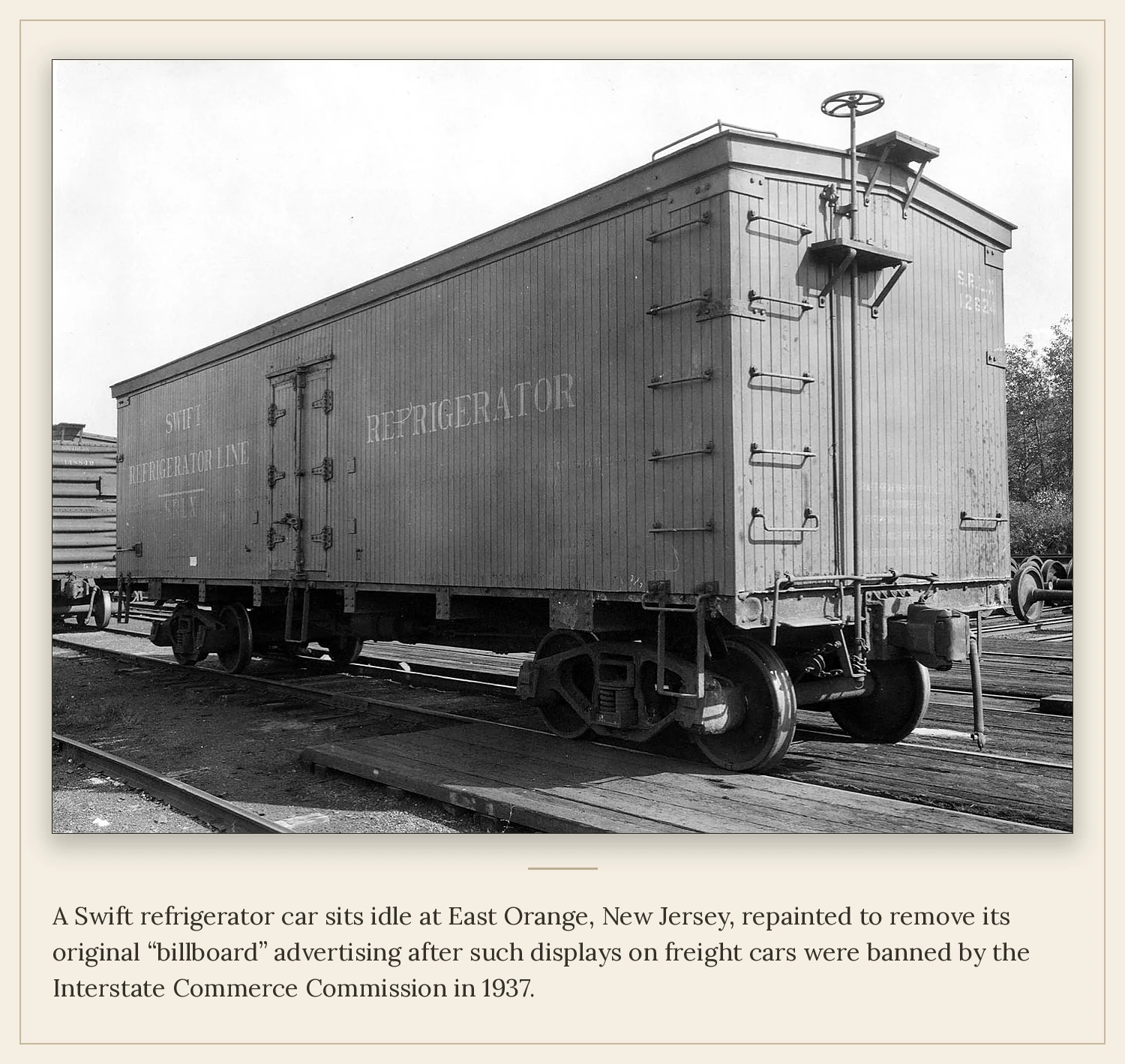
The cost was written in rust. Brine is corrosive in a way pure ice never is, and the salty meltwater dripping from those bunkers ate the steel of the cars, the rails beneath them, and the bridges they crossed. Crews had to scrub the cars between runs; later designs added tanks just to catch the corrosive drip before it could do its damage. Salt gave the meat industry its reach and quietly billed it for the privilege, year after year, in eaten metal.
This is the honest shape of salt’s role in the cold chain. It was not the foundation of everything cold; it was the specialist that handled the hardest job — frozen meat — while produce and dairy rode along on ordinary ice that salt would only have ruined. The legend flatters salt by crediting it with the whole enterprise. The reality is sharper and more useful: salt was the tool you reached for precisely when ice alone was not cold enough.
The elegance we skip past
There is one more place the popular telling goes wrong, and correcting it reveals something lovelier than the error.
It is sometimes claimed that ancient desert peoples made ice with salt, or cooled their air by blowing wind across pools of brine. Neither is quite true, and the second is backwards. The Persians did make ice in the desert — beginning some two and a half thousand years ago, they built tall conical structures called yakhchāls, with deep shaded cellars, high domes to draw hot air up and out, and wind catchers to funnel cool night air down to shallow basins of water. On clear desert nights the water radiated its heat to the open sky and froze, and the ice was sealed below to last through the summer. It was a triumph of passive engineering, and it used fresh water, shade, airflow, and the cold of the night sky. It did not use salt at all — and that radiative trick, water shedding its heat upward into a clear sky, will matter again before this story is done.
Brine, for its part, cannot cool air better than water can; it cools it worse. Evaporation chills because escaping water molecules carry heat away with them, and dissolving salt into water lowers its vapor pressure — it makes the water more reluctant to evaporate, not more eager. Fresh water evaporates faster than salt water in every honest comparison. The great evaporative coolers of the arid world — the wind towers, the wetted screens, the channels of trickling water — worked because the water was clean.
But salt has a different talent for managing moisture, and this one is real: certain salts are hygroscopic — they pull water vapor straight out of the air. A bin of calcium chloride in a damp cellar draws the humidity down and makes a space feel cooler and more livable, not by lowering the temperature but by lowering the moisture, which lets the body’s own sweat do its work. It is the seed of the modern desiccant dehumidifier — and, as it happens, the seed of some of the most advanced passive coolers being built today.
When the cold went indoors
Cooling food was only half the story. The other half was cooling people — and for most of the nineteenth century that meant the same two ingredients: ice to chill the air, and salt to push it colder still.
The most dramatic case arrived in a national emergency. In the summer of 1881, President James Garfield lay dying of an assassin’s bullet in a sweltering Washington bedroom, and Navy engineers were summoned to bring the temperature down. What they built was, in effect, America’s first air conditioner: a coffin-sized iron box packed with cotton screens, topped by a tank of shaved ice, salt, and water that melted into a briny slush and trickled down over the cloth. A fan drew outside air across the wet, salted screens and pushed it through a duct into the room, lowering the sickroom by some twenty degrees. It was crude and ravenous, devouring several tons of ice a day, and it could not save the president. But it worked, and it ran on the same eutectic principle as a hand-cranked churn — two decades before Willis Carrier patented the machine that would eventually make the whole approach look obsolete.
That is the hinge of the story. The compressor was coming, and when it arrived it would win almost everything in sight.
The machines move in
What undoes a body of practice is rarely that it was wrong. It is that something easier arrives. The commercial ice machine appeared in 1854, and mechanical refrigeration spread through the breweries and packing houses over the following decades. Then it climbed into the home. The General Electric Monitor-Top of 1927 became the first home refrigerator to sell in real numbers; barely a tenth of American households owned one in 1930, and more than half did by 1940, a figure that passed eighty percent by the mid-1950s. Air conditioning did to passive comfort what the freezer did to the icehouse. A sealed loop of refrigerant made cold cleanly, quietly, on demand — no melting block to replace, no corrosive brine to scrub, nothing to feed but electricity.

Salt did not lose an argument. It lost a job. The eutectic chemistry that had frozen a king’s dessert, anchored the thermometer’s zero, and carried Chicago’s beef to the sea was, for everyday purposes, set aside.
But “set aside” is not “gone,” and this is exactly where the tidy story of progress gets the history wrong. The passive approaches did not vanish when the compressor took the kitchen. They moved to the margins — into solar-house experiments, off-grid cabins, greenhouse walls, and finally the materials laboratory — and there, out of the mainstream’s sight, they kept evolving.
The line that never broke
The first sign that salt’s cooling life was far from over came from a solar house outside Boston.
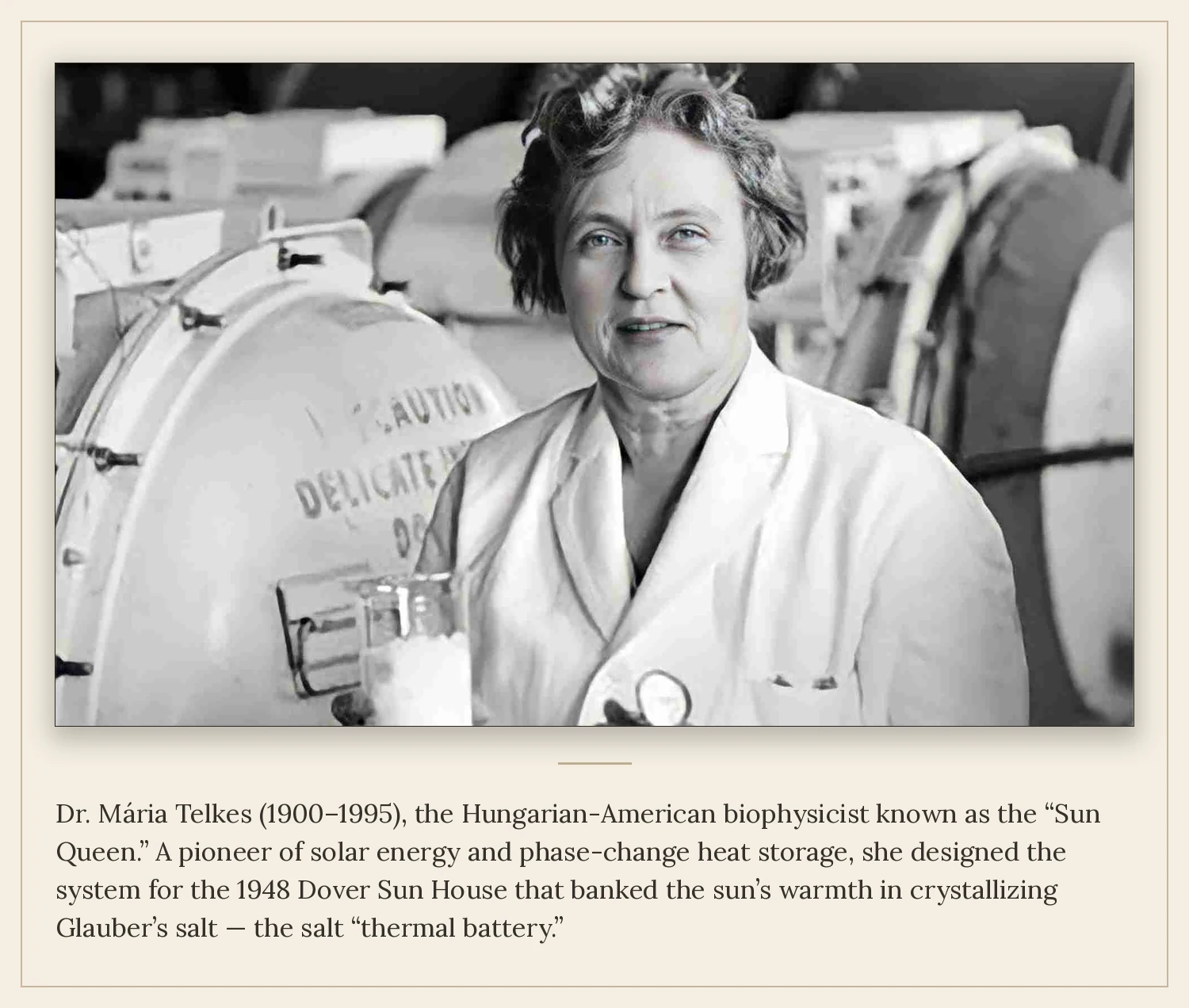
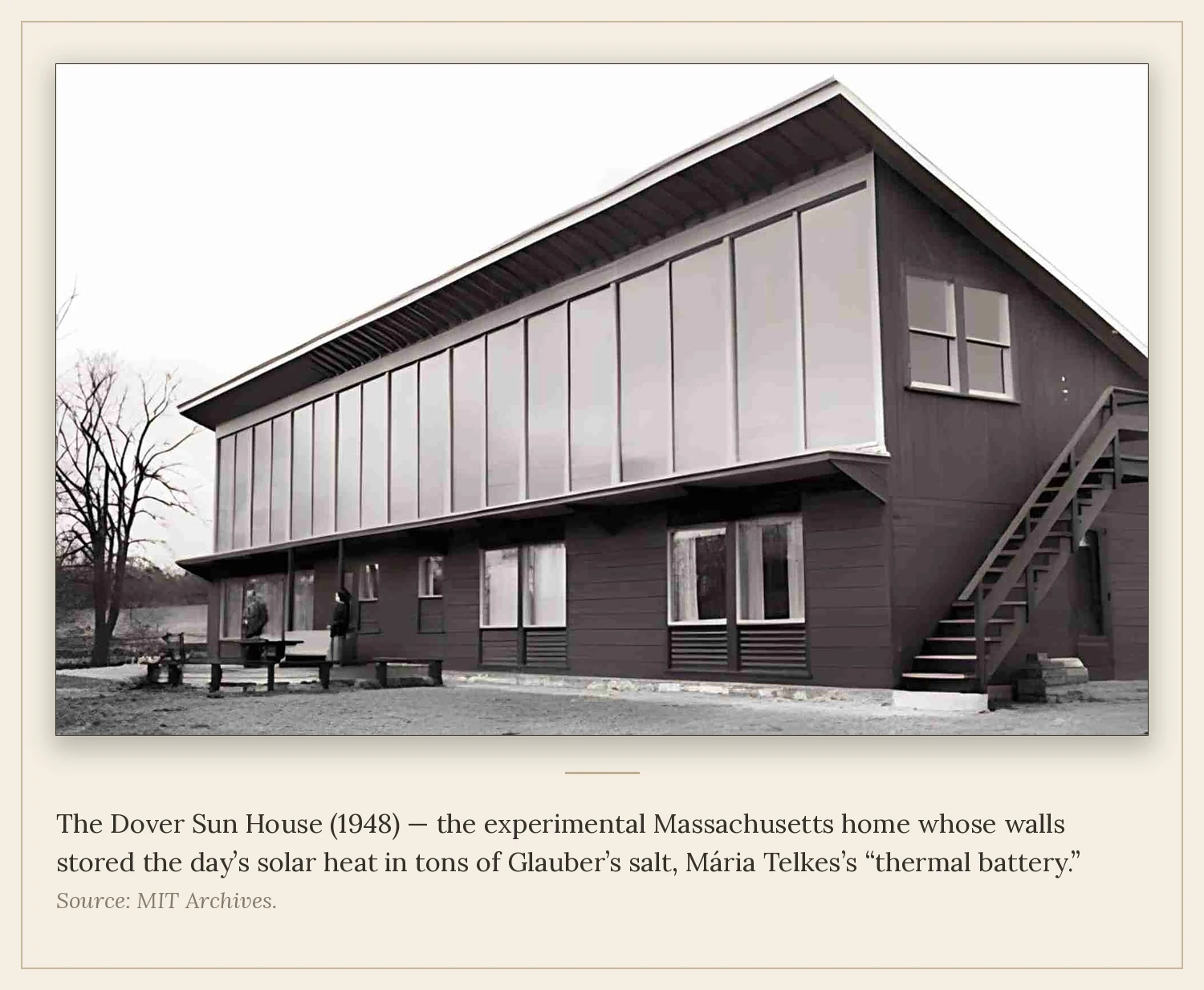
In 1948 the Hungarian-American physicist Maria Telkes — whose phase-change design had already been chosen for MIT’s postwar Solar House II — built an experimental home in Dover, Massachusetts, with twenty-one tons of Glauber’s salt sealed into bins inside the walls. Glauber’s salt, sodium sulfate decahydrate, is a cheap industrial chemical that melts at about ninety degrees Fahrenheit, and in melting it drinks in an enormous amount of heat; when the air cools, it recrystallizes and gives that heat back. The walls of the Dover house worked, in effect, like a thermal battery: charging on sunny days, when the melting salt also drew heat out of the warm rooms, and discharging through cold New England nights, carrying the household through stretches of up to ten sunless days with no furnace at all. The chemistry was sound; the engineering was not yet. After a few winters the salt had stratified and corroded its containers until they leaked, and the system was torn out. But Telkes had proved that a wall full of salt could store and release temperature on its own — and the idea refused to die.
It came back with the price of oil. When the energy crises of the 1970s sent engineers searching for buildings that could heat and cool themselves, the first materials they reached for were hydrated salts — Glauber’s salt again, and calcium chloride hexahydrate — packed into panels and ceiling tiles meant to soak up the heat of the day and release it after dark. These salt-hydrate “phase change materials” promised to flatten the temperature swings inside a building and shave the load on its air conditioner. They were also stubborn, prone to separating and supercooling and eating their containers, and for a time cheaper, better-behaved waxes pushed them aside. The promise outran the chemistry. But it never disappeared.
The chemistry, it turns out, was only waiting for better tools — and the most striking proof is barely two years old. In late 2023, researchers at Lawrence Livermore National Laboratory turned ordinary table salt and potassium chloride into a featherlight foam, freeze-drying the salts into an aerogel-like structure that reflects sunlight while letting the infrared heat of whatever sits beneath it pass straight through and radiate away into the cold of space — the same upward shedding of heat that froze water in Persian deserts, now engineered into a panel. It needs no power and no moving parts. In testing it cooled surfaces by nearly twenty degrees Fahrenheit below the surrounding air, in full sun, and outperformed a leading commercial cooling film. The same mineral Garfield’s engineers shoveled into a coffin-sized box by the ton now does similar work as a sheet thinner than cardboard, drawing its cold not from melting ice but from the night sky overhead.
And the frontier keeps moving. The newest passive coolers fold salt’s two oldest talents — pulling heat and pulling moisture — into a single material. Researchers are now packing hygroscopic salts like calcium chloride and lithium chloride into water-filled gels that cool by evaporation and radiation at once, then drink moisture back out of the night air to refill themselves so they can keep cooling the next day with no water line and no electricity. Glauber’s salt, meanwhile, is back in the laboratory, now being tuned to melt at everyday room temperature so it can shave the afternoon peak off a building’s air conditioning. Seventy-five years after Maria Telkes, the wall full of salt is being rebuilt — this time with the chemistry finally coming under control.
What the chemistry still offers
None of this means the compressor was a mistake. Mechanical refrigeration solved real problems that salt alone never could, and the passive methods still carry real limits: a salt-ice bath bottoms out fast and warms fast, only ever as cold as the ice you keep feeding it; hygroscopic salts saturate and have to be dried out; salt hydrates fight corrosion and supercooling to this day. Anyone who tells you a bag of rock salt can replace a refrigerator is selling something. Honest balance means holding both truths at once: the machines are extraordinary, and they are not the only answer.
What the old chemistry offers is range. At the humblest end, it is survival knowledge — when the power fails and a freezer begins to thaw, a bag of rock salt over a block of ice buys days of grace, and a tub of calcium chloride will quietly dry out a damp cellar with no electricity at all. At the other end, it is a research frontier: salt foams cooling rooftops by radiating heat to space, salt gels harvesting their own water from the night, salt walls storing the warmth of the day. These are not relics. They are the same handful of properties — freezing-point depression, latent heat, and the hunger of certain salts for water — being put back to work by people who never accepted that the question of cold was permanently settled.
We have built a civilization that makes cold so effortlessly we forget it was ever a problem someone had to solve. The hum behind the wall is invisible to us — until the day it goes silent, or the day the power bill, or the planet, makes us reckon again with what cold actually costs.
On that day it is worth remembering that for three hundred years, human beings reached into the warm world and stole its heat with a fistful of the most ordinary mineral on Earth. The machines did not end that story. They only interrupted it.
Citizens Rule Book: A Palladium of Liberty (Hardcopies) 🇺🇸
Keywords
First published June 18, 2026. Originally published in Liberty or Deathwire.