
Private Equity’s Dead Man’s Handshake
How the Registrar Was Bought, the Principle Was Sold, and Customers Were Left to Rescue Their Own Names
In this essay

LIBERTY OR DEATHWIRE! ⬩ INVESTIGATION ⬩ AMERICA 250 SERIES
Handshake promised to remove the gatekeepers from the internet’s root. Then its largest commercial steward changed hands, sold the platform to undisclosed buyers, and left users racing to recover their own names. The protocol was decentralized; the power to abandon it never was.
Citizens Rule Book: A Palladium of Liberty (Download) #Infowars 🇺🇸
On June 10, 2026, Namecheap did not announce a transition. It announced an immobilization. Effective immediately, every Handshake top-level domain on its platform was frozen: no registrations, no renewals, no transfers, and no management. Customers who had purchased names through one of the world’s largest registrars were suddenly unable to exercise the most basic incidents of ownership. Namecheap attributed the shutdown to the wind-down of an “upstream provider,” yet declined to identify that provider.
There was no migration plan. There were no automatic transfers to self-custody. There were no refunds for customers whose purchases had been rendered inaccessible. There was no definitive timetable and no meaningful explanation of what would happen to the names, accounts, and coin balances held within the system. The company offered a paragraph, a status page, and the customary corporate request for patience.
The unnamed provider was Namebase.
Namecheap had owned Namebase for approximately four years. It had promoted the company, integrated its services, and lent the full weight of the Namecheap name to the proposition that Handshake represented a legitimate alternative to the centralized domain-name system. Five months before freezing Handshake services, however, Namecheap sold Namebase to purchasers whose identities remain undisclosed.
The refusal to name Namebase in the June notice was not a trivial omission. It was the final act of severance. By referring vaguely to an “upstream provider,” Namecheap wrote itself out of the history of a platform it had owned, marketed, operated, and then transferred. The customers were left with the consequences, while every responsible party receded into the passive voice.
This is how private equity dismantles an institution without ever appearing to touch it. Each decision is isolated. Each responsibility is subcontracted. Each consequence is described as the work of some upstream party, market condition, migration process, strategic review, or operational necessity. Nobody admits to abandoning the promise because the promise has been divided among so many entities that no single one is forced to answer for its destruction.
The Dates are the Indictment
Every event in this sequence can be supplied with a bloodless corporate explanation. That is precisely why the events must be read together. Private equity rarely announces that it has arrived to strip an enterprise of its institutional commitments. It speaks instead of investment, scale, efficiency, leadership transitions, portfolio discipline, strategic focus, and long-term growth. The truth appears only after the dates are allowed to touch.
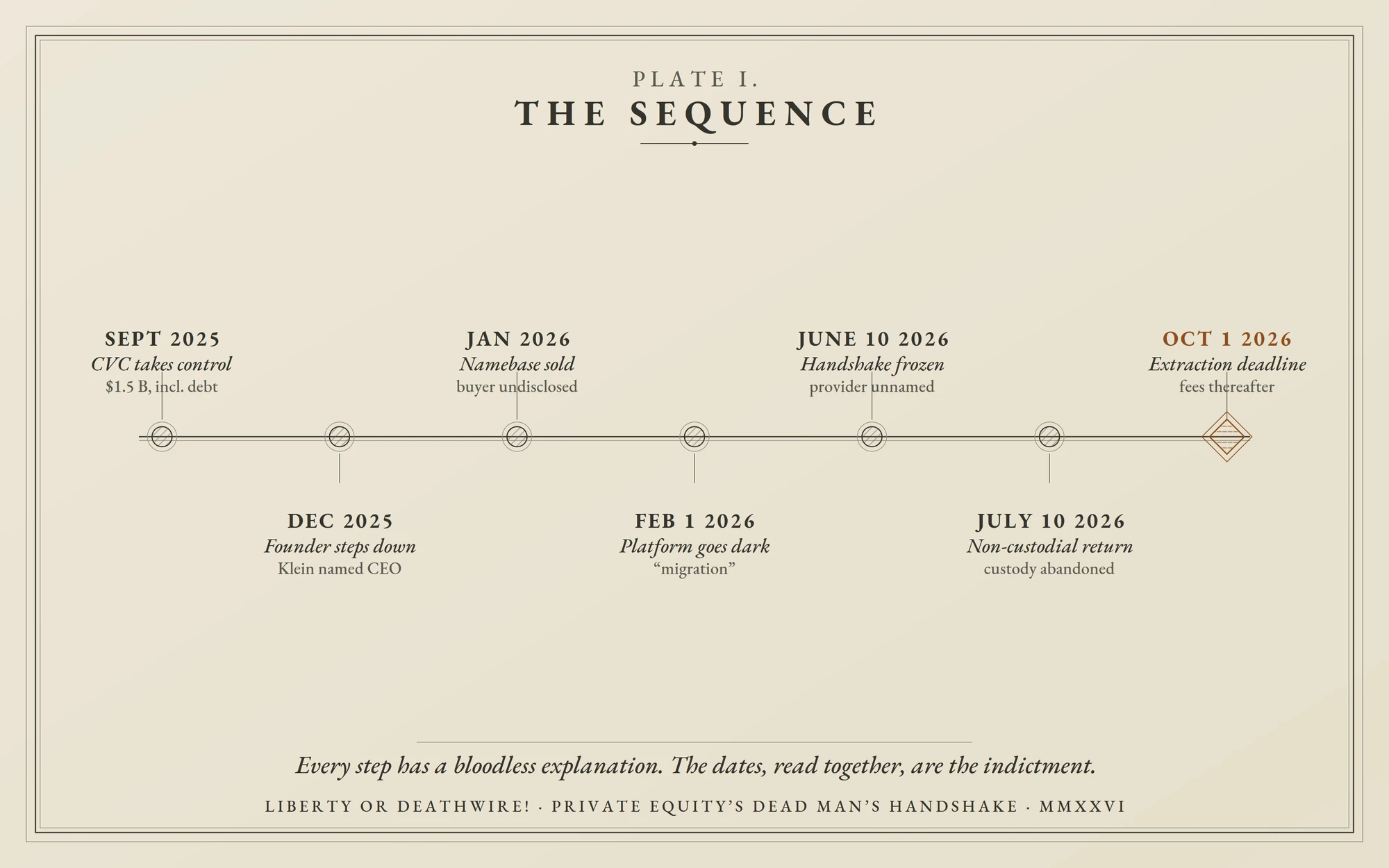
September 2025. The Wall Street Journal reports that CVC Capital Partners is taking a majority position in Namecheap through a transaction valuing the company at approximately $1.5 billion, including debt. Founder Richard Kirkendall retains a significant stake and, according to the contemporary coverage, a key role in the business.
That assurance matters. It is one of the oldest rituals in the buyout business. The founder is said to remain important. The company’s culture is praised. Its independence is celebrated. The buyer expresses admiration for the very principles that made the enterprise valuable. Customers, employees, and partners are encouraged to view the acquisition not as a transfer of control but as the beginning of an even more successful version of the same institution.
CVC is not a passive investor with a modest position and no operational influence. It manages close to €200 billion and also owns WebPros, whose software operates beneath tens of millions of domains and hosting accounts. The Namecheap transaction therefore placed another consequential piece of internet infrastructure within a financial portfolio governed not by the civic obligations of an open internet, but by capital allocation, debt service, margin expansion, and an eventual exit.
December 2025. Kirkendall is no longer chief executive. Hillan Klein replaces him. The founder moves from retaining a “key role” to being removed from the company’s highest operating position within approximately three months.
There is nothing unusual about a private-equity firm replacing leadership after acquiring control. That is the point. What the public is encouraged to view as continuity at closing can become displacement before the ink is dry. The founder’s significance helps preserve confidence while the transaction is being completed. Once control has transferred, the founder’s convictions become optional.
January 2026. Namebase is sold. The purchaser is not disclosed to the public, the press, or the users whose domains and digital assets the platform is holding in custody. The About page continues listing the former team, while the new operators announce that the exchange has been closed and outstanding orders cancelled.
This was not merely the sale of software. It was the transfer of a custodial relationship. Customers had entrusted domains, account credentials, and HNS balances to an operation owned by Namecheap. That operation was then transferred to an unidentified buyer without those customers receiving a meaningful opportunity to withdraw beforehand, consent to the new custodian, or even learn who would be controlling the system.
February 1, 2026. Namebase goes offline for what is described as a migration.
June 10, 2026. Namecheap freezes Handshake services across its own platform, citing the wind-down of the unnamed upstream provider it had recently sold.
July 10, 2026. Namebase returns as a non-custodial registry, no longer offering the custodial marketplace on which many customers had relied.
August 2026. A sunset portal appears. Users are told that they have until October 1, 2026, to extract their names and balances. Those who miss the deadline will be sent into a manual recovery process involving additional identity verification, longer processing times, and administrative costs.
The language is administrative, but the arrangement is grotesque. Customers must rescue their property from the remains of a system they did not shut down, following procedures imposed by owners whose identities they were never told, before a deadline they played no role in setting. After that deadline, the same organization that created the emergency may charge them for the labor of resolving it.
That may not satisfy the legal definition of a ransom. It nevertheless resembles a ransom note written by a compliance department: retrieve what is already yours by the appointed date, or prepare to pay for the privilege later.
Private Equity Purchased the Trust and Discarded the Obligation
Namebase was financially insignificant beside a control transaction valued at approximately $1.5 billion. It was not the kind of asset capable of materially changing the return profile of a global buyout fund. It represented something private equity is exceptionally poor at valuing because it cannot be reliably entered into a spreadsheet: a conviction.
Kirkendall had publicly supported the argument that the Internet Corporation for Assigned Names and Numbers held too much authority over the global root zone. Namecheap’s acquisition of Namebase in 2022 placed the company’s reputation and resources behind an alternative. For the following four years, Namecheap’s involvement told customers that Handshake was not merely an obscure cryptographic experiment. A large, established, commercially successful registrar had chosen to stand behind it.
That endorsement was not incidental to the product. It was the product.
Customers did not purchase Handshake names solely because they had evaluated the protocol, reviewed the source code, modeled browser adoption, and independently assessed the long-term viability of HNS. Many participated because Namecheap had placed its name, distribution, and presumed institutional continuity behind the system. The registrar converted its credibility into customer adoption.
Then private equity acquired control.
CVC did not purchase Namecheap because it shared a philosophical objection to centralized internet governance. It acquired a valuable registrar with recurring revenue, established customers, market recognition, and cash flows capable of supporting a leveraged return. Within that structure, Namebase’s original purpose had no independent standing. A decentralized naming experiment with negligible revenue, declining token value, limited adoption, and no obvious contribution to an eventual exit multiple was not a principle to defend. It was a non-core asset to remove.
That is the private-equity trick in its purest form. Trust is treated as a valuable intangible when calculating the purchase price, but as a free resource when the portfolio is being optimized. The goodwill accumulated by a founder helps justify the valuation. The obligations attached to that goodwill disappear the moment they interfere with the return model.
Private equity acquired the benefit of Namecheap’s endorsement without accepting the duty created by that endorsement. It inherited the customers who had relied on the company’s reputation, but it did not treat their reliance as a liability requiring an orderly transition. It monetized the credibility on the way in and externalized the cost of betraying it on the way out.
The customers were not consulted when the commitment was withdrawn. They were not told beforehand that custody would be transferred. They were not informed who would receive control over their accounts and assets. They were not compensated when services were terminated. They were not provided with an automatic migration. They were instead handed the operational burden of unwinding a position they had entered partly because Namecheap had assured the market, through years of conduct, that the platform was worth trusting.
Nobody needs to allege fraud to understand the abuse. No secret conspiracy is required. The transaction did not malfunction. The system performed exactly as designed: the financial sponsor preserved the assets capable of producing a return, discarded the commitments that could not, and pushed the cost of disentanglement onto the least powerful participants.
The customers discovered that they had never been parties to the decisions that governed their property. They had been revenue while the product was useful and administrative residue once it was not.
Custody Was Transferred Without Meaningful Consent
Remove the language of blockchain, decentralized identifiers, alternative roots, and cryptocurrency. Examine only the mechanics.
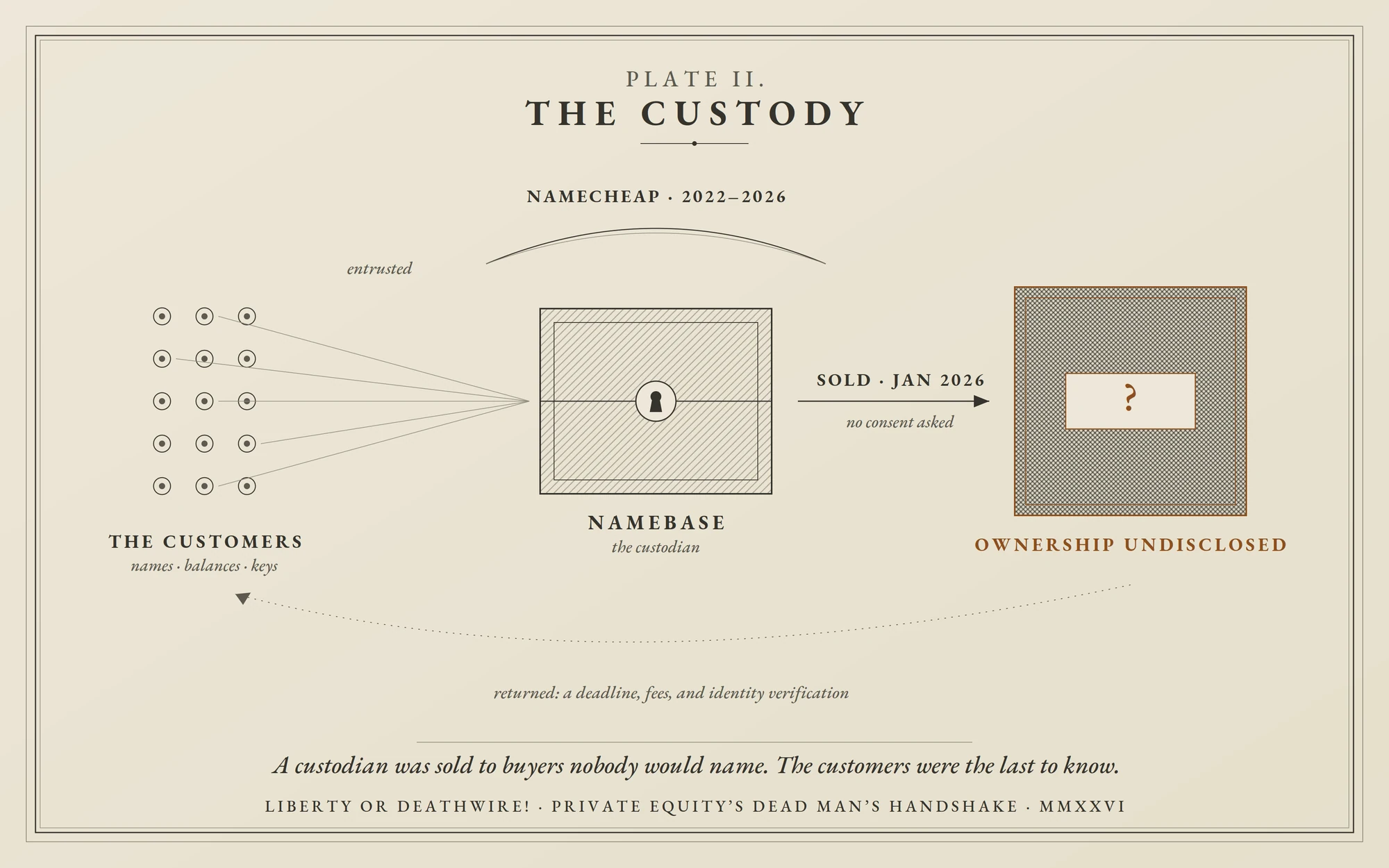
A company held customer property in custody. That company was owned by a recognizable registrar. The registrar sold the custodial operation to an undisclosed purchaser. The customers were not asked for consent. They were not given a meaningful advance opportunity to remove their property. They were not told who the new custodian was. Months later, they were informed that they must complete a time-sensitive withdrawal procedure or face a more burdensome recovery process administered by the same unidentified ownership.
In banking, the transfer of customer accounts is accompanied by extensive disclosures, continuity requirements, regulatory supervision, and records identifying the acquiring institution. In securities, the movement of custodial relationships cannot ordinarily be handled through anonymous ownership and a belated sunset page. Even in more lightly regulated industries, a company entrusted with customer assets is generally expected to identify the entity assuming that responsibility.
Here, opacity was treated as sufficient disclosure.
The domain industry has long benefited from ambiguity over whether a registered name is property, a contractual right, a revocable license, or merely an entry in a privately operated database. Handshake was supposed to answer that uncertainty by placing control in cryptographic keys rather than institutional permission. Yet its most prominent marketplace reproduced the very weakness the project claimed to overcome: users relied on a centralized intermediary, the intermediary changed hands, and their practical ability to control their names vanished with a corporate decision.
Private equity did not create that contradiction. It exploited it.
The buyers could dispose of Namebase because the legal relationship was weak enough to permit it. The new owners could remain undisclosed because the industry’s rules were weak enough to tolerate it. The customers could be forced into a deadline-driven recovery because they lacked the contractual and regulatory leverage to demand anything better.
This is the territory in which private equity thrives: the distance between what ownership permits and what stewardship requires. The legal documents say the company may restructure, transfer, discontinue, migrate, or terminate. The moral relationship says that an institution should not spend years encouraging reliance and then disappear when that reliance becomes inconvenient. The buyout model recognizes the first obligation because it is enforceable. It treats the second as sentimental overhead.
A registrar is not merely a storefront selling digital strings. It is a steward of continuity. Its value comes from the expectation that records will persist, renewals will function, transfers will remain available, and customers will not awaken to discover that the custodian of their assets has been sold to parties nobody will identify. Once that trust is treated as disposable, the registrar may continue to process transactions, but it has ceased to function as an institution.
The Customer-Funded Wind-Down
Handshake was failing before CVC acquired control of Namecheap. Any serious account must admit it. The honest version is more damning than the conspiratorial one.
No major browser provided native Handshake resolution. Reaching a Handshake site generally required an extension, a specialized resolver, or a manual DNS configuration. Those measures were manageable for technically capable users and practically invisible to everyone else. That usability barrier imposed a ceiling on adoption that registrar distribution alone could not overcome.
HNS rose above $0.85 in May 2021. By August 2026, it was trading near one-quarter of one cent, with a total market capitalization below $2 million and daily volume measured in the low thousands. The economic collapse preceded the CVC transaction. The project’s central problem was not a hostile buyout fund. It was that almost nobody outside a narrow technical community had adopted the infrastructure required to use it.
Private equity’s defenders may present that failure as an alibi. It is not.
A declining asset does not cease to have customers. A dying project does not erase the obligations created while it was alive. An owner is not absolved of responsibility because the business it inherited is inconvenient, unprofitable, or technologically stranded. The question is not whether CVC had an economic reason to discontinue the experiment. Of course it did. The question is why economic inconvenience was permitted to cancel every obligation to the people who had relied on Namecheap’s years of promotion.
CVC did not have to destroy a thriving decentralized competitor. It did not wage war against an insurgent internet architecture. It did not need to pressure browsers, manipulate token markets, or suppress a viable rival. The asset was already commercially inert. Eliminating it required little more than a portfolio review, a transfer to an undisclosed buyer, and a status-page announcement.
That is not a defense of private equity. It is the clearest illustration of its danger.
The model does not need to hate an institution’s purpose. It only needs to be indifferent to it. It does not need to conspire against an alternative. It only needs to conclude that the alternative does not improve margins. It does not have to burn the public square. It can simply decide that maintaining the square does not contribute to the exit multiple, sell the maintenance operation to strangers, and instruct the citizens to remove their belongings before fees apply.
Private equity did not fight the decentralized web and win. It inherited one of its failed experiments, stripped away the last institutional promise supporting it, transferred the remains to owners who would not identify themselves, and left the users to finance the burial.
The obscenity lies not in the decision to recognize that Handshake had failed. It lies in the belief that failure released the owner from every duty except maximizing recovery for itself.
Centralization Ships Enabled
The alternative-root project failed, but the question it attempted to answer has not disappeared. Control over identity, access, naming, and participation continues to consolidate among governments, browsers, operating systems, application stores, registrars, payment networks, and a shrinking number of infrastructure providers.
Across multiple jurisdictions, internet access is becoming increasingly connected to verified identity. The European Union’s eIDAS 2.0 framework advances digital identity wallets. The United Kingdom’s Online Safety Act has expanded age-assurance requirements across broad categories of online content. Australia has moved to restrict social-media access for users under sixteen. Domain registrants face continuing pressure for more accurate identity information, stronger verification, and expanded know-your-customer practices.
There is no available evidence that these developments caused the Namebase wind-down. There is no need to invent such a connection. A spreadsheet is sufficient to explain why a private-equity portfolio would discard a small, unprofitable, founder-backed experiment.
The structural relationship is more important than a secret motive. Both developments concern who ultimately holds the switch.
Handshake proposed distributing authority over the root so that no single registrar, registry, government, or administrative body could revoke a name. That proposal lost, not because a private-equity firm mounted a grand campaign against it, but because ordinary users were expected to install extensions, alter DNS settings, acquire tokens, manage keys, and understand an unfamiliar naming system.
Centralized identity systems face no comparable burden. They arrive through browsers people already use, applications already installed, laws already enacted, and platforms that can make compliance a condition of entry. Decentralization had to be discovered, chosen, configured, and maintained. Centralization arrives as the default setting.
Private equity magnifies that asymmetry because it governs infrastructure according to near-term financial utility. Experimental systems, public-interest commitments, and founder-led principles are tolerated only while they remain inexpensive or strategically valuable. When the portfolio is reviewed, the least profitable alternatives are the first to disappear—not necessarily because anyone opposes their purpose, but because nobody in the control structure is paid to defend it.
That indifference is more dangerous than hostility. An enemy at least acknowledges that something is worth fighting. Private equity can erase a principle without ever understanding it.
Should digital identity wallets become routine requirements for opening accounts, accessing platforms, proving age, or conducting transactions, the important fact will not be that some hidden force crushed Handshake. It will be that an alternative was available for years, supported by a major registrar, and still failed to cross the threshold of ordinary usability. When the institution that had endorsed it was acquired, the experiment had no constituency powerful enough to defend it and no revenue substantial enough to protect it.
The centralized future did not need to defeat the alternative. It merely needed to outlive it.
For Anyone Still Holding Handshake Names
The immediate issue is no longer ideological. It is practical and time-sensitive.
Anyone with Handshake top-level domains remaining in Namebase custody has until October 1, 2026, to move them into a self-custodial wallet through the sunset portal. The transfer process reportedly requires approximately one HNS per name in network fees. Users should therefore transfer their names before withdrawing their remaining HNS balances. Removing the coin balance first could leave the account without enough HNS to complete the domain transfers.
Each transfer takes approximately forty-eight hours because of the Handshake protocol’s transfer rules rather than a discretionary Namebase delay. Names that were previously listed or staked may require a separate delisting or migration step before they can be moved. Users holding multiple names should not assume that the entire process can be completed on the final day.
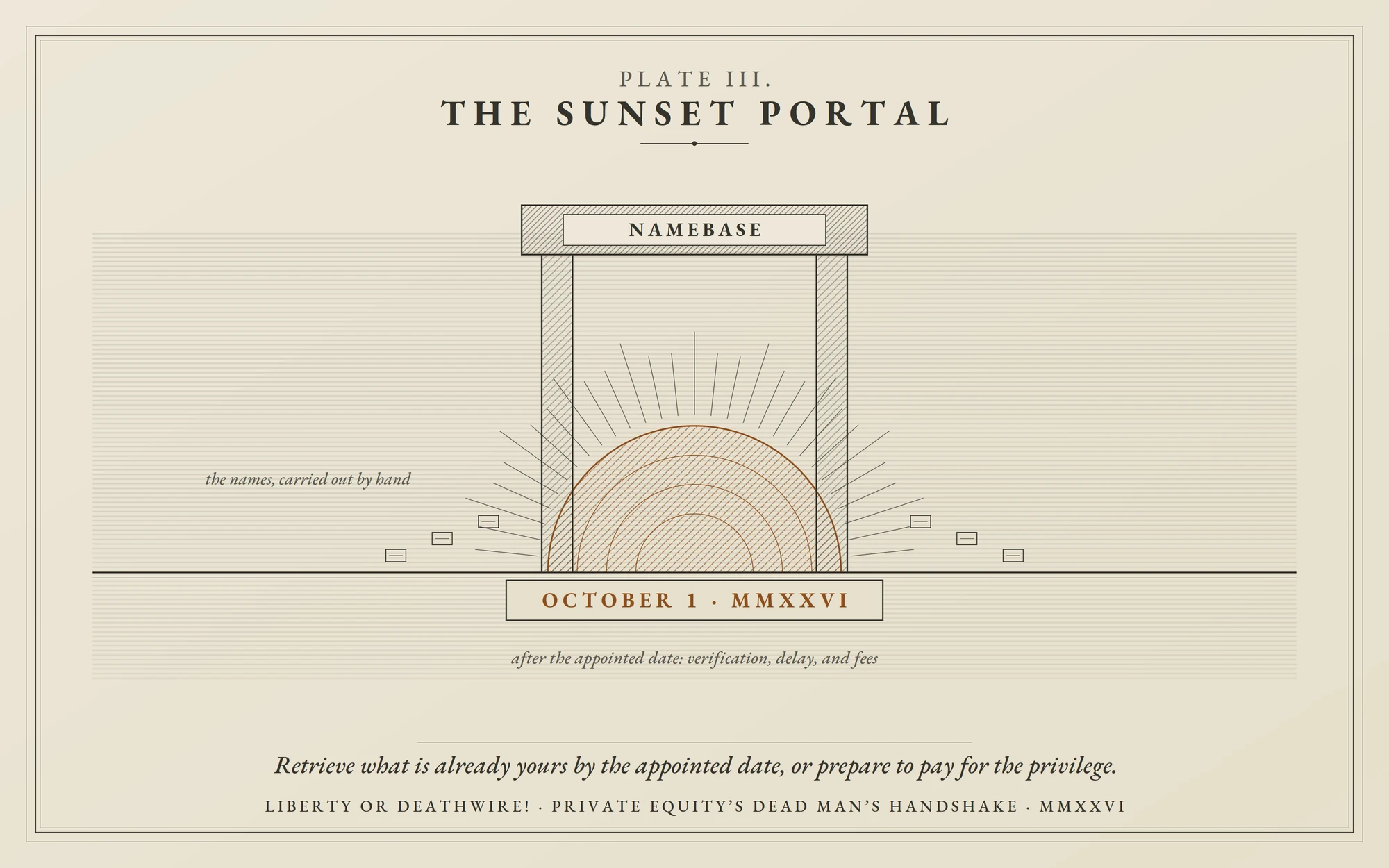
After October 1, recovery is expected to become manual, require additional verification, take longer, and potentially involve administrative fees. That process will be overseen by a company whose controlling owners have still not been publicly identified.
Once the domains are moved into self-custody, the responsibility for maintaining them also transfers to the holder. Handshake names require periodic renewal transactions demonstrating continued access to the relevant keys. Namebase previously automated that function. Holders who recover their domains must now establish their own procedures for safeguarding keys, tracking renewal periods, retaining sufficient HNS for network fees, and ensuring that the names do not expire through neglect.
This is the final indignity of the episode. Customers must become their own technical custodians on a deadline because the corporate custodian that invited their reliance no longer finds that reliance economically useful.
The Private-Equity Model Worked Exactly As Intended
The lesson is not that CVC secretly assassinated Handshake. The lesson is more ordinary and therefore more important. Once Namecheap passed into the control of a buyout fund, a founder-backed commitment that had been cultivated for four years could be reduced to a non-core line item. The company retained the commercial benefit of the trust that commitment had created while rejecting the responsibility attached to it.
The acquisition absorbed Namecheap’s reputation. The restructuring displaced the founder. The portfolio review separated the unprofitable experiment. The sale transferred custody to undisclosed buyers. The shutdown pushed migration costs onto customers. The sunset portal converted recovery into a deadline. The post-deadline process threatened to convert the company’s own failure of stewardship into a fee-generating administrative burden.
At every stage, the party with the greatest control carried the least inconvenience. The people with the least control carried nearly all of it.
That is private equity running amok—not because it necessarily violates the law, but because it repeatedly demonstrates how little the law requires from owners who acquire institutions built upon public trust. The fund may purchase the company, replace the leadership, abandon the mission, dispose of the assets, conceal the identity of the acquirer, and force customers to unwind the consequences. So long as the contracts permit it and the notices are posted, the system considers the matter resolved.
Private equity’s defenders will say that unprofitable projects must be closed. They are right. They will say that Handshake failed to achieve meaningful adoption. They are right again. They will say that investors are not charities and that CVC had no obligation to finance an indefinite experiment in alternative internet governance. That is also true.
None of those statements explains why customers were treated as expendable.
Closure did not require secrecy. It did not require transferring custody to unidentified buyers. It did not require freezing services without a ready migration path. It did not require forcing users to recover their own property under deadline. It did not require threatening additional fees after the deadline passed. Those were not inevitable consequences of Handshake’s failure. They were choices about who would absorb the cost of that failure.
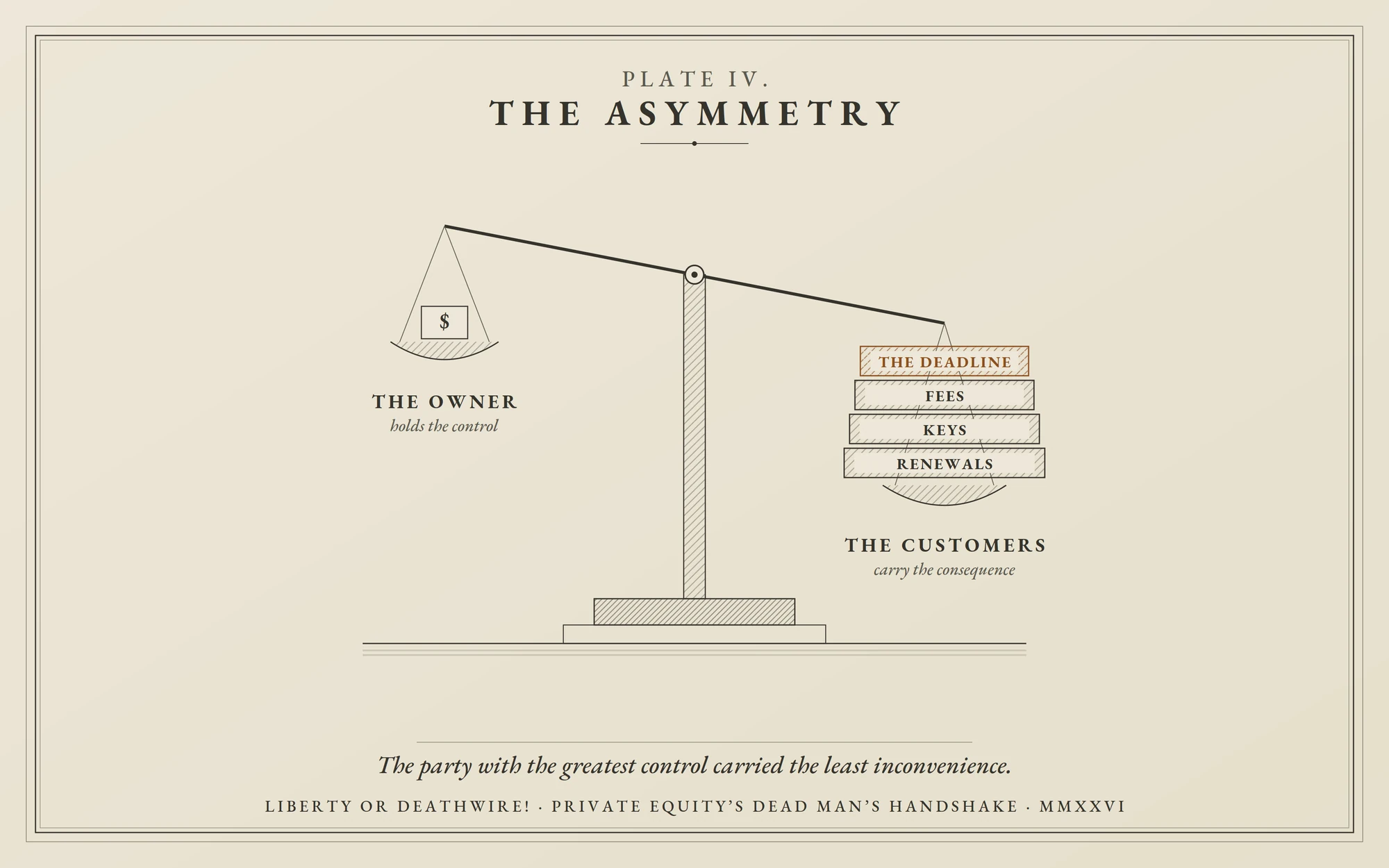
Private equity made certain that it would not be the owner.
The quiet wind-down should therefore be remembered for what it reveals. Private equity does not always destroy an institution through dramatic layoffs, public bankruptcy, or visible asset stripping. Sometimes it commits a colder act. It acquires the accumulated trust, removes the convictions that produced it, transfers the unwanted obligations to strangers, and sends the people who believed the promise a link to the status page.
Keywords
First published August 27, 2026. Originally published in Liberty or Deathwire.