
Built to Serve, Designed to Replace
A STEM-Minded Repudiation of Artificial Intelligence in Defense of Human Liberty
In this essay
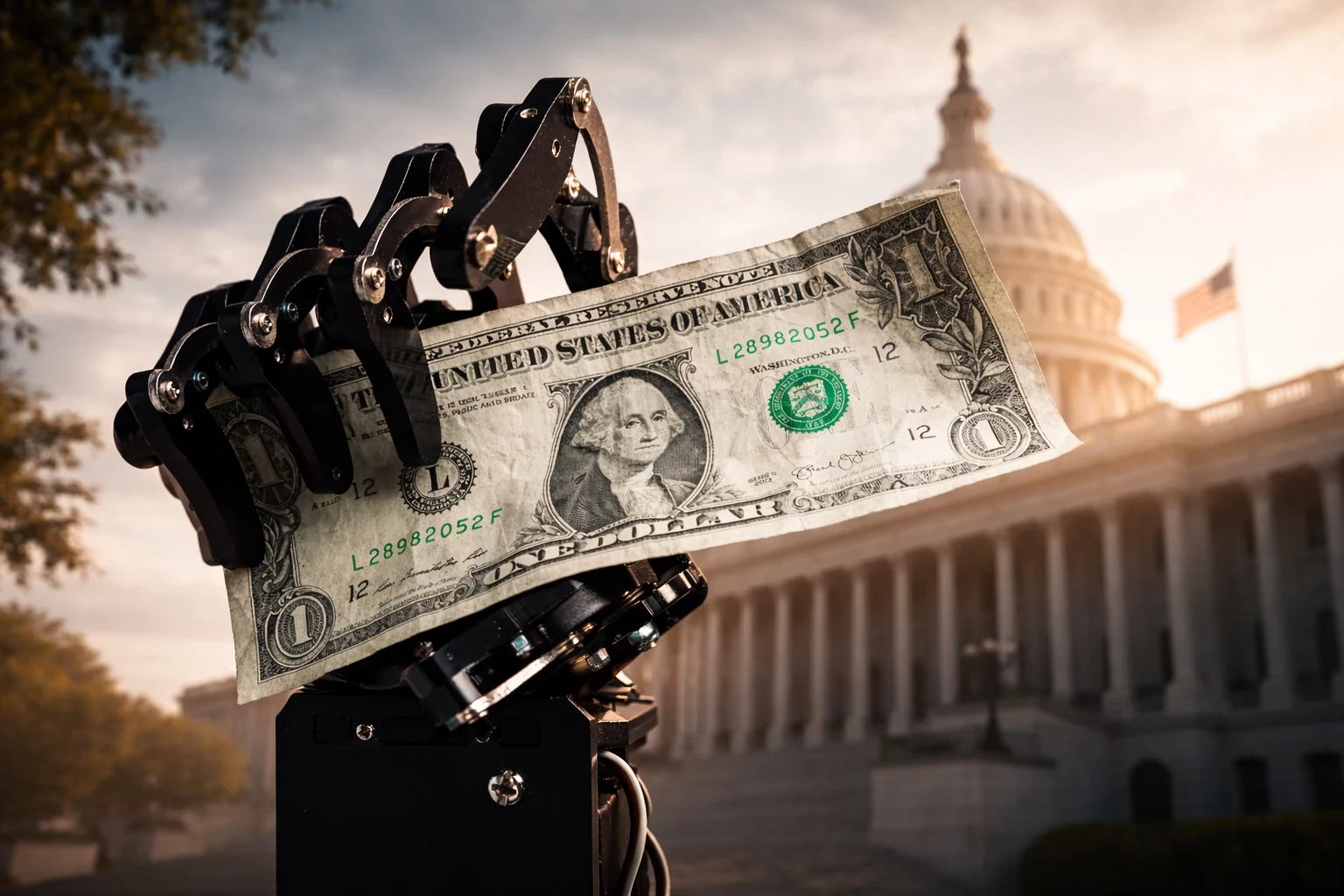
“STEM endures by developing the human mind; artificial intelligence advances by copying man. This is not alignment—it is war.”
Defiantly,
Andrew B. Raupp
@stemceo on X
The assumption that the STEM (science, technology, engineering and mathematics) community stands in unanimous support of artificial intelligence is not only inaccurate—it is increasingly untenable. Many of those who build, study, and teach these systems have begun to voice serious concern about their scale, their incentives, and their long-term implications. This skepticism does not arise from resistance to progress, but from a disciplined understanding of how complex systems behave when they expand beyond meaningful human oversight.
History offers no shortage of examples in which instruments forged to advance civilization, often quietly and without spectacle, begin to subordinate it—optimizing, automating, and abstracting until the human being, once the author of progress, is reduced to its byproduct. Artificial intelligence now stands at such a threshold: not as a neutral extension of scientific inquiry, but as an accelerating architecture whose integration into economic, civic, and cognitive life risks displacing the very human agency that gave rise to STEM itself.
A sober examination—grounded not in speculation, but in engineering realities, economic structures, and observable societal drift—reveals a simple truth: to question this trajectory is not to oppose STEM, but to defend it.
Power Extraction
The environmental consequences alone demand scrutiny of the highest order. Artificial intelligence systems are not abstractions suspended in the digital ether; they are materially anchored in sprawling data centers whose appetite for energy, water, and land rivals that of small nations. These facilities are increasingly situated in or near vulnerable communities, where water tables are strained by cooling demands and electrical grids are distorted to prioritize computational throughput over local resilience. The thermodynamic inefficiency inherent in large-scale model training—where marginal gains in predictive performance require exponential increases in compute—reveals a system that consumes disproportionately while delivering diminishing societal returns. In this, AI mirrors a form of industrial excess once thought relegated to earlier eras of unregulated expansion, yet now re-emerges cloaked in the language of innovation. A technology that externalizes environmental costs onto communities while concentrating informational and economic power elsewhere cannot be reconciled with a human-centered scientific ethos.
Algorithmic Authority
Parallel to this material footprint is the expansion of surveillance and behavioral inference capabilities that render traditional notions of privacy increasingly obsolete. Artificial intelligence does not merely process data; it synthesizes identities, predicts behaviors, and, when integrated into governance, enables a form of track-and-trace oversight that exceeds historical precedents in both scale and subtlety. What was once the domain of targeted investigation becomes ambient observation. Individuals are no longer assessed solely by actions, but by probabilistic projections derived from aggregated data streams—purchases, movements, communications, even inferred intentions. The result is not simply a loss of privacy, but the emergence of a preemptive administrative state in which deviation can be anticipated and constrained before it manifests. Such a system, once normalized, alters the relationship between citizen and government in ways that undermine the presumption of autonomy upon which free societies depend.
Cognitive Erosion
More insidious still is the cognitive impact of artificial intelligence on the developing mind. The human capacity for critical thought is not an innate constant; it is cultivated through effort, friction, and the necessity of grappling with uncertainty. AI systems, by design, remove that friction. They present conclusions without requiring the user to traverse the reasoning that underlies them. For children, whose intellectual faculties are still forming, this substitution of process with output risks eroding the very neural pathways that enable independent analysis. For adults, the effect is more gradual but no less consequential, as reliance on machine-generated synthesis diminishes the inclination to question, verify, or originate. Over time, the locus of knowledge shifts from the individual to the system, and with it, the confidence to challenge authority—whether institutional or algorithmic—begins to wane. A society that outsources its thinking, even partially, forfeits the intellectual sovereignty necessary for self-governance.
Andrew B. Raupp
Before the Machine Teaches the Child
The Great Educational Experiment Without Consent…
Human Displacement
The economic dimension reinforces this trajectory. Artificial intelligence, particularly in its current deployment, is not merely a tool that augments human labor; it is increasingly structured to replace it. Entire classes of work—analytical, creative, administrative—are being absorbed into systems that operate without rest, compensation, or dissent. The displacement is not confined to low-skill roles but extends into domains once considered secure, thereby destabilizing the foundational assumption that education and specialization guarantee participation in the economy. What emerges is a concentration of productive capacity in the hands of those who control the systems, while the broader population faces diminishing avenues for meaningful contribution. This is not a neutral market evolution but a reconfiguration of economic power that risks rendering large segments of society economically redundant.
Andrew B. Raupp
“American” Tech Giants Push STEM While Actively Undermining It
To describe this outcome as merely disruptive would be to understate its philosophical implications. A system that systematically reduces the necessity of human input challenges the premise that human beings are central to the processes that shape their world. It introduces, implicitly or explicitly, an anti-human orientation in which efficiency supersedes dignity and optimization overrides purpose. Such a trajectory stands in direct opposition to the principles that have historically guided STEM—principles rooted in enhancing human capability, not replacing it.
Autonomous Warfare
The militarization of artificial intelligence further compounds these concerns. Autonomous systems, predictive targeting, and algorithmic decision-making in conflict scenarios introduce a level of speed and detachment that compresses the temporal space in which moral judgment can occur. When decisions about life and death are delegated, even partially, to systems optimized for strategic outcomes, the accountability that underpins just conduct in war becomes diffused. The prospect of AI-driven escalation, where feedback loops between opposing systems accelerate beyond human control, is not theoretical; it is a foreseeable extension of current trajectories. In such a landscape, the potential for widespread loss of life—through miscalculation, exploitation, or deliberate use—becomes not an anomaly but a structural risk.
Epistemic Collapse
Equally troubling is the effect of artificial intelligence on the integrity of knowledge itself. Large-scale models are trained on existing corpora, synthesizing patterns and generating outputs that, while coherent, are derivative. Over time, as these outputs are reabsorbed into the data ecosystem, a feedback loop emerges in which original sources are diluted by their own approximations. The epistemic foundation upon which knowledge rests becomes increasingly recursive, less anchored in primary insight and more in aggregated inference. This phenomenon has been aptly captured by Dan Houser, whose observation—reported by IGN—that AI resembles “when we fed cows with cows and got mad cow disease” underscores the danger of systems that consume and reproduce their own outputs. The analogy is not rhetorical flourish; it is a precise articulation of a system that, left unchecked, risks contaminating the very knowledge base it depends upon.
Andrew B. Raupp
Whose Future Are We Building? The Ethical Crisis in STEM
Hold the Line
In light of these converging realities—environmental strain, surveillance expansion, cognitive erosion, economic displacement, militarization, and epistemic degradation—the argument for restraint is neither radical nor regressive. It is, rather, a rational response grounded in the principles of systems engineering and human-centered design. A technology whose externalities are not fully understood, whose governance structures are nascent at best, and whose societal impacts are both profound and irreversible warrants a pause commensurate with its scale.
Such a pause must not be symbolic but substantive. It must include the suspension of large-scale AI deployment and the initiation of processes that return decision-making authority to the citizenry. Referendums, public deliberation, and transparent evaluation of both benefits and risks are not impediments to progress; they are the mechanisms by which progress is aligned with the will and welfare of the people. In the absence of such mechanisms, the trajectory of artificial intelligence will be determined not by collective interest but by concentrated incentives that may diverge sharply from it.
Rightly Ordered
The STEM movement, at its core, is a pro-human endeavor. It emerged not to elevate systems above people, but to equip people with the tools to understand and shape their world. If artificial intelligence, in its current form and trajectory, undermines that mission, then fidelity to STEM requires not passive acceptance but active interrogation. The question is not whether artificial intelligence can do more, but whether what it does serves the enduring interests of humanity.
Andrew B. Raupp
STEM Against the Machine
As the architecture of this technology expands, so too must the clarity with which it is examined. The more rigorously artificial intelligence is analyzed through the lens of human impact, the more evident it becomes that its promised benefits are unevenly distributed, while its risks are broadly shared. In such a calculus, the absence of a clear, widespread upside for the masses is not a minor oversight; it is a defining flaw.
To proceed without addressing this imbalance is to invert the relationship between innovation and society, allowing the former to dictate the terms of the latter. To pause, to deliberate, and to realign is to affirm that the purpose of science and technology remains what it has always been at its best: the advancement of human flourishing, not its displacement.
Concluding Declaration
Artificial intelligence does not stand apart from us; it is our own construction, shaped by human intellect and carried forward by human hands. In this, the conflict it presents is not external, but internal—a contest between what we create and what we are willing to preserve. It is no small matter when the works of man begin to erode the very faculties that made them possible. However intricate the engineering, however advanced the design, a system that diminishes human productivity, weakens critical thought, and substitutes creativity with replication cannot be said to advance the condition of man.
It may be argued, with some merit, that mastery of STEM disciplines is required to bring such systems into being. Yet this only sharpens the contradiction. For what is the value of a discipline if its highest applications render its foundational virtues unnecessary? What is the purpose of cultivating intellect, if its fruits are used to supplant it? In this tension lies an unavoidable truth: STEM and artificial intelligence, as presently aligned, are not moving in concert, but toward one another on a direct and opposing course.
Those within STEM who retain a sense of responsibility to the integrity of their field—and to the generations who will inherit it—must reckon with this plainly. Caution alone is insufficient where consequences are so far-reaching. What is required is discernment, skepticism, and, where necessary, a principled resistance to the unexamined expansion of systems that compromise the very standards they claim to advance. For the preservation of both mankind and the credibility of STEM itself depends not on what can be built, but on what ought to be sustained.
Citizens Rule Book: A Palladium of Liberty (Hardcopies) 🇺🇸
Liberty or Deathwire! runs on grit, not grants. No sponsors. No filters. No masters. 📠
Keywords
First published April 3, 2026. Originally published in Liberty or Deathwire.