Before the Machine Teaches the Child
A Case for Digital Restraint in the Formation of Young Minds
In this essay +

The Great Educational Experiment Without Consent
The modern school has been asked to accept a dangerous bargain: surrender the oldest disciplines of human formation in exchange for the newest devices of commercial convenience. In classroom after classroom, children are handed screens before they have mastered sustained reading, fluent handwriting, structured argument, or the difficult art of thinking in silence. We are told this is progress. Yet the case for such rapid technological immersion has been advanced far more quickly than it has been proven.
The U.S. Surgeon General has warned that robust independent safety analyses of social media’s impact on children have not yet been conducted, even as youth use has become nearly universal among teenagers and widespread among children under thirteen. UNESCO, in its guidance on generative AI in education, has likewise urged a human-centered approach and warned that many countries and institutions remain unprepared on regulation, privacy, and developmental safeguards. Even Stanford’s recent survey of AI in K–12 education concluded that the research base is expanding rapidly while rigorous evidence remains thin. That is not a foundation for mass adoption in childhood. It is a warning flare.

Attention as the First Casualty
Sweden’s decision to implement a nationwide mobile-phone ban in schools beginning in autumn 2026 deserves to be understood not as a quaint moral panic, but as an act of educational self-respect. According to The Guardian, the policy will require schools and after-school clubs to collect phones from students aged 7 to 16 at the start of the day and return them after classes, backed by national funding and framed as part of the country’s largest education reform in decades. Sweden is not moving backward. It is recognizing that the first duty of a school is not to mirror the marketplace, but to defend attention.
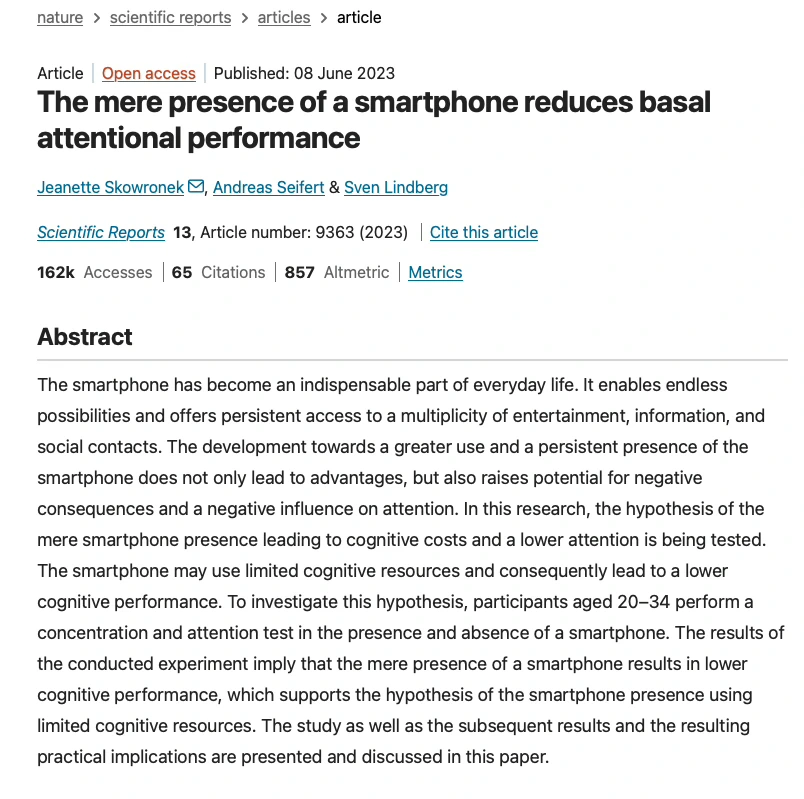
OECD findings help explain why such measures are gaining force: a majority of students across OECD countries reported having their attention diverted in mathematics lessons by classmates using digital devices, and students who reported such distraction scored significantly lower in math. These are not trivial inconveniences. Attention is the gateway faculty. A child who cannot hold a thought long enough to develop it will eventually lose confidence in thought itself. Big Tech profits from fractured concentration because an interrupted mind is easier to steer, easier to sell to, and easier to keep in a permanent state of appetite. Education, by contrast, should train the opposite kind of citizen: one capable of endurance, judgment, and self-command.
Why Literacy Must Precede Technology
This is why technological literacy must precede technological access. Children should not be plunged into AI tools and social platforms as passive consumers of opaque systems they do not understand. They should first learn what these systems are, how incentives shape them, how data is extracted from them, how feeds manipulate salience, how recommender systems reward emotional volatility, and how convenience can quietly become dependency. True literacy is not mere operational fluency. A child who can swipe, prompt, post, and upload is not therefore educated; he may simply be well-instrumented.
The deeper task is to teach children to ask who designed the tool, what behavior it rewards, what faculties it displaces, what information it harvests, and what form of power it normalizes. That is where the question of technocratic control enters. The gravest danger of early digital saturation is not only that it may lower comprehension, diminish memory, or crowd out healthier activity—though there is evidence for each of those concerns—but that it habituates the young to life inside systems they are told not to question. A generation raised to offload judgment to algorithms may eventually lose the instinct to defend the sovereignty of the human person. That is not innovation. It is a civic demotion.
The Case for Digital Conservation
The answer is not Luddism. It is conservation. A civilization that cares about children must deliberately preserve the developmental experiences from which intellectual freedom actually arises: reading paper books slowly enough to wrestle with meaning rather than skim for stimulus; learning cursive and handwriting so that thought passes through the hand and acquires form; writing essays without artificial assistance so that the mind learns to generate, organize, and defend its own claims; debating in person so that argument becomes a discipline of listening as well as speaking; preparing speeches from memory so that language becomes embodied rather than outsourced; gardening, building, drawing, sporting, and exploring the outdoors so that the child remains tethered to reality rather than trapped in simulation.
Research on handwriting has found more elaborate brain connectivity during writing by hand than typewriting, with implications for learning and memory, and recent work suggests handwriting practice can strengthen children’s letter-sound mapping and word ‘. Meanwhile, the larger literature on phones and screens has become serious enough that even business publications now summarize evidence linking smartphone saturation to diminished cognitive performance and cultural decline in concentration.
Final Thoughts
There is a moral irony in the present moment that should not be missed. Many of the people who know the digital environment best are often the least willing to expose their own children to it without restraint. In Maclean’s, Viral Nation CEO Joe Gagliese—whose business is deeply entangled with the social-media economy—argued that children should be kept off social media because adults outside the industry do not fully grasp what the platforms are doing to developing minds. That admission is more revealing than a hundred glossy district procurement brochures. When even insiders speak as defectors from the culture they helped build, the rest of society should pay attention.

The proper role of digital technology in STEM (science, technology, engineering & mathematics) and STEM education is not to replace the human being, but to extend human capability after a person has developed judgment, discipline, and moral ballast. Used sparingly and intelligently, technology can amplify humanity. Introduced too early, too often, and too uncritically, it can deform it. The first obligation of civil society is therefore not to make children “AI-ready.” It is to make them reality-ready—capable of reading deeply, writing clearly, laboring patiently, speaking courageously, and recognizing when a machine is offering help at the price of independence.
Thus, a child should meet artificial intelligence only after he has first encountered natural intelligence in its full dignity: the mind sharpened by books, the hand trained by work, the conscience formed by limits, and the soul strengthened by life beyond the screen.
Andrew B. Raupp is the Founder / Executive Director @stemdotorg. “Resolutely preserving the rights and freedoms of the STEM education community through sound policy & practice…”
Keywords
First published March 24, 2026. Original publication