The Assay of Trust
The first trustmark was struck in silver. Every seal since is its heir.
In this essay +
A buyer cannot see purity. Hold a silver cup to the light and it tells you nothing you can trust: a thin wash of silver over copper shines exactly like the solid article, and a coin shaved of a tenth of its weight spends the same as one left whole. For most of the history of commerce, the only person who truly knew what a thing was made of was the person selling it — and the person paying simply guessed.
The long human project we call trust is, to a surprising degree, the history of the authentication methods we built to close that gap between what a seller knows and what a buyer can verify. The oldest of those protocols that is still running was struck into metal seven centuries ago. It is older than the Bank of England, older than the New York Stock Exchange, older than nearly every institution we now treat as the bedrock of honest markets. It is a tiny picture of a leopard’s head — and to read it correctly is to understand almost everything about why we believe the labels we believe.
From Shop To Shop
1300 · THE STATUTE
The leopard arrived by law. In 1300, King Edward I issued a statute decreeing that no vessel of silver could leave a goldsmith’s hands until it had been tested and marked — and that the silver itself had to meet a fixed standard of fineness, 92.5 parts pure in every hundred. The wardens of the goldsmiths’ craft were to move from shop to shop, assaying the work and striking each passing piece with a leopard’s head, the King’s mark. The standard acquired a name that has outlived empires: because the silver had to be at least as fine as the silver of the realm’s coinage, it was called sterling.
Read what that single sentence of medieval law actually did, because every credible mark since has been an elaboration of it. It set a public standard — a number anyone could appeal to. It appointed an independent party to test against that standard, someone other than the maker. And it required the result to be recorded in a mark the buyer could see. Standard, assay, mark. The buyer no longer had to trust the seller; the buyer could trust the system that policed the seller.
The institution grew up around the mark. In 1327, Edward III granted the Goldsmiths’ Company its first royal charter, giving the guild authority to enforce the standard across the trade. In 1363, a further statute required every goldsmith to strike his own personal mark — a maker’s mark — beside the King’s leopard, so that a substandard piece could be traced to the hand that made it. Anonymity was the friend of fraud, and the law abolished it. A name was now attached to every claim.
The Hall, And The Date Letter
1478 · THE HALL
For a while the assayers went to the silver. Then the silver came to the assayers. In 1478 a statute made the Goldsmiths’ Company itself liable for any ware found below standard — and liability, then as now, concentrated the mind. The Company stopped sending wardens on rounds and built a permanent office at Goldsmiths’ Hall in London, staffed by a full-time Common Assayer who tested every piece brought to him. Makers were now required to carry their work to the Hall to be marked, and the mark struck there took the name it still carries: the hallmark.
The office then added a fourth element that may be the most quietly radical of all: a date letter — a single letter, changed each year, recording not only when a piece had been assayed but which warden had been responsible for assaying it. The date letter made the tester accountable in his turn. If a fraudulent piece surfaced years later, the mark would say which year it had passed and on whose watch. The system did not merely vouch for the maker. It kept a record against itself.
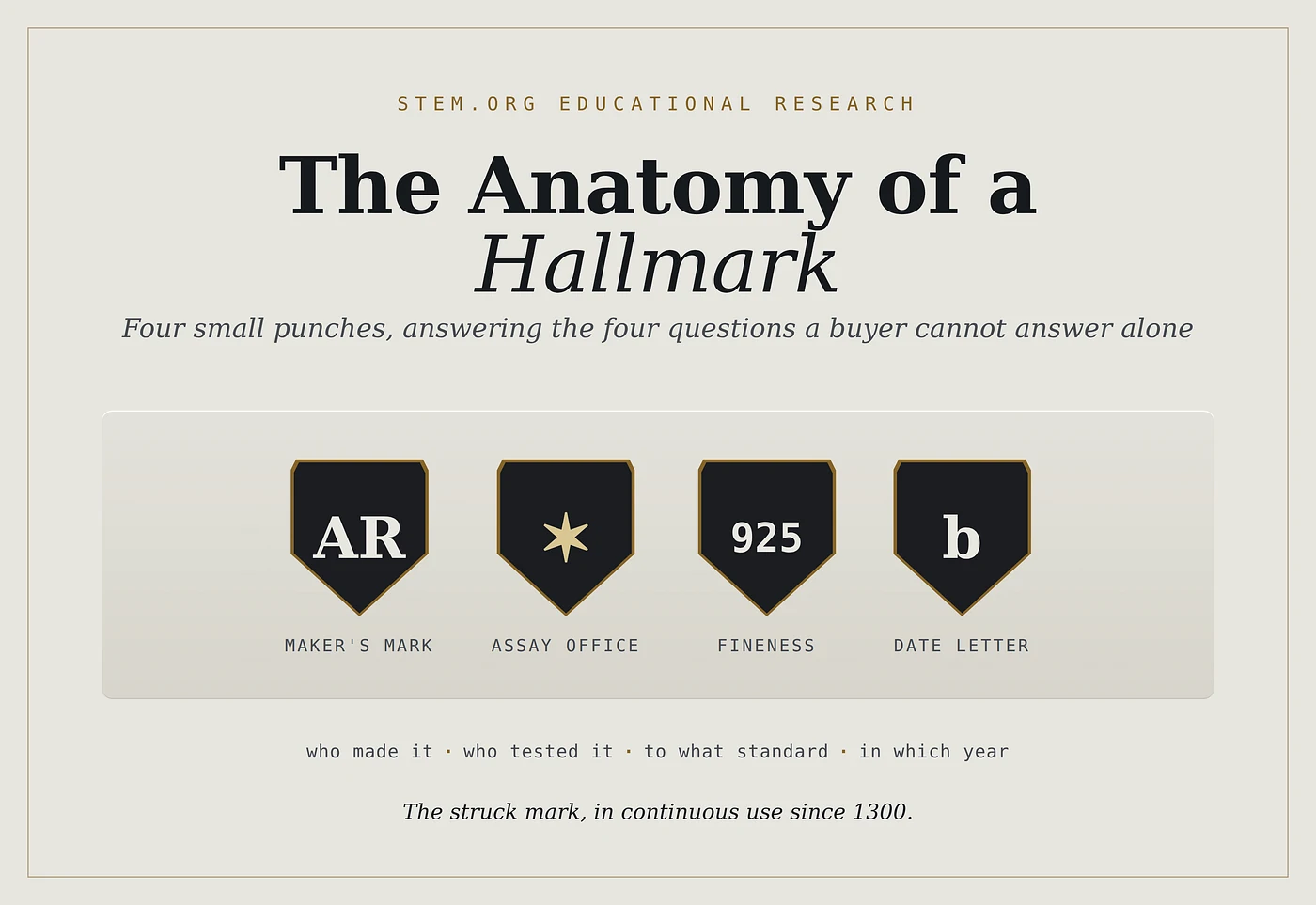
By the sixteenth century the grammar of the mark was complete. A finished hallmark was, in effect, a sentence of four words: a maker’s mark (who made this), the leopard’s head of the office that tested it — joined in 1544 by the lion passant as the standard mark — a fineness mark (to what purity), and a date letter (when, and by whom). Four small punches, struck in a row, answered the four questions a buyer most needed answered and could not answer for himself.
Even The King’s Mint Stands Trial
1248 · THE TRIAL
The clearest proof that the English took the integrity of the mark seriously is what they were willing to do to the most powerful mint in the kingdom. Since the thirteenth century — the first recorded public trial dates to 1248 — the realm’s own coinage has been audited in a ceremony called the Trial of the Pyx, named for the boxes in which sample coins were locked away through the year. It is, by a wide margin, the oldest form of independent quality control still practiced anywhere on earth.
The procedure is a small marvel of distrust engineered into ritual. Throughout the year the Royal Mint sets aside sample coins at random and seals them in the pyx. Once a year a jury — at least six assayers of the Goldsmiths’ Company, summoned to the Hall by a senior judge, the King’s Remembrancer — counts and weighs the coins, then melts a selection down and measures the result against a standard “trial plate” held as the benchmark. The Mint does not test itself. An independent guild tests the Mint, in a court of law, against a physical standard that neither party controls.
And the teeth were real. If the coinage failed, the Master of the Mint could be fined, removed, or imprisoned. One medieval master went to prison in 1318 for a failed trial; the last to be punished was Isaac Newton himself, in 1696 — newly installed at the Mint, and already the author of the Principia — though he later proved the fault lay in a defective reference plate, not in his coin. The lesson the Pyx encodes is the one every honest credentialing body eventually learns: a mark is worth only the consequences standing behind it. Authority that cannot be called to account is not authority. It is decoration.
The Standard And The Shortcut
1697 · BRITANNIA
A standard, once set, is under permanent siege from the shortcut. In the boom years of the late seventeenth century, silversmiths discovered it was profitable to melt the realm’s coins down into plate, quietly debasing the currency to feed the fashion for silver. Parliament’s answer in 1697 was to raise the bar: a new, higher “Britannia” standard of 95.84 percent, marked by the figure of Britannia herself, made coin-silver too soft to use for plate and so removed the temptation at its source. When the crisis passed, the older sterling standard was restored and Britannia left as an option. The episode is a permanent reminder that a standard is not a monument but a discipline — only ever as strong as the institutions willing to defend it against the people who profit from eroding it.
The Anchor That Never Went To Sea
1773 · THE ANCHOR
For four centuries the mark belonged to London. The Industrial Revolution forced it open. By the 1770s the workshops of Birmingham were producing precious metalwork at a scale London’s single office could not serve — and the irony at the heart of the story is that Birmingham’s silver trade had grown out of the manufacture of small, cheap, ingenious objects the trade itself called “toys”: buckles, snuffboxes, trinkets, the disposable charms of the age. The manufacturer Matthew Boulton — a member of the Lunar Society alongside James Watt and Erasmus Darwin — was tired of sending his wares seventy miles to Chester or London to be marked, with the delays, damage, and highwaymen of the road. He led a campaign in Parliament, lodged through it at a tavern called the Crown and Anchor on the Strand, and in 1773 won assay offices for Birmingham and Sheffield against the determined opposition of the London guild. Tradition holds that the two towns settled their marks on the toss of a coin at the tavern: Birmingham took the anchor, Sheffield the crown. Which is why, to this day, the hallmark of a city farther from the sea than almost any other in Britain is a ship’s anchor.
Boulton was the new office’s very first customer. He was also, the story goes, among its first casualties: a batch of his plate failed the assay and came back to him as a flattened ruin, the substandard silver put under the hammer and destroyed. The detail is not a footnote; it is the whole philosophy in miniature. A mark that lets the failing piece through is worse than no mark at all, because it launders the lie. To this day the Dublin office will destroy an entire batch if a single item drawn at random falls short. The mark protects the public precisely because it is willing to break the maker’s property to do it — even when the maker is the most celebrated industrialist of the age.
Why Honest Sellers Need The Mark Most
1970 · THE LEMONS
It took economics six hundred years to explain, in formal terms, what the goldsmiths had already built. In 1970 the economist George Akerlof published a paper — rejected by several journals as too slight before it won him a Nobel Prize — describing what happens to a market when buyers cannot tell good goods from bad. Akerlof used used cars; his “lemons” were the bad ones. When buyers cannot distinguish quality, he showed, they will pay only the price of the average — too little for the honest seller, and just right for the cheat. The honest seller, underpaid, withdraws. Average quality drops. Buyers, sensing it, pay even less. Round and round, until the good goods are driven out entirely and the market fills with lemons, or collapses altogether.
The cure Akerlof named is the leopard’s head in modern dress: warranties, licensing, and third-party certification — trusted signals that let a buyer believe a quality claim made by a stranger. This is the deepest truth about the hallmark, and the one most often missed: the mark exists to protect the honest maker as much as the buyer. Without a credible, independent mark, the maker who actually meets the standard has no way to prove it and no way to charge for it; quality becomes invisible, and therefore worthless. The assay office does something an underwriter would recognize at once. It takes the maker’s private knowledge of the metal and converts it into a public assurance, absorbing the risk of the claim onto an institution whose entire value is its refusal to lie. That is what a trustmark is. It is risk, underwritten.
What Every Credential Still Owes The Mark
TODAY · THE INHERITANCE
None of this is antiquarian. The leopard’s head is still struck in London, and the system that strikes it is still the law. Under the Hallmarking Act 1973, it remains a criminal offence to sell an unmarked precious-metal article in the United Kingdom as gold or silver, and the Act still names the three things a modern hallmark must say: a sponsor’s mark (who submitted it), an assay-office mark (who tested it), and a fineness mark (to what standard). The same statute carries a provision that ought to be carved over the door of every credentialing body in the world. It requires the dealer to display a notice teaching the customer how to read the marks. The law does not merely demand the mark; it demands that the buyer be taught to read it — because a mark no one can interpret is no protection at all.
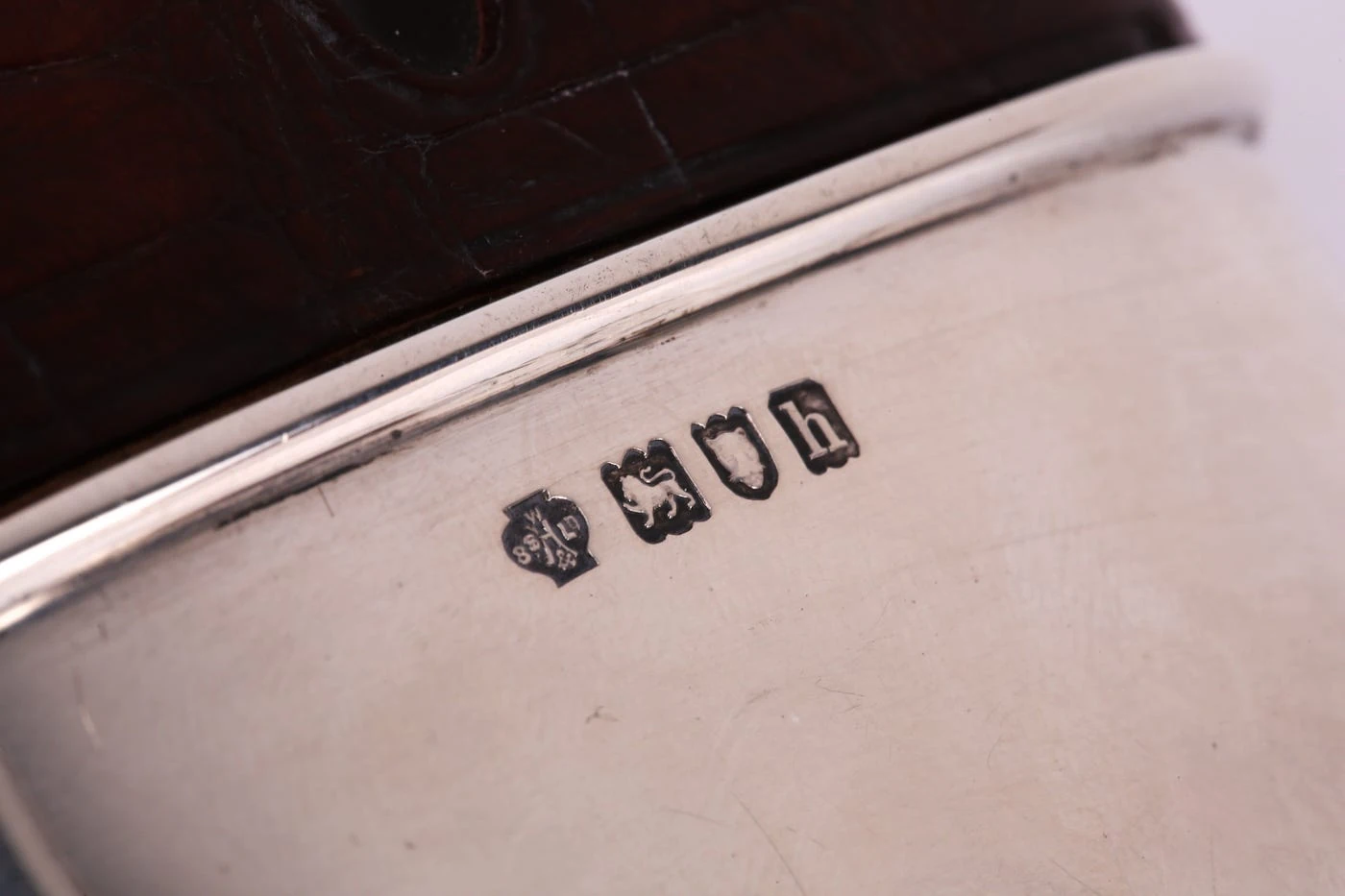
Here, then, is the inheritance, set down plainly. A credible mark requires a published standard, not a private opinion. It requires an assayer independent of the maker. It requires that the claim be traceable to a name and a date. It requires consequences severe enough that passing the test actually means something. And it requires precision of language — because the leopard, the lion, the anchor, the date letter, and the fineness number each say one thing and one thing only. A mark that tries to mean everything means nothing; the moment the public can no longer tell what a seal certifies, Akerlof’s lemons begin to gather.
This is why, at STEM.org, the words are kept exact. A school is accredited. A teacher is certified. A product is authenticated. A publication is reviewed. Those are not interchangeable courtesies; they are different assays, each testing a different claim against a different standard, each struck as a different mark. The discipline is seven hundred years old. It was learned the hard way, in a London hall, by a guild that understood a truth the modern marketplace keeps having to relearn: trust does not scale on goodwill. It scales on a standard, an independent test, an honest mark, and the willingness to put the failing piece under the hammer.
The Seal That Borrows A Word
2021 · THE COUNTERFEIT
Hold the words to their meaning, and a claim now common in the toy aisle collapses. A toy is a product — an object, like the teaspoon an assayer once weighed in his palm. An object can be authenticated: tested against the claim printed on its box and marked accordingly. It cannot be accredited, any more than a silver spoon can be awarded a degree — accreditation is an act performed upon an institution, certification upon a person, and authentication upon a thing. A toy is a thing. Thus, STEM and STEAM toys are not accredited. They are authenticated, or they are merely asserted.
And the merely-asserted claim is seldom innocent. When a box reads “STEM / STEAM Accredited” the wording is, more often than not, engineered to mislead — a marketing instrument cut to the pattern of a schoolhouse. The most consequential version arrived in 2021, when a national toy-industry trade body launched a “STEAM accreditation” program for products — a “Stamp of Approval” that a manufacturer pays a fee to apply for and may then display on its packaging.. The tactic works in four quiet moves. It weaponizes a word: accredited summons, in a parent’s mind, a school board or a department of education, when in practice it usually means only that a manufacturer paid a private firm a fee. It dresses the claim in the costume of a diploma — gold seals, crests, the silhouette of a graduation cap, phrases like “Board Certified” or “Approved Framework” — so that from across the aisle the box reads as an official credential. It preys on pressure: as classrooms lean harder into STEM and STEAM, the seal whispers that the object in the package is an extension of the curriculum, when it is a retail commodity and nothing more. And it shelters in a loophole — for where “FDA Approved” and “Certified Organic” are terms protected by law, the words STEM and STEAM belong to the public domain, policed by no agency at all, so that a paid badge may be mistaken, safely and profitably, for a government standard.
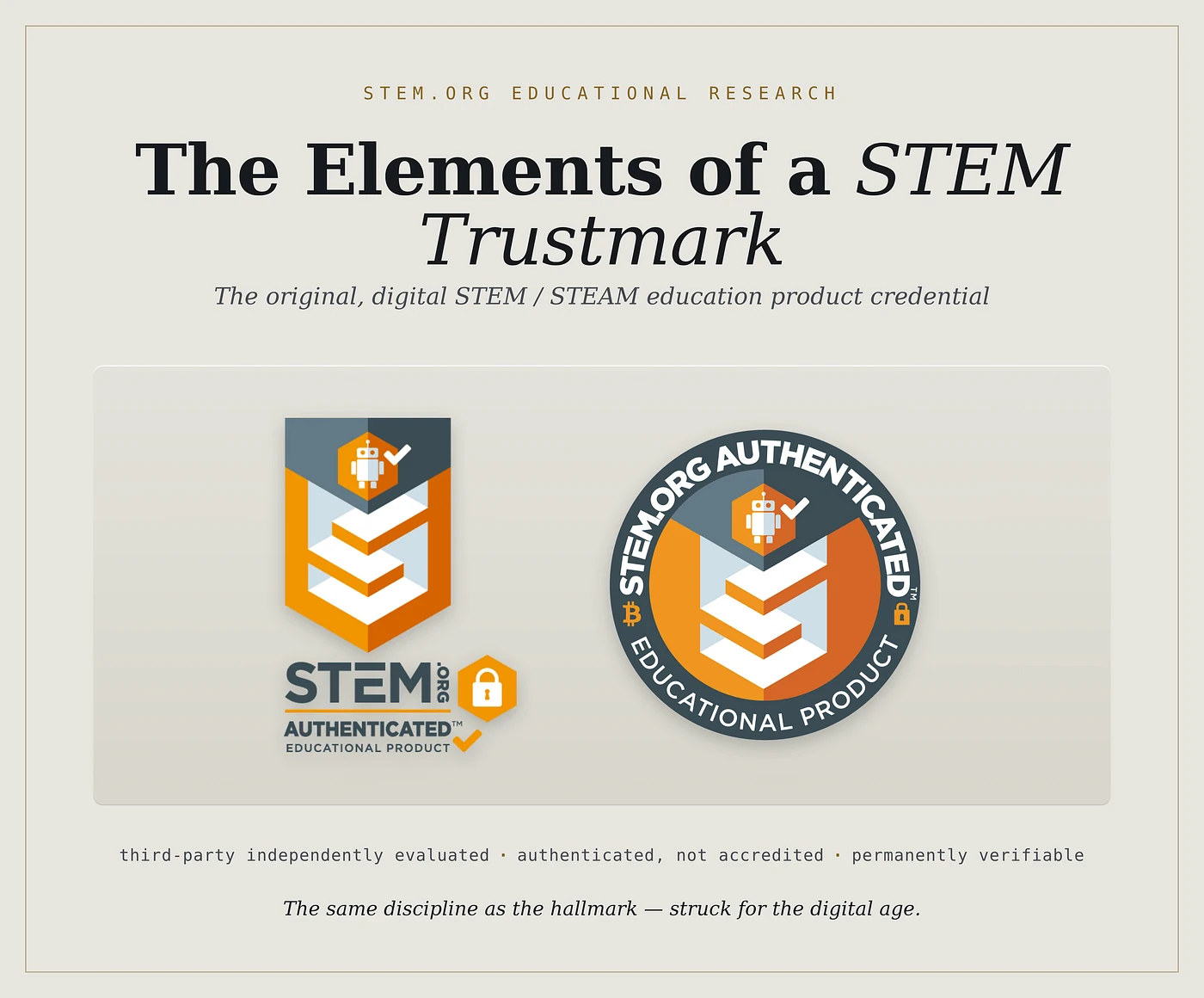
The full history behind the STEM.org product trustmark — with the paper trail to prove it — is told in our investigation, The Label on the Box.
The defense is the hallmark’s own logic, reduced to four questions a parent can put to any seal. Who tested this? Against what standard? Can I verify it myself? How much did you pay for it? A credible mark answers without flinching, because answering them is the whole reason it exists — a published standard, an assayer independent of the maker, a record anyone can check. A seal that cannot answer them is not a credential; it is a costume. The distance between the two is the distance between a hallmark and a sticker.
Thus, the leopard’s head has held that line, unbroken, since 1300. But a line is never inherited — only held, in every generation, or surrendered. The STEM.org Trustmark holds it now — the same discipline, struck for the digital age.
Andrew B. Raupp is the Founder / Executive Director @stemdotorg. “Resolutely preserving the rights and freedoms of the STEM education community through sound policy & practice…”
Keywords
First published June 25, 2026. Original publication