STEM Without Sovereigns
Who should decide how a generation learns — the builders in ten thousand classrooms, or a distant seat that will never enter one?
In this essay +
- THE CREDO
- Rough consensus and running code
- THE FIRE
- The assay does not lie
- THE CASE
- Law that grows
- THE KNOWLEDGE PROBLEM
- Why the builders win
- THE ADMINISTRATOR’S REFLEX
- What the sovereign gets wrong
- THE HONEST OBJECTION
- When a sovereign helps
- THE CLASSROOM
- The standard no center can hold
- THE PRINCIPLE
- Put the test above the throne

“The most durable rules in human affairs were never handed down. They were grown, tested, and left open to challenge — and that is exactly why they held.”
In 1992, while governments on both sides of the Atlantic were busy ordering their agencies to adopt a suite of computer-networking standards that would be effectively dead within a decade, an engineer named David Clark stood before a roomful of his peers and said the thing that outlasted all of it. “We reject,” he told the Internet Engineering Task Force, “kings, presidents, and voting. We believe in rough consensus and running code.”
It sounds like a slogan. It is closer to a theory of knowledge. Behind it lies a claim about how good rules actually come into the world — a claim that cuts against almost every instinct of the modern administrative mind, which assumes that a standard is something an authority writes down and then compels. There is another way, older than the internet and older than the nation-state, and its record is startlingly good. In this tradition a standard is not decreed at all. It is proposed by the people who have to live inside it, adopted only if it works, and left permanently open to challenge by anyone who can prove it wrong. It answers not to a throne but to a test.
Three institutions, separated by centuries and by everything else, are built on that single principle: the internet’s Request-for-Comments tradition, the silversmith’s hallmark, and the common law. Each replaced a sovereign’s judgment with an external check. Each was made by builders rather than administrators. And each has outlasted, outperformed, and outlived the centrally mandated alternative that was supposed to replace it. The stakes are not antiquarian. The same question that ran through the assay office and the task force — who may set the standard, and to what must it answer — now hangs over how a generation of children will learn STEM (science, technology engineering and mathematics), and it will be settled, one way or the other, in our own time.
THE CREDO
Rough consensus and running code
The founding document of internet governance is titled, with deliberate humility, a Request for Comments. When Steve Crocker circulated RFC 1 in April 1969, he was a graduate student unsure of his authority to tell anyone anything, so he framed the whole enterprise as an open question rather than a pronouncement. The name stuck, and with it the posture: every core protocol of the network you are using to read this — the addressing scheme, the mail format, the web itself — began life not as a regulation but as a numbered invitation to be improved or ignored.
The Internet Engineering Task Force that grew up around this practice has no membership rolls, no dues, and no vote in the ordinary sense. A proposal advances by rough consensus — not unanimity, but the absence of sustained, reasoned objection — and it earns its place only when there is running code: at least two independent implementations that actually talk to each other. The test is not whether the committee approves. The test is whether the thing works when two strangers build it apart and switch it on.
Set against this was one of the most authoritative standards efforts ever mounted. Through the 1970s and 1980s, the International Organization for Standardization and the international telegraph authority convened the world’s experts to design the “correct” way for computers to communicate: the Open Systems Interconnection suite, the famous seven-layer model, blessed by treaty organizations and endorsed by ministries. It was to be the official future. Governments made sure of it. The United States, through its Government OSI Profile, required federal systems to procure OSI compliance; Britain did the same. The upstart alternative — the TCP/IP protocols that Vint Cerf and Bob Kahn had sketched in 1974 and that a generation of engineers had since hammered into working shape — was, by official policy, the thing to be phased out.
By the mid-1990s it was OSI that lay in the ground. Its seven-layer diagram survives, immortal, on the whiteboards of every networking class on earth; its actual protocols are a historical curiosity. TCP/IP won so completely that the government mandates for its rival were quietly rescinded, and the network it carried became the defining infrastructure of the age. The historian Andrew Russell has told this story in full — his account even borrows Clark’s phrase for its title — and the lesson he draws is the one that matters here. OSI failed not because its designers were foolish; they were brilliant. It failed because it tried to specify the future in a committee before anyone had built it, while TCP/IP was refined in the only laboratory that counts, which is deployment. No ministry can make a non-working protocol interoperate. The code either speaks to other code or it does not, and that verdict is delivered by the network, not by the chair.
If this sounds like a one-time accident of the Cold War, consider the rerun. Two decades later the World Wide Web Consortium set out to replace the messy, forgiving language of the web with a clean, rigorous, XML-based successor — the “correct” HTML, top-down and backward-incompatible. The people who actually built browsers refused. In 2004 they broke away, formed a rival working group, and wrote a pragmatic standard grounded in what browsers really did and what authors really typed. Running code won again; the consortium eventually abandoned its cathedral and adopted the builders’ living standard. The pattern is not coincidence. It is the mechanism.
THE FIRE
The assay does not lie
Seven centuries before the first RFC, England faced a humbler version of the same problem: how does a buyer know that the silver cup in his hand is silver at all? He cannot see purity. The metal lies as easily as a man does. A statute of 1300, in the reign of Edward I, answered not by trusting the maker’s word and not by installing a royal inspector at every forge, but by binding the craft to a test. Silver would be assayed — a scraping taken, melted, its true fineness measured in the fire — and only metal that met the standard could be struck with the mark.
The genius of hallmarking is who kept it. The standard was defined and administered not by a distant bureaucracy but by the trade itself, through the goldsmiths’ own company, and the assay was carried out at offices scattered across the country rather than concentrated in one seat of power. The Crown supplied a light backstop of statute; the practitioners supplied the knowledge, the furnaces, and the discipline. Above all, the claim the mark made was checkable. A hallmark is not an official’s opinion that the silver is good. It is a record that the metal survived the fire — and the fire can be lit again, by anyone, at any time. The standard answers to a fact about the world, not to the authority of whoever stamped it. That is why it has run, in continuous use, for more than seven hundred years, and why the better modern trustmarks — including work I have spent my own career on — still reach back to it for their logic. The principle predates every one of us by seven centuries: a mark is worth only as much as the test a stranger can repeat.
Contrast the assay with its modern administrative cousin, the quality seal that is simply awarded — conferred by a body, displayed for a fee, and backed by nothing a buyer can independently verify. The words may be grander and the logo shinier, but there is no fire behind it. It asks to be believed rather than checked. The hallmark’s whole authority runs the other way: it asks to be checked, and survives because it can be.
THE CASE
Law that grows
The third example is the largest, because it governs almost everything the English-speaking world does. The common law was never written by a sovereign in a single act of design. It accumulated, case by particular case, as judges confronted real disputes between real people and reasoned by analogy from what had been decided before. No one planned it. No legislature foresaw it. It is the residue of countless collisions with reality, each one testing a rule against a situation its authors could not have imagined.
Its commercial core came from even further outside the palace. Medieval merchants, trading across borders that no single crown controlled, evolved their own body of custom — the lex mercatoria — and their own swift tribunals, the fairground “courts of pie powder,” named for the dusty feet of the traders who used them. These were standards in the fullest sense: rules for credit, sale, and shipment, grown by the people who bore the losses when the rules were wrong, and adopted across jurisdictions because they worked, not because any king imposed them. Only later did the common law, under judges such as Lord Mansfield in the eighteenth century, draw that merchant custom up into itself.
Friedrich Hayek gave this contrast its sharpest statement. In Law, Legislation and Liberty he distinguished law that is grown from law that is merely made — the evolved order of the common law against the constructed order of the comprehensive code, of which Napoleon’s is the monument. His argument was not that legislation is always wrong; it was that a single designer, however able, cannot possess the knowledge dispersed among the countless people whose circumstances the rule must fit. That knowledge is local, particular, and often wordless. It lives in the hands of practitioners and surfaces only in the friction of actual cases. Grown law captures it; made law, drafted in advance of the facts, cannot. A rule of the common law earns its authority the way a protocol earns interoperation and a hallmark earns trust: by surviving contact with a reality no committee could have specified.

THE KNOWLEDGE PROBLEM
Why the builders win
Strip the three cases to the frame and the same machine is running in each. In every one, the ultimate arbiter is something outside the room where the standard is written. For the protocol it is running code; for the silver it is the assay; for the law it is the accumulated verdict of real disputes. None of these can be overruled by declaration. You cannot decree a broken protocol into working, cannot stamp base metal into sterling, cannot legislate away the facts of a case. The authority of the standard is borrowed from the test, and the test answers to the world.
This is why the builders beat the administrators, and it is not a matter of virtue. It is a matter of information. The people who lay the brick, forge the silver, write the protocol, and argue the case hold knowledge that the central designer structurally cannot: knowledge that is specific, tacit, and distributed across thousands of heads and hands. A standard grown by those people is shaped, continuously, by everything they know and cannot articulate. A standard handed down to them is shaped only by what a small group could foresee — which, in any sufficiently complex domain, is never enough.
Contestability is the other half of the engine, and the more important half. An open standard is not merely proposed from below; it can be challenged from below — questioned, amended, implemented differently, forked outright by anyone who thinks they can do better and is willing to prove it in running code or in court or in the market. That permanent liability to challenge is what turns a standard into a self-correcting system. Its errors are not sealed in; they are exposed, contested, and fixed. The mandated standard has no such mechanism. Its errors are protected by the same authority that issued it, and so they persist — not until they are disproven, but until the enforcement finally fails. The dream of the administrator is a single point of control: one throat to choke, one office to hold responsible. But a single point of control is also a single point of failure, a single point of capture, and a single point past which no correction can pass without permission. Resilience does not live there. It lives in the fork.
THE ADMINISTRATOR’S REFLEX
What the sovereign gets wrong
Watch the failure happen and it is almost always the same reflex: the authority mistakes its power to name the standard for the power to make it true. The story of longitude is the cleanest case. In 1714 the British Parliament offered twenty thousand pounds — a fortune — to anyone who could solve the era’s deadliest technical problem, finding a ship’s position at sea. The prize was administered by a Board of Longitude thick with astronomers, who expected the answer to come from the heavens, in the form of lunar tables. It came instead from the workshop of John Harrison, a self-taught joiner and clockmaker who reasoned that the problem was really one of keeping perfect time and spent his life building marine chronometers that did. The builder solved it. The administrators, invested in their own method and their own expertise, spent decades refusing to pay him in full, relenting only after the King himself intervened. The knowledge was in Harrison’s hands; the authority was on the Board; and the two spent a generation at war.
Or take a sovereign trying to govern a standard it truly cannot touch. In 1635 France chartered the Académie française to fix and purify the French language — to rule, by authority, on what was correct. Nearly four centuries on, the Académie still issues its rulings, still prescribes the proper French word to replace each intruding anglicism. And the language, spoken by the builders who actually use it, goes on evolving in serene indifference to the throne. The dictionary can record usage or resist it, but it cannot command it. A living standard, grown by its users, does not take orders — not from forty immortals, and not from anyone.
The OSI cathedral, Harrison’s Board, the Académie’s rulings: in each, a capable and well-intentioned authority produced the “correct” answer and discovered that correctness certified from the center is not the same thing as a standard that works in the field. The center can be right and still lose, because the thing it is trying to standardize answers to a test it does not control.
THE HONEST OBJECTION
When a sovereign helps
None of this makes central authority the villain, and a case this one-sided would deserve suspicion. There is a large class of problems the sovereign solves better than the builders, and honesty requires naming it. When the value of a standard lies almost entirely in convergence rather than in correctness — when any consistent choice beats the chaos of no choice — a decree is exactly right. Which side of the road to drive on has no true answer; it has only the overwhelming need that everyone answer alike, and there a sovereign’s line on a map saves lives. The same holds for the definition of the metre, for time zones, for the recent European mandate that consumer devices converge on a single charging port after decades of wasteful, builder-driven fragmentation. Where coordination is the whole game and no deep, tacit knowledge is the bottleneck, the center is not the enemy of a good standard. It is the shortcut to one.
Nor is the bottom-up world a paradise. Standards grown by builders can splinter into incompatible camps — the format wars, the messaging apps that will not speak to one another — and they can lock in early, imperfect choices through sheer momentum, so that the arrangement everyone uses is not the best one but merely the first to win. The victory of a decentralized standard is not proof of its perfection; it is proof of its fitness to survive, which is a different and lesser thing.
But notice what the honest objection actually concedes, and what it does not. It concedes that authority has a role: a light backstop, a coordinating hand, a mandate where convergence is all that matters. It does not concede the administrator’s deeper claim — that a central designer should specify, in advance and by decree, the substance of a standard in a domain thick with dispersed knowledge. The internet’s builders were never anarchists; the task force has process, the RFC has an editor, the merchant custom had its courts and the common law its appeals. The systems that work are not the ones with no structure. They are the ones whose structure exists to keep the test honest and the door to challenge open — not to replace the test with the judgment of whoever holds the pen.
THE CLASSROOM
The standard no center can hold
Of all the standards being written in our own moment, few will matter more than the ones that decide how a generation learns science — and few are more completely a matter of the dispersed, tacit, local knowledge this essay has been tracing. A STEM education does not happen inside a framework document. It happens in thousands of particular rooms: in the teacher who finds the one analogy that makes a circuit make sense, in the after-school program that learns by trial what actually lights a child up, in the local experiment that works for reasons no one can fully write down. The knowledge lives in the hands of the builders — teachers, schools, the people who face real students — and it is exactly the kind a distant designer cannot hold. The integrated, cross-disciplinary approach that the word “STEM” now labels was itself worked out this way, in particular classrooms by practitioners, long before any body convened to standardize the term.
And yet the administrator’s reflex is arriving on schedule. The impulse to define STEM education from a center, to standardize it into a single approved shape, and to consolidate authority over it in one distant seat is the OSI move exactly — a “correct” framework drawn far from any classroom and then diffused as the one everyone ought to adopt. The seven-layer diagram was elegant too. It is the protocols that died.
The immediate occasion is a new international institute for STEM education, established under the auspices of UNESCO. Grant the fairest case first, because it is real: international bodies can do genuine good — pooling research, lifting under-resourced systems, convening people who would otherwise never meet. That is the honorable work of a convener, and this essay has already conceded its value. The danger lies just past it, at the line the convener is not supposed to cross — when convening hardens into commanding, when coordination slides into consolidation, when a single far-off institute drifts from sharing what works toward decreeing what counts, and becomes the seat that decides, for classrooms it will never enter and children it will never meet, what a STEM education even is. That is no longer coordination. It is a throne, and it is built at the greatest possible distance from the test.
It will not be the only such attempt, and it should be watched in company with the others: the accrediting bodies that consolidate the right to say who is qualified, the trade councils that annex a common word and rent it back, the “frameworks” that begin as suggestions and end as conditions. Each is the same instinct wearing different clothes — gather the authority to a center, and let sheer distance do the governing. And each fails for the reason this essay keeps returning to: the knowledge the standard needs is not at the center. It is in the room.
The test of a STEM education was never whether a distant institute had blessed the framework behind it. It is whether a child can actually do the science — reason through the problem, build the thing, and show the work — and that test can be set, and checked, in any classroom on earth. Keep the standard there, with the builders, open and contestable and near to the work; let the far bodies convene and share, not command and consolidate. On the day the governing question becomes “what has the capital approved?” rather than “can the student actually do it?”, the mark will have left the metal — and STEM will be governed, at last, by people with their own interests in mind, not the student’s.
But none of that is written. A standard grown in ten thousand rooms cannot, in the end, be seized from any one of them, and the builders are under no obligation to surrender it. This is the part the administrators forget: the authority they are reaching for was never theirs to take, because the knowledge it rests on is the one thing that cannot be moved to a capital. The fight is real, and it is being fought — but it is winnable, precisely because the center can command the word and never the work.
THE PRINCIPLE
Put the test above the throne
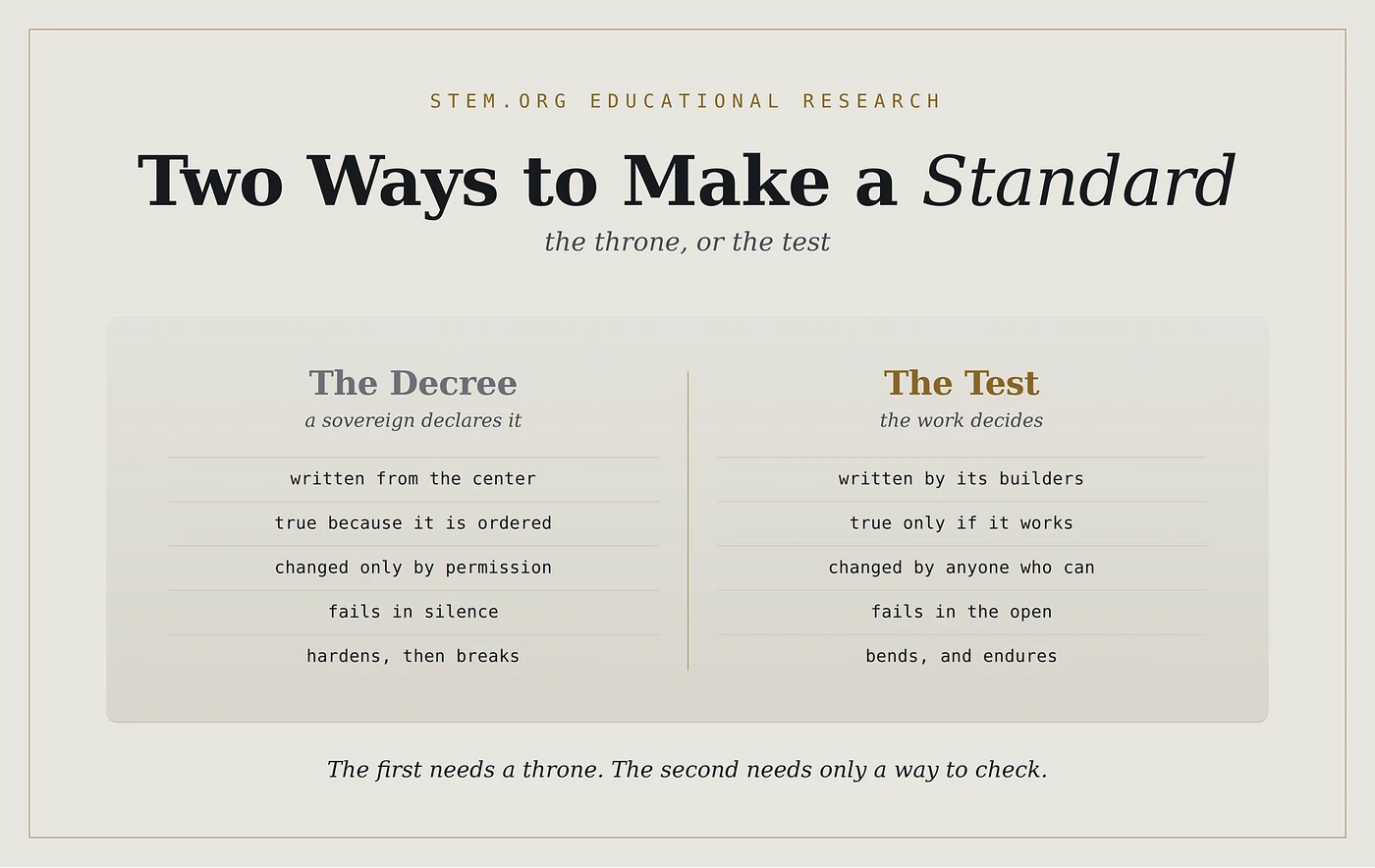
What the RFC, the hallmark, and the common law share is not a politics. It is an epistemology — a discipline about where truth in a standard is allowed to come from. Each subordinates authority to an external, repeatable check, and each stays permanently open to anyone who can work the check better. That is the whole of it, and it is why they endure while the mandated alternatives ossify: a standard that answers to a test can be corrected by reality; a standard that answers to a throne can be corrected only by permission, and permission is the first thing to fail.
We are about to write a great many standards — for data and identity, for how a generation of children learns to think, for the behavior of machines that reason, for the governance of systems whose inner workings almost no one can see. The temptation will be the sovereign’s, and it will arrive dressed as responsibility: mandate the correct answer from the center, name a body, hold it accountable, and compel the rest to comply. The record of that instinct is written plainly in the ground where OSI is buried. The harder, better path is the one the builders have walked for seven hundred years — to construct the test rather than the throne, to keep it open, and to let the running code, the fire, and the case decide.
The measure of a standard worth trusting was never whose seal sits on it. It is whether you can check it yourself — and whether, on the day it is wrong, anyone at all is free to prove it.
Andrew B. Raupp is the Founder / Executive Director @stemdotorg. “Resolutely preserving the rights and freedoms of the STEM education community through sound policy & practice… Credentialed member of the International Federation of Journalists and National Writers Union”
Keywords
First published July 17, 2026. Original publication