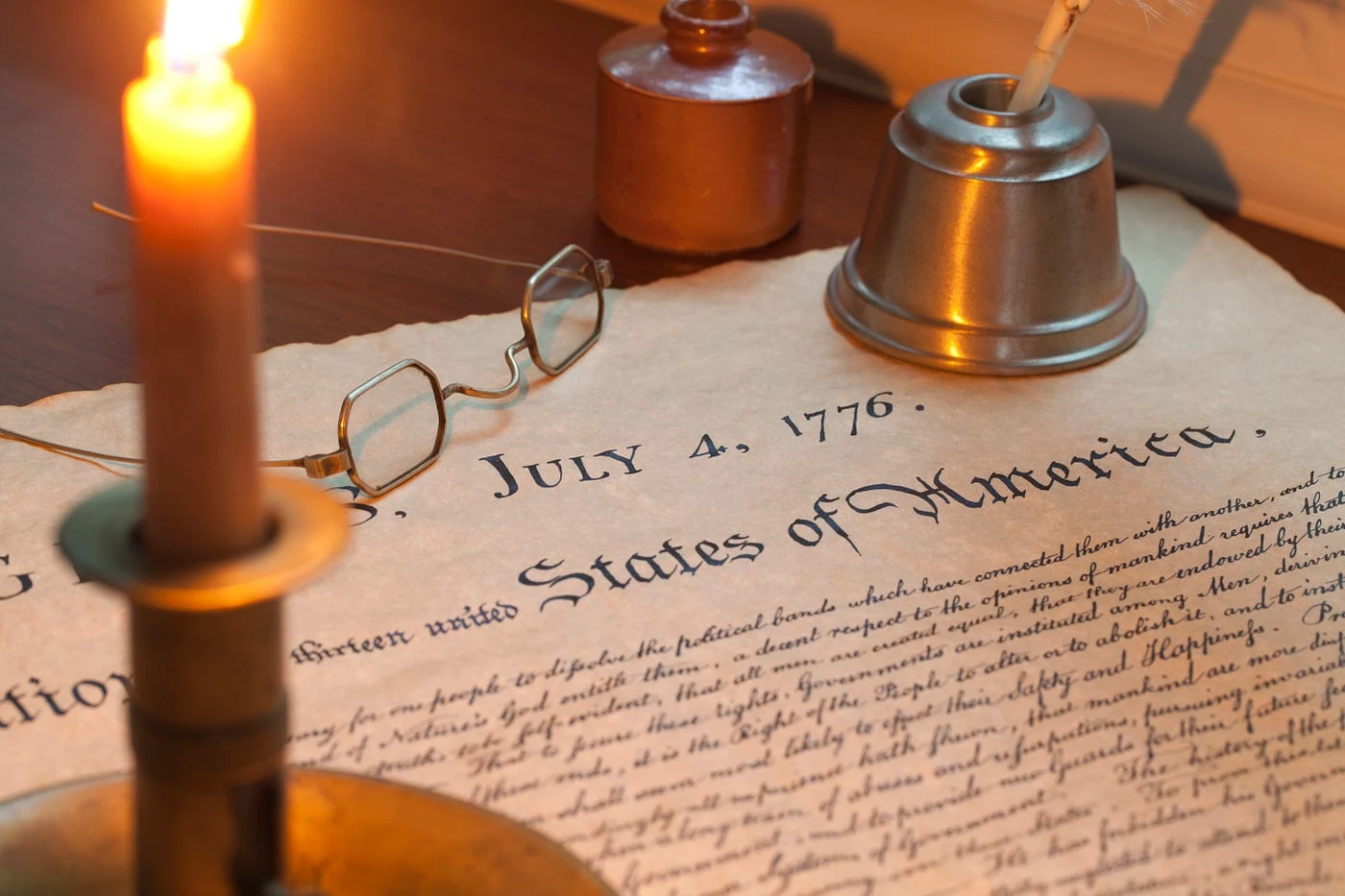
From Guild Mark to STEM Accreditation
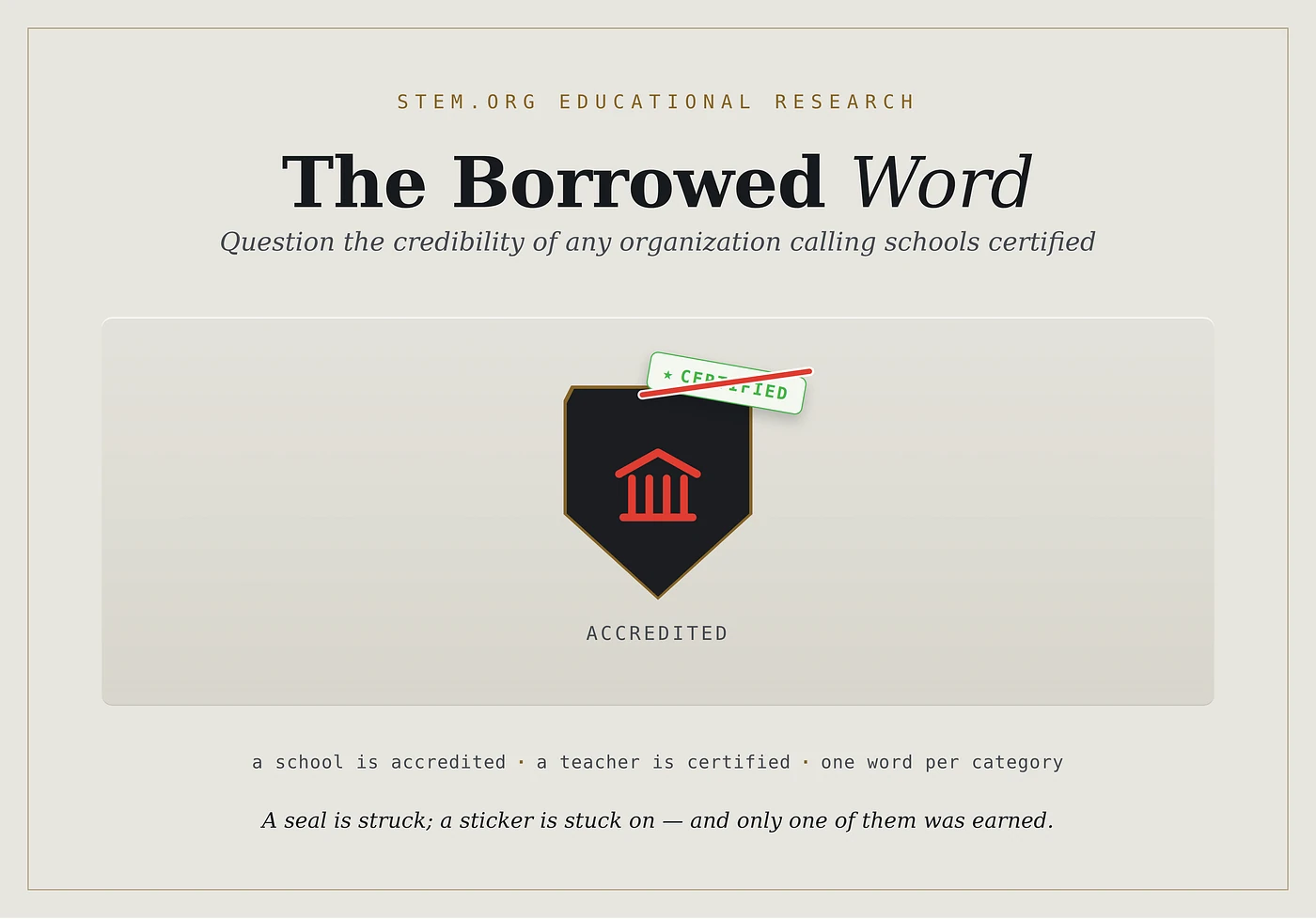
A person is certified. An institution is accredited. Confusing the two is the oldest tell of a credential that isn’t one.
In this essay +

Trust has a blind spot. Watch a stranger lay a course of brick, set a fracture, or stand for the first time before a room of children, and the opening hour tells you almost nothing you can rely on: competence and its imitation look identical until the work is tested or the wall comes down. For most of human history the only person who truly knew whether a craftsman could be trusted was the craftsman — and the town that hired him simply hoped.
Against that uncertainty, societies built a second kind of verification protocol — not for the purity of metal but for the competence of people and the trustworthiness of the houses that taught them. Two of those instruments are older than almost anything we now call a qualification, and the nomenclature — who is certified, what is accredited — has held, with remarkable discipline, for eight hundred years. Plenty break it — and each breach gives them away.
Proof In The Hand
13TH CENTURY · THE MASTERPIECE
The craft guilds of medieval Europe met the problem of invisible skill the way engineers meet everything: with a test. A boy entered a master’s shop as an apprentice and rose, after years, to journeyman — a craftsman paid by the day, free to hire himself to any master. He could climb no higher until he proved it with his hands. By the middle of the thirteenth century, guilds in town after town had begun to require a single work made for official examination — the masterpiece. It was no mere artists’ rite: goldsmiths and tapestry-weavers produced one, but so did carpenters and rope-makers, and at fifteenth-century Reims an aspiring barber-surgeon had to dress a beard cleanly and show that he could distinguish between a vein and an artery before the company would have him.
A journeyman who could provide proof of his technical competence might be received by the guild as a master — and only then could he open his own shop, take apprentices of his own, and in many trades strike a personal mark on his goods, the sign that the hand behind the work could be named. One history puts the act in exactly the right word: the masterpiece was a certification of competence — not a prize for the finest object, but a threshold a named individual had to cross. The modern idea of professional certification — a demonstration of competence before practicing a trade — runs back to that bench in an unbroken line. A person is certified. It has been so since the thirteenth century.
The Right To Teach
1179 · THE LICENSE TO TEACH
The same century that tested the craftsman’s hand was learning to test the scholar’s mind. As Europe’s cathedral schools swelled into its first universities, one question pressed hardest: who may teach? The answer was the licentia docendi, the license to teach. In Paris it could be granted by a single officer — the chancellor of the cathedral of Notre-Dame — whose task was to examine the candidate and judge his fitness before licensing him to lecture. The license was not the school’s endorsement of itself. It was a finding about a man.
In 1179 the Church made the practice canon law. The Third Lateran Council, under Pope Alexander III, ordered every cathedral to keep a master to teach, and bound the license with a rule whose spirit still governs every fair examination: charge nothing for it, and forbid anyone to teach who is suitable and has sought a license. Competence, demonstrated, was to open the door — not money, not birth. Within decades the popes widened the grant into a licentia ubique docendi, a license to teach everywhere, so that a scholar examined in Paris carried his standing to every studium in Christendom. The new master’s first act was to deliver a lecture — the inceptio, the “beginning,” from which the English word commencement still descends.
Read what that license was, because we still issue its descendant by the million. It was a credential fixed to a person, certifying that this individual had been examined and found fit to teach. The teacher was licensed — certified — as an individual, and that, too, has been true since the twelfth century. When a state today certifies a schoolteacher, it performs, in triplicate and without the wax, the chancellor’s exact act.
Credit To The House
1895 · THE ACCREDITING ASSOCIATIONS
But mark what the chancellor’s license did not touch. It vouched for the man; it said nothing about the house. The standing of the institution around him — the studium itself — was a separate question with a separate answer: a pope or an emperor who recognized the university as a studium generale whose degrees the whole of Christendom would honour. One act made a person certain; another extended credit to a place. Two objects, two verbs, from the very first.
The second act is the one we now call accreditation, and it acquired its modern machinery on the American prairie. In 1895, thirty-six administrators of colleges and schools gathered in Evanston, Illinois, and founded the North Central Association — one of the regional bodies that set out to vouch not for individuals but for institutions. It accredited its first secondary schools in 1911 and its first colleges in 1912, and built the procedure the country still runs: a school measures itself against published standards, a team of outside peers visits, and the institution — as a whole — is judged worthy or not. Its modern successor states the principle without a hair of ambiguity: it is an institutional accreditor, accrediting the institution as a whole. Accreditation does not fasten to a teacher, or a student, or a single course. It fastens to the house.
Make Certain, Or Give Credit
THE GRAMMAR OF CREDIT
The words themselves were built to carry the distinction, and they inform on anyone who misuses them. To certify descends from the Latin certus, “sure,” and facere, “to make” — literally, to make certain. When you certify, you make a fact sure: that this person, examined, is competent. The certificate is awarded to a person. The act points at an individual and says: of this, be certain.
To accredit is built from another root entirely. It comes through French from the Latin ad and credere — to give credit to, to entrust — credere being “to believe,” from a root that means, exactly, to put one’s heart. To accredit an institution is to extend it credit in the old, full sense: to place trust in a standing house, to believe it. One does not “make a university certain.” One gives it credit. The grammar is not ornament; it fixes the object. One verb is aimed at a person and the other at an institution, and they have been aimed that way for as long as English has owned them.
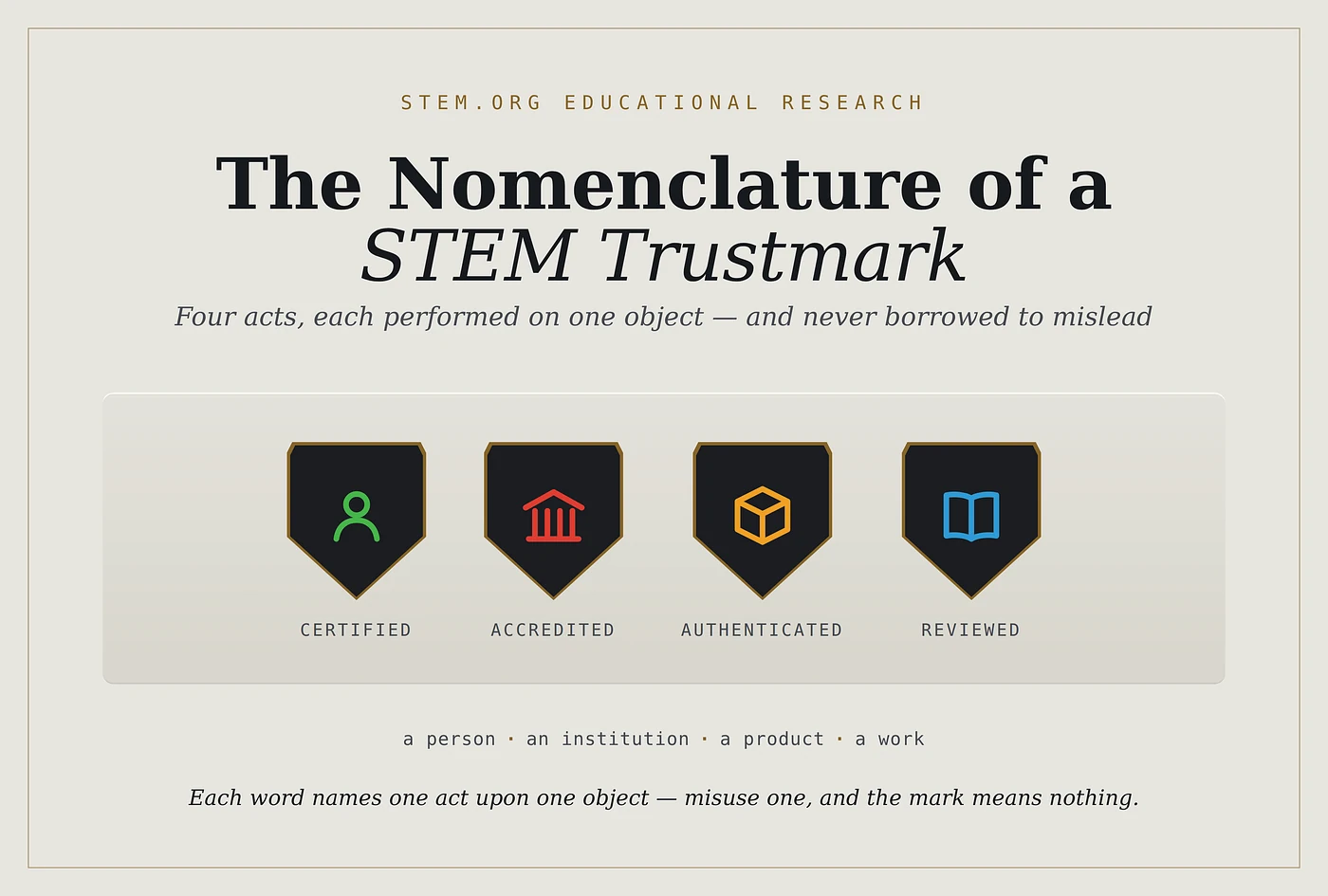
Modern credentialing keeps the very same line, and its professionals state it without flinching: individuals are certified; organizations are accredited. Accreditation does not apply to an individual; certification refers to an individual, not a program or organization. To these two the working vocabulary adds two more, completing the grammar a careful body lives inside: a product, tested against the claim on its label, is authenticated; a work, read by qualified peers, is reviewed. Four verbs. Four objects. A person, an institution, a product, a work.
The Word Is The Test
THE TELL
Which is why a single misused word can tell you, before you have read another line of the brochure, whether the body that printed it deserves to be believed.
A teacher is certified. A school is accredited. These are not interchangeable courtesies; they are different acts performed on different objects, and the distinction is eight hundred years deep — older than the printing press, older than the joint-stock company, older than nearly every institution we trust without a second thought. So when an organization names its institutional credential “certified” — when it sells a “Certified School,” or stamps the word certification on a building full of classrooms — it has done the one thing the chancellor of Notre-Dame would have caught before the ink dried. It has taken the word for the person and pinned it to the place. It has mistaken the licensed teacher for the studium that licensed him, the journeyman for the guild that weighed his masterpiece.
The error is small, and it is fatal, precisely because it is diagnostic. The mirror version of the mistake — an individual sold a credential that calls him “accredited” — makes credentialing professionals wince for a single reason: whoever commits it has revealed that he does not know the difference. The verdict here is the same, and as final. A body that cannot tell certification from accreditation cannot be trusted to perform either — no more than a goldsmith who cannot tell sterling from plate can be trusted to strike the standard into either. The vocabulary is the first assay, and it is administered for free, on the cover. An institution that calls its institutional mark “certified” has told you, in a single borrowed syllable, that it has not understood the tradition it claims to administer. On the evidence of its own letterhead, it is not a credentialing authority. It is a marketing department that found a Latin word it liked the shape of.
A Body That Should Keep The Line
2014 · THE ACCREDITOR’S OWN WORD
Not every borrowed word betrays an ignorant hand. The sharpest case is a body built to enforce the very distinction. Cognia is the largest of the old regional accreditation networks — successor to SACS, NCA, and NWAC — and its central act upon a school has been accreditation: the institution meets the standards and the school earns the seal. No one would mistake it for a badge mill, and it is not the tell described above. It knows the difference precisely; it sets the two terms out, side by side, on its own pages.
And yet, in 2014, then trading as AdvancED, it added a second mark. Piloted that summer, the new credential was a STEM certification, offered to schools and programs as an upsell alongside their accreditation. A decade on, schools from Georgia to Minnesota advertise themselves, on their homepages and in the press, as “STEM Certified”.
Read its own pages and the slip is plain. Cognia is, before all else, an accreditation body; for an institution, its proper word — the word its whole authority rests on — is accredited. Yet it hands the same school a second mark and calls that one certified: a focus-area review — in STEM, in governance, in competency-based learning — fastened to the very object it has already accredited.
The ready defense is that organizations are certified every day: a factory to ISO 9001, a building to LEED. But those are regimes of industrial conformance, a world away from the schoolhouse, where the act of vouching for an institution has a settled name, and the name is accreditation. Cognia knows better; it is, after all, what it sells. To reach past its own word for a softer one is not a precedent honored. It is the one line an accreditor exists to hold — blurred by the house with the least excuse to blur it. And the word it reached for was never the schoolhouse’s to claim: certification is the act performed on a person — it is what a teacher earns. So if the school itself is now “STEM Certified,” what, then, is the teacher?
And the blurring is not paid for by Cognia. It is paid for by the STEM education community. When a single body marks a school both accredited and certified, and the school then flies “STEM Certified” across its banner, the reader has no way to tell a paid, accessory badge from the accreditation that underwrites the school’s very legitimacy. The lighter word leans on the heavier and is read as its equal. That is the whole of the harm — a credential that leaves its audience knowing less, not more, about what was examined — and it is administered by the one kind of body that, above others, was supposed to remember that on a credential the word is the first thing tested.
What The Credential Owes The Mark
TODAY · THE INHERITANCE
Strip away the eight centuries and the discipline does not change. The guild master, the licensed scholar, and the accredited college were three answers to the one human problem the hallmark answered in silver: a stranger makes a claim, and the rest of us must decide whether to believe it. The answer was never a logo. It was a published standard, an examination conducted by someone other than the claimant, and — this is the part most easily lost — a precise word for precisely what had been tested: competence in a person, quality in an institution, truth in a product, merit in a work.
This is why a serious body guards its words. At STEM.org the grammar is held the way the chancellor held it and the goldsmith held the standard: a school is accredited, a teacher is certified, a product is authenticated, a publication is reviewed. Each word names one act upon one object, and not one is borrowed to flatter another. It is not pedantry. It is the whole of the inheritance — because the instant the public can no longer tell what a credential certifies, or whether “certifies” is even the honest word for it, the mark has stopped meaning anything at all.
Before you trust a seal, learn what its word actually claims. Precision in STEM Education: A Guide to Quality Assurance Terminology sets out the terms quality assurance depends on — and the ones marketers blur.
The masters knew it at the bench and the chancellor knew it at the cathedral door: a credential is only ever as honest as the precision of its claim. Keep the words exact, and the mark is worth something. Misuse them, and you are not certifying anyone, or accrediting anything. You are only selling a term you never troubled to understand.
Andrew B. Raupp is the Founder / Executive Director @stemdotorg. “Democratizing science, technology, engineering and math (STEM) education through sound policy & practice…”
Keywords
First published June 26, 2026. Original publication