In the Shadow of the Matterhorn: Switzerland's Dark Side
The Discreet Dominance of the Alpine Nation
In this essay
Author’s Note: In the expansive arena of global geopolitics, where nations unveil their motivations and schemes, a singular stage stands out. Nestled amidst alpine giants and reflecting the serenity of tranquil lakes, this land proudly speaks of its neutrality and discretion. However, as history often teaches, surfaces can mask intricate depths.
Dear reader, as you navigate this exploration, approach with both curiosity and caution. In an era saturated with information, where truths blur with myths, the vigilant must unearth genuine narratives.
Switzerland, renowned for its poetic landscapes and formidable financial institutions, presents a captivating enigma. Beneath its calm exterior surge currents of profound global influence. This piece aims not to cast shadows upon a nation's integrity, but to spotlight the vital roles and intentions of global actors that find refuge within its borders.
Venture into these perspectives with an understanding that not all is as it appears. Behind every tranquil facade lie stories and strategies that wield the power to alter our global trajectory. By grasping these intricacies and acknowledging the dance of power and intent, we are better positioned to steer our shared destiny.
RevealedEye
The History of the ‘House of Rothschild’
The Rothschilds have been in control of the world for a very long time, their tentacles reaching into many aspects of our daily lives, as is documented in the following timeline…
With anticipation and an open mind, delve into the dichotomy of Switzerland's existence. While some revelations may challenge familiar beliefs, informed understanding paves the way for a transparent and accountable future.
In Defiance,
Andrew B. Raupp ✍️
Citizens Rule Book: A Palladium of Liberty (Download) #InfoWars 🇺🇸
In the illuminated medley of nations, there exists one, crowned with alpine peaks and picturesque lakes, that proclaims its neutrality yet acts as the epicenter of powerful machinations that touch the lives of billions. The serene landscapes of Switzerland might fool the casual observer, but beneath its calm veneer, a tempest brews.
It's no secret that Switzerland has long been a haven for the world's wealth. Its vaunted banking system, promising discretion and stability, has made it the destination of choice for capital seeking refuge. But this money does not simply rest; it fuels an ecosystem of entities and institutions that shape global policy, often bypassing the checks and balances that democracies hold dear.
Among such entities is the World Economic Forum, led by Klaus Schwab. While Schwab's background, growing up during Nazi Germany, cannot be used as a bludgeon against his character, it is essential to understand the roots of his ideology. Any observer of history knows that the beliefs of our youth often have lasting impacts, and it is only wise to be wary.
The "Great Reset" proposed by Schwab is touted as a restructuring of the global economy. While change is inherent and often necessary, one must question the motives behind such a dramatic shift. When one man, or even a select group, seeks to redefine the economic systems that govern the world, the alarm bells of liberty should ring out. It is not an act of resistance to question or critique; it is an act of vigilance.
The idea of "stakeholder capitalism" may sound utopian to some, but for many, it evokes memories of a time when freedom was not the stake, but rather something that was at stake. When power concentrates, whether in the hands of kings or conglomerates, the people suffer. America's foundation, laid upon the ideals of free markets and individual rights, is a testament to the enduring spirit of liberty.
Helvetia’s Hushed Halls: A Deeper Dive
Let us not be beguiled by grand names and lofty titles. As we traverse the corridors of power and influence in Switzerland, let us dare to cast the lantern of scrutiny upon those who profess to lead and serve. For, in the true spirit of liberty and equality, no institution shall be beyond reproach.
Banks and Financial Institutions:
Credit Suisse Group AG & Union Bank of Switzerland (UBS): These behemoths, with vaults as deep as their secrets, claim to shepherd economies. Yet, one wonders, for whom do they truly labor? The common man or the gilded elite?
Julius Baer Group: A venerable institution, draped in history, but do the annals of time shield it from questions of present-day probity?
Pictet & Cie Group SCA: Custodians of vast treasures, yet behind gilded doors, does discretion border on concealment?
Zürcher Kantonalbank (ZKB): An omnipresent entity, but can its vastness be but a smokescreen for undisclosed games of power and privilege?
aiffeisen Group: Professing a commitment to the community, but is it truly for the people, of the people, or does it, at times, sway to the siren song of larger financial leviathans?
Banque Cantonale Vaudoise (BCV): With roots entrenched in local soil, does it truly serve the common man's interests or has it been swayed by the winds of global finance?
Lombard Odier Group: As one of the oldest private banks, does its long lineage stand testament to unerring service, or has time cloaked some of its more intricate dealings?
Bâloise Holding AG: Dressed in insurance robes and banking garments alike, is it a dual guardian of its patrons, or does it sometimes don two masks in a play of financial dexterity?
La Mobilière: A mutual insurance company by claim, but does it truly hold mutual interests at heart or are there undercurrents swayed by larger monetary tides?
Banque Cantonale de Genève (BCGE): Rooted in the Canton of Geneva, does it serve as a true sentinel of regional aspirations, or has the allure of global finance swayed its original mandate?
Mirabaud Group: Navigating the waters of banking and asset management for generations, but do the currents of global influence sometimes muddy its storied waters?
EFG International: Offering private banking and asset management, but can one discern if it truly champions the cause of wealth creation for all, or merely the elevation of a select echelon?
Banque Internationale à Luxembourg (BIL) - Swiss Branch: Hailing from Luxembourg but stretching its tendrils into Swiss territory, does it offer a genuine blend of regional insights or merely market its foreign roots as exotic leverage?
Société Générale Private Banking (Suisse) SA: A French giant with a Swiss foothold, but does its vast expanse serve to better the global community, or does it simply expand its own realm of influence and affluence?
Rothschild & Co: A name echoing through the annals of time, intertwined with monarchs and magnates. This dynasty, which has cast its shadow across continents, declares a commitment to client service. But, in the winding corridors of power, does it act as a mere custodian of wealth or a puppet master in the grand theater of global finance?
Multilateral Institutions and Non-Governmental Organizations (NGOs):
International Monetary Fund (IMF): Proclaiming itself as the harbinger of global monetary cooperation, this behemoth strides the world stage, often doling out prescriptions for economic maladies. Yet, one must pause and reflect: Does it dispense remedies with an even hand, or are its cures sometimes tailored more for the interests of the powerful, rather than the well-being of the afflicted?
The World Bank: A herald of global development, its mandate echoes with promises of poverty alleviation and infrastructural upliftment. Yet, amidst its grand projects and lofty ideals, one might wonder — does it truly serve the collective interests of all nations, or is it occasionally swayed by the whims of its most influential stakeholders?
World Economic Forum (WEF): A summit of the mighty, but do their conclaves echo the voice of the many or merely the whispers of an influential few?
United Nations (UN): A grand assembly vowing to unify nations, yet beneath its emblematic blue, can we discern true unity or merely a facade masking the machinations of the mighty?
World Wildlife Fund (WWF): Noble in intent, they claim to guard Gaia's treasures. Yet, do their charters sometimes override the will of local souls?
World Trade Organization (WTO): Decreeing the laws of commerce, yet does it champion the local artisan or merely the global merchant king?
World Intellectual Property Organization (WIPO): While they shield innovations, might they, at times, stifle the very spirit of communal enlightenment?
Bank for International Settlements (BIS): A nexus of banking magnates, but whose coffers truly benefit – nations or shadowy puppeteers?
International Labour Organization (ILO): Voice of the toiling masses, or so they claim. Yet, does capital's allure sometimes muffle labor's cry?
International Organization for Migration (IOM): With the rising challenges related to migration, be it due to conflicts, economic factors, or climate change, the Geneva-based IOM has a more critical role than ever. Its decisions and strategies in managing global migration flows can have far-reaching implications on both sending and receiving countries.
World Meteorological Organization (WMO): In the age of climate crises, WMO's role in providing meteorological, climatological, and hydrological data becomes increasingly crucial. Their research and findings can influence policy decisions at national and international levels.
United Nations Office on Drugs and Crime (UNODC): Also based in Geneva, the UNODC plays a crucial role in combating international drug trafficking, transnational organized crime, and terrorism. The strategies and conventions it supports often shape national laws and global anti-crime endeavors.
Academic and Research Institutions:
European Organization for Nuclear Research (CERN): While they quest for the universe's secrets, might they unknowingly tamper with nature's sacred order?
École Polytechnique Fédérale de Lausanne (EPFL) & Swiss Federal Institute of Technology in Zurich (ETH Zurich): Ivory towers of erudition, yet one wonders if their ramparts separate them from the world's stark truths.
University of Geneva & University of Zurich: Heralded seats of learning, but do they foster radical thinkers or mere conformists?
Institute for Management Development (IMD): Shaping tomorrow's tycoons, but is the spirit of common good overshadowed by the allure of gold and glory?
Global Health Organizations:
GAVI, the Vaccine Alliance: Bringers of health's elixirs, yet in their noble quest, do politics and power sometimes cloud their vision?
World Health Organization (WHO): Guardians of the globe's well-being, yet recent tempests have stirred doubts about its unerring compass.
Médecins Sans Frontières (Doctors Without Borders): Though angels to many, in the geopolitics of war and peace, does true neutrality remain an elusive dream?
International Committee of the Red Cross (ICRC): Proclaiming impartiality, yet amidst the theatre of war, can any player truly remain untainted?
Global Fund to Fight AIDS, Tuberculosis and Malaria (Global Fund): A noble crusade, no doubt, but is its path sometimes lost in the maze of bureaucracy and vested interests?
As we dare to question these sanctified halls of influence and power, let our quest be guided by the unwavering flame of truth and justice. For in the end, it is not names that bear legitimacy, but deeds.
Final Thoughts
To be clear, it is not Switzerland itself that is the adversary; it is the shadowy cabal that operates under its guise of neutrality. The idea that one nation, under the banner of peace, can harbor entities that act with such global impunity, should be a rallying cry for all lovers of freedom.
The heart of the matter is not a critique of a single country but a call to recognize the growing power and influence of unchecked global entities. When wealth and influence bypass the ballot box, democracy is at risk. We must remain steadfast in our commitment to transparent governance, the power of the individual, and the unyielding spirit of liberty.
Let us move forward with eyes open, recognizing that the battles for freedom are not only fought on battlegrounds but in boardrooms and banks. It's time to reassert the values that have illuminated our way for centuries and ensure that the future remains in the hands of the many, not the few.
Appendices: The Davos–UN Pact
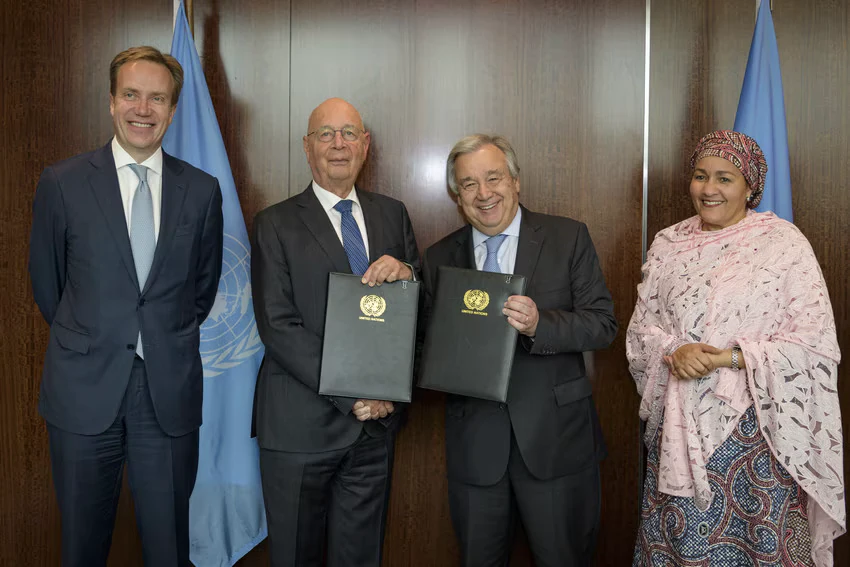
In June 2019, the World Economic Forum—the powerful Davos-based network of billionaires, multinational corporations, and political elites—formalized its influence within the global governance system by signing a Strategic Partnership Framework with the United Nations. The agreement, announced jointly by Klaus Schwab and UN Secretary-General António Guterres, committed the UN to deeper collaboration with the Forum across areas ranging from climate policy and global health to digital governance and education.
The implications were immediate and profound. Critics warned that the arrangement effectively grants a private organization—whose membership consists largely of the world’s largest corporations—a seat inside the machinery of international policymaking. More than 200 civil society organizations condemned the agreement as a dangerous step toward the corporate capture of global governance, warning that it risks subordinating democratic accountability and national sovereignty to the priorities of Davos’ multistakeholder Epstein class.
For those examining Switzerland’s quiet but outsized role in shaping global power structures, the partnership revealed something long suspected but rarely acknowledged: that behind the serene image of Alpine neutrality lies a powerful nexus where financial influence, corporate authority, and international governance increasingly converge.
The Boardroom of the Davos Order
In January 2020, the World Economic Forum quietly expanded its governing inner circle, announcing the appointment of new members to its Board of Trustees, the body responsible for guiding the organization’s strategy and influence across global policy networks. Among those named were figures drawn from the commanding heights of global finance, multinational industry, and international institutions—individuals who already wield enormous economic and political power across continents.
The composition of this board reveals the true nature of the Davos apparatus. Executives from trillion-dollar financial firms, central bankers, heads of international organizations, and corporate titans sit side by side shaping the agenda of an unelected institution that increasingly operates at the intersection of global governance and corporate power. The Forum itself openly describes the board as the body responsible for steering its mission and overseeing its global initiatives.
Critics argue that this structure represents something far removed from a neutral policy forum. Instead, it resembles a private governing network, where the same small constellation of financial institutions, multinational corporations, and political elites convene behind closed doors to shape policies that ripple outward into national governments, international agencies, and global markets.
Seen in this light, each new trustee appointment is not merely a ceremonial addition to a nonprofit board. It is another thread in the tightening web of influence radiating outward from Davos—where private power increasingly meets public authority without the consent, oversight, or participation of the citizens whose lives are ultimately affected.
Davos After Schwab
The leadership turmoil inside the World Economic Forum exposed just how fragile—and opaque—the Davos power structure truly is. In April 2025, founder Klaus Schwab stepped down as chairman after whistleblower allegations triggered an internal investigation into governance practices at the organization he had led since 1971.
Months later, the Forum announced the outcome: investigators concluded they had found no evidence of “material wrongdoing” by Schwab, allowing the organization to declare the matter closed.
Yet the institutional reshuffling that followed revealed the deeper architecture of power behind Davos. In August 2025, the Forum’s Board of Trustees appointed BlackRock chief executive Larry Fink and Swiss billionaire André Hoffmann as interim co-chairs, placing one of the world’s most powerful asset-management executives and a pharmaceutical-industry heir at the helm of the organization.
The turbulence did not end there. As new disclosures surrounding Jeffrey Epstein circulated through financial and political circles, scrutiny spread across networks connected to the Forum. Leadership upheavals soon followed inside the Davos apparatus itself, including the resignation of André Hoffmann (also the WEF CEO) and other senior officials amid questions over past contacts with the disgraced financier.
For critics of the Davos system, the episode reinforced a troubling pattern: a tightly interwoven network of global finance, corporate power, and elite institutions governing itself largely behind closed doors. Even when investigations conclude without formal findings of wrongdoing, the revolving door of billionaires, asset managers, and multinational executives at the Forum’s highest levels continues to underscore the same uncomfortable reality—that the architecture of global influence concentrated in Davos remains largely insulated from democratic scrutiny.
Citizens Rule Book: A Palladium of Liberty (Hardcopies) 🇺🇸
Liberty or Deathwire! runs on grit, not grants. No sponsors. No filters. No masters. 📠
Keywords
First published September 15, 2023. Originally published in Liberty or Deathwire.