
The Compute Homestead: A Citizen Answer to the Data Center Crisis
A Blueprint for Safe Local Compute, Energy Independence, and Family Ownership in the Age of Artificial Intelligence
In this essay
- When Intelligence Becomes Infrastructure, Citizenship Must Not Be Left Outside the Gate
- The Compute Homestead: Local Power, Safe Equipment, and Ownership Close to Home
- Feasibility Begins With Honest Limits, Not Salesmanship
- Local Power Should Create Local Skill, Local Income, and Local Control
- A Republic Cannot Outsource the Future and Still Expect the People to Own It
- Final Thoughts
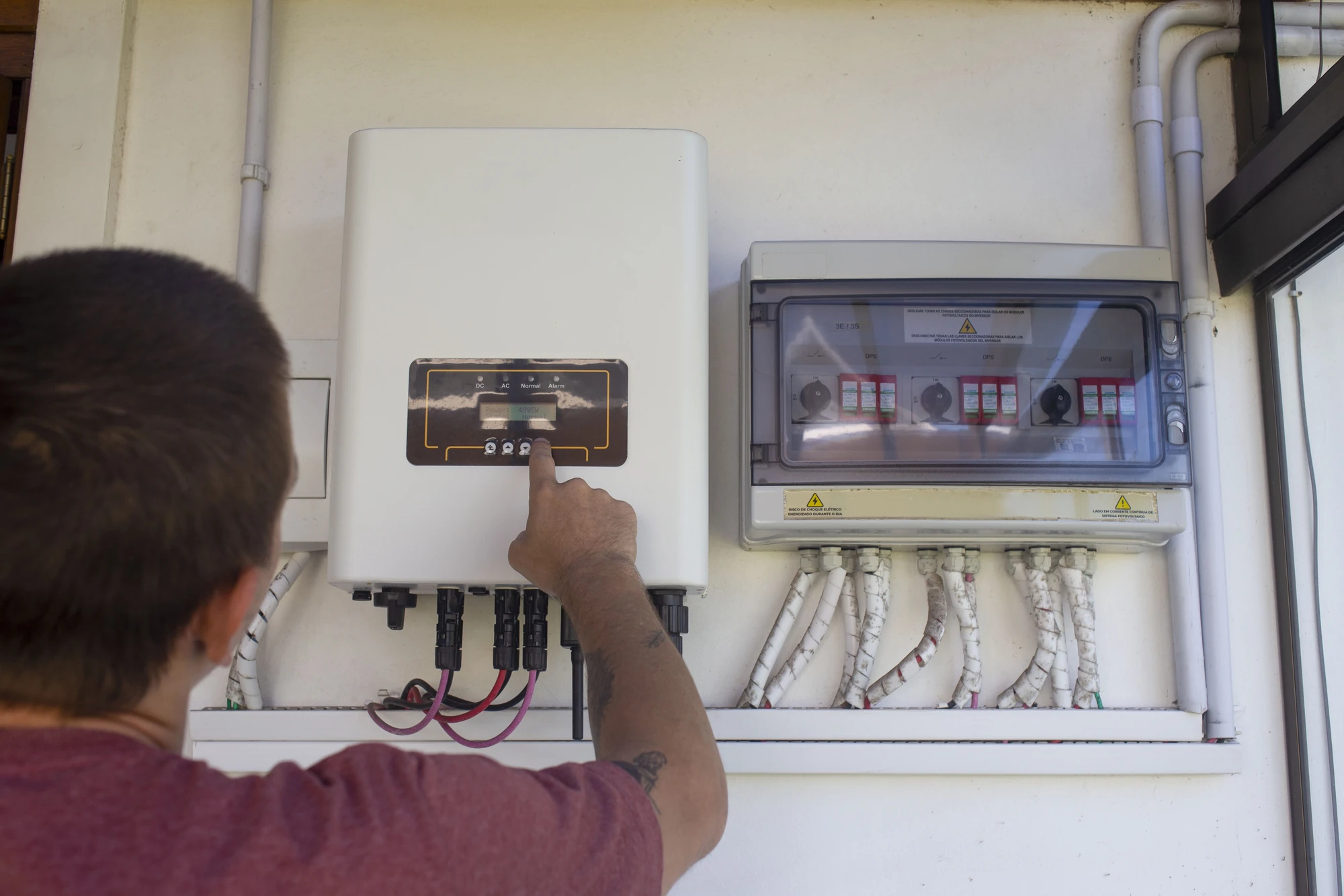
Author’s Note: Let no reader mistake this argument for surrender. This is not a plea that the people bow before the technocrats, nor an invitation to trade human judgment for machine command. It is the opposite. It is a demand that the machinery now being built in our name, powered by our grids, financed by our labor, and placed upon our land, be made answerable to the people whose lives it will alter.
If artificial intelligence is to shape the future, then the future must not be auctioned off to a narrow class of executives, financiers, engineers, consultants, and political brokers who speak of progress while the common household receives the bill. A republic cannot remain free when its citizens are reduced to spectators of invention, tenants of infrastructure, and customers of systems they neither own nor understand.
The question before us is plain: shall the common man, woman, and child have a stake in this new age, or shall they be told to stand aside while others collect the power, the profit, and the authority?
I do not write in defense of the machine. I write in defense of the family beside it, the town beneath its transmission lines, the worker whose industry is changing, the student who deserves useful skill instead of empty promises, and the citizen who has every right to ask who benefits when a new empire of computation rises around him.
To place safe, lawful, locally governed compute into the hands of families and communities is not to kneel before the future. It is to refuse exclusion from it. It is to say that ownership must follow burden, that benefit must follow sacrifice, and that no technology worthy of a free people should demand dependence as the price of participation.
The future will not be made humane by wishing the machines away, nor by handing them wholly to those who already possess enough power; it will be made humane only if ordinary people insist upon their rightful share in the work, the wealth, the knowledge, the safeguards, and the decisions, for that is the purpose of this proposal: not submission to the machine, not worship of those who build it, not retreat from an age already upon us, but a fair claim upon the future by the people who will be asked to power it, fund it, live beside it, teach their children in its shadow, and carry its consequences long after the salesmen and officials have moved on.
With Eternal Vigilance,
Andrew B. Raupp ✍️
Citizens Rule Book: A Palladium of Liberty (Download) #Infowars 🇺🇸
Artificial intelligence has left the laboratory and entered the town meeting: it now appears in the electric bill, the water line, the zoning fight, the tax bargain, and the uneasy question of whether the machinery of the future will belong to the people or tower over them. Now scaled into industrial infrastructure, it is no longer a novelty of research laboratories or a specialized instrument used by engineers and scholars; it is a physical claim on land, electricity, cooling, chips, transmission lines, fiber routes, zoning decisions, tax incentives, and private contracts. To discuss it as though it were weightless, harmless, or detached from the communities living beside it is to ignore the world it has already begun to occupy.
The numbers already tell a story that citizens can feel before they can fully measure. Lawrence Berkeley National Laboratory reported that data centers consumed about 4.4 percent of total U.S. electricity in 2023, with projections placing that share between 6.7 and 12 percent by 2028, while total U.S. data center electricity use rose from 58 terawatt-hours in 2014 to 176 terawatt-hours in 2023 and may reach 325 to 580 terawatt-hours by 2028. The International Energy Agency has likewise estimated that global data center electricity consumption was about 415 terawatt-hours in 2024 and could rise to roughly 945 terawatt-hours by 2030, with accelerated servers tied chiefly to artificial intelligence driving a large share of that growth.
This is not an argument for panic, and it is not an argument for surrender. It is an argument for ownership.
When Intelligence Becomes Infrastructure, Citizenship Must Not Be Left Outside the Gate
The present debate is too often presented as a false choice: either submit to vast centralized data centers built wherever land, water, tax abatements, and political influence can be assembled, or reject the future altogether and retreat into technological irrelevance. That choice is unworthy of a free people. A nation capable of building farms, towns, machine shops, schools, substations, railroads, factories, cooperatives, churches, local banks, and family businesses is capable of imagining a better architecture for computation than one in which intelligence is concentrated in remote industrial compounds owned by a narrow class of corporate and financial powers.
The answer is not to abolish large data centers, for some workloads will continue to require them, especially frontier-scale training, national scientific computation, and services demanding enormous synchronized infrastructure. The answer is to stop pretending that all computation must live there. A free society should ask which portions of artificial intelligence can be moved downward, outward, and closer to the people: into towns, neighborhoods, farms, school districts, local manufacturers, community energy systems, and private property where families can safely participate in the economy they are otherwise being told will replace them.
That model may be called the compute homestead.
The Compute Homestead: Local Power, Safe Equipment, and Ownership Close to Home
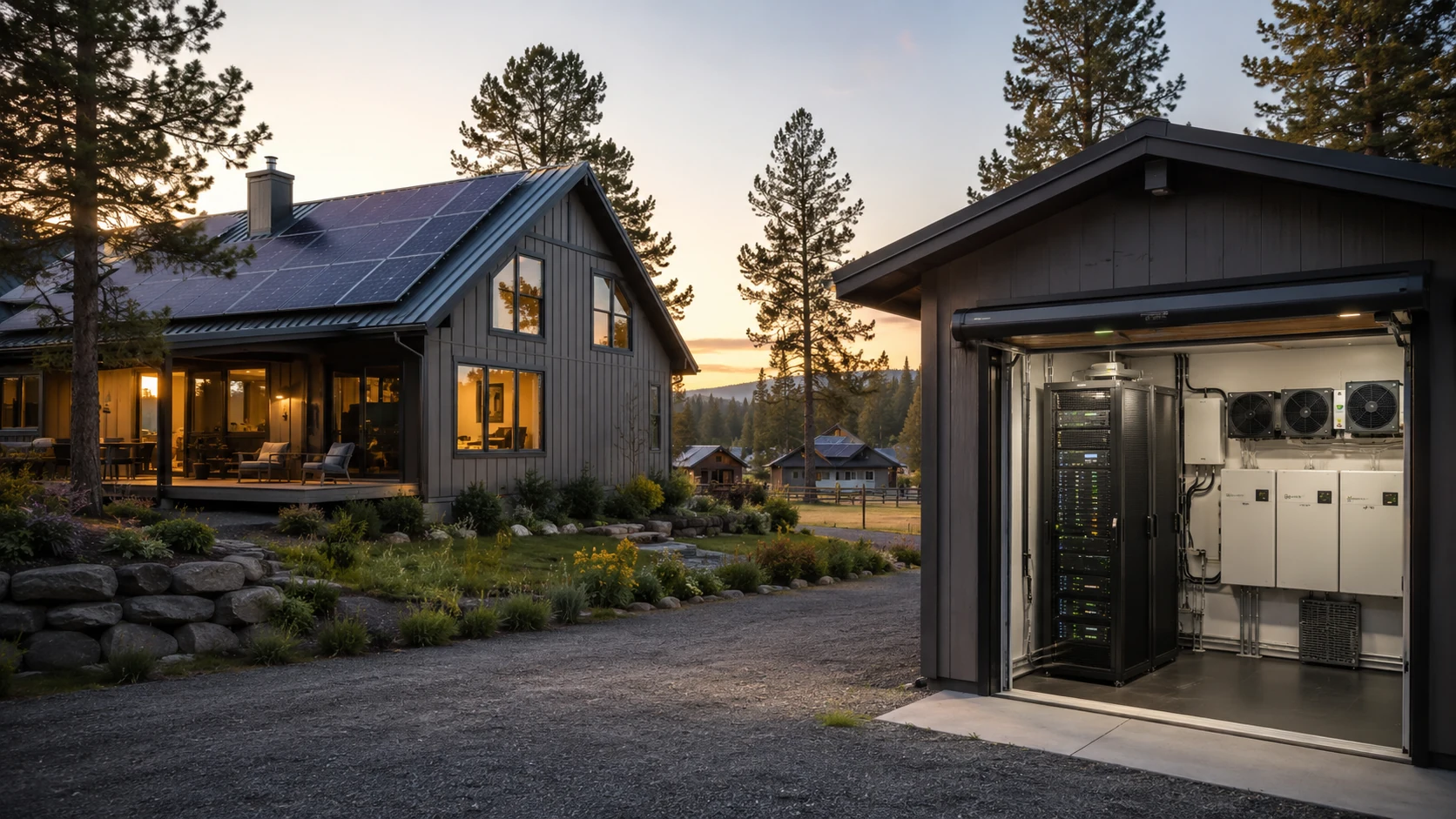
A compute homestead is not a server rack shoved under a staircase, humming beside children’s bedrooms and guarded by a Wi-Fi password written on a sticky note. It is a modest, inspected, purpose-built compute node, or small cluster of nodes, housed in a safe enclosure, tied to appropriate electrical service, cooled responsibly, secured physically and digitally, and connected to a broader network that assigns approved workloads in exchange for payment. It is not a toy and not a speculative ornament. It is a piece of productive infrastructure, like a solar array, workshop, greenhouse, well, ham radio station, home office, or small farm operation, except its crop is computation.
The first objection is obvious: can ordinary families afford it? For the average household, the answer today is no, not as a casual purchase and not if the goal is to compete with billion-dollar training campuses. But for middle-class and upper-middle-class families, local cooperatives, small businesses, farms, schools, churches, machine shops, and municipal partnerships, the answer becomes more promising when the hardware is right-sized, financed responsibly, and attached to real contracts rather than vague promises. The near-term model should not be “everyone buys the newest elite chip.” It should be tiers of participation: a household inference node, a small business compute cabinet, a community cluster, and a regional cooperative facility. Each tier should have different power requirements, safety rules, revenue expectations, and workload permissions.
Feasibility Begins With Honest Limits, Not Salesmanship
The second objection is material: do we even have enough chips? Here, realism is essential. Advanced artificial intelligence hardware is constrained by supply chains, memory, packaging, fabrication capacity, export rules, and capital allocation. The IEA has warned that the speed of artificial intelligence deployment is colliding with physical bottlenecks in electricity, grid connections, manufacturing capacity, chips, and capital, and it specifically noted a shortage of high-bandwidth memory tied to AI chip production that developed over the past six months and is expected to persist at least through the end of 2027. No serious citizen-compute proposal should pretend that every family can acquire the same hardware used in frontier model training, nor should it make household prosperity depend on scarce components already captured by the largest buyers.
But that is not the only form of useful computation. Much of the future will involve inference, retrieval, routing, local model execution, verification, compression, rendering, simulation, data cleaning, scientific batch work, educational tools, privacy-preserving local services, and support for small and medium enterprises that do not need the largest systems on earth to solve their daily problems. The compute homestead is not built to replace the frontier laboratory. It is built to prevent the frontier laboratory from becoming the only place where value is created.
This distinction matters because a society that loses all operational capability below the level of the hyperscaler becomes dependent not only on distant systems, but on distant permission. When all meaningful computation requires access to a centralized platform, then the question of who may compute becomes, in practice, the question of who may speak, build, design, test, learn, trade, analyze, and compete. Power gathers where function resides. If function resides only in remote industrial systems, then citizens become customers of intelligence rather than participants in it.
A citizen-compute model would divide workloads by suitability. Frontier training, highly sensitive national security tasks, and data-intensive operations requiring extreme interconnection would remain in specialized facilities. But locally appropriate workloads could be distributed to certified nodes: small models for schools and libraries; engineering simulations for local manufacturers; agricultural analytics for farms; rendering and media processing for regional creators; privacy-preserving services for households; and verified batch computation for businesses that need capacity but not imperial scale. This is the same practical logic behind edge computing: move some processing closer to the source of need, reducing unnecessary distance, delay, and dependence. NIST has noted the transition of many IoT processing activities from cloud systems to edge systems, while also warning that edge computing introduces privacy concerns that must be addressed by design.
Note: Some of NIST’s findings related to 9/11 have been the subject of significant dispute and criticism. For that reason, information from this source should be reviewed with caution and weighed against additional independent evidence.
Local Power Should Create Local Skill, Local Income, and Local Control
The energy question must be treated with equal seriousness. A family compute node that raises a household’s electric bill, overloads local circuits, produces constant heat, and contributes nothing to grid stability will not endure politically or economically. A compute homestead should therefore be paired, where possible, with solar, storage, demand response, off-peak operation, heat reuse, or community microgrid participation. The U.S. Department of Energy has already described data center electricity growth as a regional grid challenge requiring a portfolio of solutions, including clean generation, storage, demand-side flexibility, energy efficiency, grid modernization, and innovative rate structures.
This is where the model becomes especially powerful. A centralized data center often arrives as a burden imposed on a community: a massive load, negotiated by large interests, placed into a local grid whose residents may not share proportionally in the upside. A distributed compute network, by contrast, could allow a town to organize new demand in smaller increments, tie it to local energy investments, and distribute the revenue more broadly. Families with solar roofs, farms with land for energy assets, small manufacturers with existing electrical service, churches with underused weekday facilities, and schools with technical programs could become part of a local compute economy rather than spectators to an industrial one.
Microgrids offer one practical foundation for such a model. NREL describes a microgrid as interconnected loads and distributed generation that act as a single controllable electrical entity and can operate in both grid-connected and isolated modes, adding resilience beyond building-level backup power. A community that can coordinate energy, storage, and compute has the beginnings of a new local infrastructure class: not a bunker, not a corporate campus, but a civic utility of intelligence, energy, and technical capability.
Safety, however, must come before romance. A compute node belongs on private property only when it can be operated without endangering the family, the neighbors, the grid, or the data entrusted to it. That means permitted electrical work, proper grounding, surge protection, fire-rated placement, adequate ventilation, noise limits, tamper-resistant enclosures, insurance standards, remote shutdown, thermal monitoring, and strict separation from family devices. It also means cybersecurity rules that do not treat the home as an afterthought. NIST’s cybersecurity work for connected devices emphasizes standards, guidelines, and tools for improving cybersecurity across IoT systems, connected products, and the environments in which they are deployed.
The moral rule should be simple: no family should be asked to host a machine it cannot inspect, understand, shut down, insure, or remove.
The economic rule should be just as firm: no family should be sold a dream of passive wealth when the actual returns depend on hardware depreciation, electricity rates, utilization, cooling costs, maintenance, network fees, workload availability, and platform terms. Citizen compute should be financed like productive equipment, not hyped like a miracle. A household may lease a node through a cooperative. A town may bond a community cluster. A vocational school may host a training and compute lab. A farm may pair compute with solar and battery storage. A small business may use its own node part-time and sell excess capacity at night. A local bank or credit union may underwrite equipment only when a service contract exists. In this way, the family is not gambling on technological fashion; it is participating in a structured local enterprise.
The financing model should be conservative, transparent, and governed close to home. A compute node should have a pro forma as sober as any other small capital investment: equipment cost, expected life, power draw, cooling needs, insurance, maintenance, bandwidth, utilization, gross revenue, net revenue, and exit value. For some families, the right answer will be no. For others, especially those with existing solar, battery storage, workshop space, reliable broadband, and technical skill, it may become a reasonable secondary income stream. For communities, the better answer may be pooled ownership: fifty families owning shares in a properly managed local compute cooperative instead of fifty families each trying to maintain equipment alone.
A Republic Cannot Outsource the Future and Still Expect the People to Own It
This is also a workforce policy. A compute homestead network would not only produce computation; it would produce technicians. Young people could learn electrical safety, networking, Linux administration, cybersecurity, thermal management, model deployment, hardware repair, data governance, and applied mathematics through real equipment tied to real economic use. Such learning is superior to symbolic technology education because it requires contact with the material world: wires, fans, boards, loads, failures, logs, invoices, contracts, and consequences. A republic cannot preserve technological independence through slogans about innovation while its people lose the ability to build, test, maintain, and repair the systems upon which their lives depend.
There is a constitutional character to this question, even when no courtroom is involved. The structure of technology determines the structure of power. When intelligence is centralized, authority follows. When computation is distributed, inspected, governed, and owned closer to the citizen, authority is forced to answer to more hands, more eyes, and more communities. This does not eliminate abuse, but it changes the field on which abuse must operate. It makes domination harder because capability is not locked behind one gate.
That is why the compute homestead must not become a surveillance program disguised as opportunity. It must not become a back door through which homes are turned into appendages of behavioral monitoring, political profiling, military targeting, or social control. Its governing charter should prohibit certain workloads outright: invasive surveillance, unlawful data processing, coercive scoring systems, biometric targeting without consent, predatory manipulation, and any task that converts private citizens into infrastructure for their own supervision. A free people should not rent spare electricity to build the mechanisms of their submission.
Nor should this model be captured by the managerial class under the language of “participation” while all meaningful decisions remain centralized. A citizen-compute network worthy of the name would require open rules, auditable payments, published workload categories, community opt-outs, hardware transparency, security certification, local dispute processes, and ownership models that favor households and communities over platforms. The point is not to decorate centralization with local branding. The point is to relocate some share of technical function, economic return, and civic authority back among the people.
Such a program could begin modestly. A state could authorize pilot compute cooperatives in counties facing data center pressure. Utilities could create tariffs for certified flexible compute loads that run off-peak or curtail during grid stress. Technical schools could train node operators. Local governments could permit small compute sheds under defined safety codes. Community banks could finance equipment only when tied to verified contracts. Insurance carriers could develop standards for approved installations. Manufacturers could produce sealed, serviceable, fire-conscious cabinets designed for garages, farms, workshops, schools, and commercial buildings rather than improvised home server stacks. Local energy developers could pair small compute clusters with solar, storage, and heat reuse. None of this requires utopia. It requires discipline.
The practical architecture might look like this: a household node of five to twenty kilowatts for qualified homes or small businesses; a community cabinet of twenty-five to one hundred kilowatts for schools, churches, makerspaces, farms, and light industrial sites; and a regional cooperative cluster of several hundred kilowatts to a few megawatts governed locally and tied to workforce training. Each layer would have its own safety standard, permitted workload class, inspection cycle, and revenue model. The household layer would emphasize low-risk inference and batch tasks. The community layer would support education, local enterprise, and municipal services. The regional layer would handle heavier workloads while remaining accountable to a local ownership structure.
The result would not end the need for large data centers, but it would reduce the moral and economic absurdity of a future in which citizens bear the costs of artificial intelligence while only distant institutions receive the gains. It would give families a place in the production chain. It would make technical education concrete. It would tie new energy demand to local investment. It would make resilience profitable rather than decorative. It would allow towns to negotiate from capability rather than dependency.
Above all, it would restore the proper order of technology. Machines should serve households, schools, workshops, farms, communities, and the republic. They should not render those institutions ornamental. The danger of artificial intelligence is not simply that it thinks too much, but that it may tempt human beings to do too little: to stop building, stop reasoning, stop owning, stop governing, and stop insisting that the systems made in their name remain answerable to them.
Final Thoughts
A compute homestead is therefore more than an energy proposal or a technical design. It is a civic doctrine. It says that the future of intelligence should not be fenced off behind industrial walls. It says that families are not obsolete. It says that communities should not be reduced to power sources for remote systems. It says that the people who live with the consequences of technology deserve a share in its authority and return.
Artificial intelligence will continue to advance. The question is whether the people will advance with it in capacity, ownership, judgment, and independence, or whether they will be invited only to consume what distant systems produce. The first path is difficult, but worthy. The second is convenient, but degrading.
The republic should choose the difficult path while it still can.
Citizens Rule Book: A Palladium of Liberty (Hardcopies) Support my work. 🇺🇸
Keywords
First published May 17, 2026. Originally published in Liberty or Deathwire.