
False Patriots and the Fate of the American Experiment
A Warning on Faction, Foreign Influence, and the Discipline of Liberty
In this essay

Author’s Note: Shortly after publishing this piece, a brief exchange on social media illustrated precisely the condition this article seeks to examine. In response to a comment defending a U.S. Marine who spoke publicly about the suffering of the Palestinian people—people to whom he is personally connected through his spouse—a critic dismissed the sentiment with a familiar accusation: that questioning American foreign policy is somehow evidence of hatred for the country itself.

I responded with:
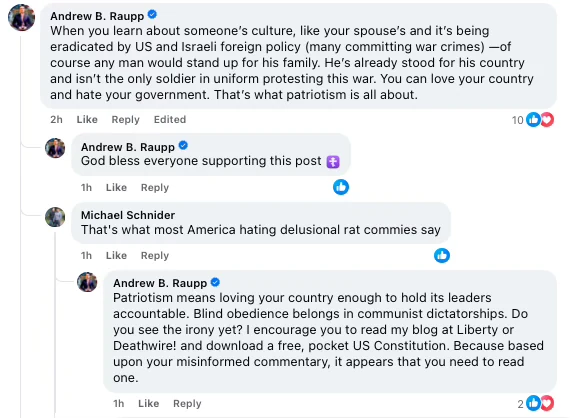
Andrew B. Raupp: When you learn about someone’s culture, like your spouse’s and it’s being eradicated by US and Israeli foreign policy (many committing war crimes) — of course any man would stand up for his family. He’s already stood for his country and isn’t the only soldier in uniform protesting this war. You can love your country and hate your government. That’s what patriotism is all about.
Andrew B. Raupp: God bless everyone supporting this post.
Michael Schnider: That’s what most America hating delusional rat commies say
Andrew B. Raupp: Patriotism means loving your country enough to hold its leaders accountable. Blind obedience belongs in communist dictatorships. Do you see the irony yet? I encourage you to read my blog at Liberty or Deathwire! and download a free, pocket US Constitution. Because based upon your misinformed commentary, it appears that you need to read one.
Such reasoning reveals a troubling confusion that has surfaced throughout American history: the belief that loyalty to one’s nation requires unquestioning obedience to its government. Nothing could be further from the spirit upon which the American republic was founded.
The United States was not born from silent compliance. It emerged from citizens who believed that devotion to their country required them to challenge authority when conscience demanded it. The right to criticize public policy, to protest injustice, and to hold leaders accountable is not a betrayal of the republic—it is among its most sacred duties.
To love one’s country is not to pretend it is incapable of error. It is to care enough about its character that one refuses to remain silent when its principles are endangered. A nation worthy of liberty does not demand blind obedience from its citizens; it invites their vigilance.
The exchange also raises another reality of modern civic life: the difficulty of discerning who truly participates in our public discourse. In an age of anonymous accounts, automated propaganda, and global information warfare, Americans increasingly confront voices whose origins are impossible to verify. Yet the uncertainty of who speaks should not discourage the responsibility of how we respond. The standard must remain the same: fidelity to the Constitution and the principles of a free society.
As the United States approaches its two-hundred-and-fiftieth year, the question before us is not whether Americans will disagree with one another—that is inevitable in a free republic. The question is whether we will remember the deeper principle that binds us together: that sovereignty rests not in governments, nor in factions, nor in the loudest voices of the moment, but in the people themselves.
A citizen who speaks with conscience is not the enemy of the republic. Silence in the face of injustice is.
If the American experiment is to endure into its next century, it will do so not because its citizens learned to obey more quietly, but because they remembered how to think—and to speak—as free people.
In Defiance,
Andrew B. Raupp ✍️
Citizens Rule Book: A Palladium of Liberty (Download) #InfoWars 🇺🇸
The Enduring Experiment of Liberty
As the United States approaches the two-hundred-and-fiftieth year of its founding, the nation stands beneath the long shadow of its own experiment in liberty. Two and a half centuries ago, a people scattered across a young continent attempted what history had rarely seen: the deliberate construction of a republic grounded not in bloodline, tribe, throne, or sect, but in the enduring proposition that free men and women could govern themselves through reason, law, and mutual restraint. That experiment did not promise perfection, nor did it presume the moral superiority of those who undertook it; rather, it acknowledged the frailties of human nature and sought to bind them with institutions sturdy enough to withstand ambition, faction, and the perpetual temptation of power.
The durability of that design has never rested solely upon parchment or architecture, but upon the vigilance of the citizenry. Constitutions may outline the structure of liberty, yet only a vigilant people can animate it with life. For generations, Americans understood that the greatest dangers to republican government do not always appear in the form of invading armies or declared enemies; more often they arrive clothed in the garments of patriotism itself, speaking loudly of loyalty while quietly hollowing the foundations of sovereignty and law. The danger lies not merely in those who oppose the republic openly, but in those who claim to love it so fiercely that they presume the authority to bend its principles in pursuit of their own designs.
The Corrosion of False Patriotism
False patriotism is among the most corrosive forces known to free societies. It wraps itself in the flag, invokes the language of sacrifice, and demands obedience while discouraging scrutiny. It thrives where citizens mistake noise for devotion and spectacle for duty. In its most dangerous form, it transforms love of country into a weapon against the very constitutional order that gave that country its character. Such counterfeit loyalty teaches men to cheer the erosion of limits on power, to excuse the abandonment of civil restraint, and to celebrate policies that weaken the independence of the nation while pretending to defend it.
Project Artichoke: When the State Studied How to Break the Mind
Equally perilous to the health of the republic is the intrusion of foreign ideological passions into the machinery of American self-government. The United States was founded upon a principle rare in the history of nations: that no external crown, sect, or authority should command the allegiance of its institutions. The republic was not constructed as an extension of any foreign struggle, nor as a vessel through which ancient quarrels might be settled upon American soil. Its sovereignty depends upon the simple but profound understanding that the interests of the United States must never be subordinated to the ambitions, grievances, or religious fervors of external movements.
Foreign Zeal and the Sovereignty of the Republic
Throughout history, republics have faltered when factions within their borders allowed outside loyalties to eclipse their duty to the commonwealth. When foreign causes, however passionately embraced, begin to dictate the language of domestic politics, the republic risks becoming an instrument rather than an actor. The danger is not the existence of diverse sympathies among citizens—such diversity is inevitable in a free society—but the moment when organized ideological zeal (i.e. Zionism) seeks to bend national policy to the service of external dogmas or geopolitical ambitions. At that point, the independence of the republic itself stands imperiled.
Religious fervor, when fused with political ambition and foreign entanglement, carries particular weight in this calculation. Faith has always played a role in the moral lives of citizens, and the American tradition rightly protects the free exercise of belief. Yet the constitutional design never intended that the machinery of the state should be harnessed to advance the triumph of any sect besides Christianity, nor that the destiny of the nation should be tied to the theological disputes or nationalist aspirations of lands beyond its shores. When fervent ideological movements seek to capture public policy in service of sacred causes abroad, they risk transforming the republic into something its architects never envisioned: a stage upon which distant conflicts are reenacted through the authority of American power.
New York and its Divorce From the Christian, Ethical Standard of Government
A free people must therefore cultivate a disciplined distinction between sympathy and subordination. Americans may care deeply about events across the world; they may express solidarity with communities and traditions far beyond their borders; they may advocate for causes rooted in conscience or conviction. Yet the constitutional order demands that national policy remain anchored in the interests and liberties of the American people themselves, rather than in the doctrinal zeal of movements whose primary allegiance lies elsewhere —particularly countries like Israel.
The Vigil Required of a Free People
A republic survives not by the brilliance of its founding moment, but by the character of those who inherit it. Every generation receives the institutions of liberty as both a gift and a burden, entrusted with the responsibility of preserving their integrity against the ambitions of the age. Each small concession to unaccountable influence, each quiet normalization of foreign entanglement, each instance in which ideological fervor replaces constitutional deliberation becomes another stone removed from the foundation of self-government. By the time the structure begins to visibly crack, the erosion has already been long underway.
The approaching anniversary of the American founding should therefore be treated not just as a celebration, but as a moment of sober reflection. Two hundred and fifty years is a remarkable span in the life of any republic, particularly one built upon such daring premises. Yet longevity alone does not guarantee permanence. Institutions endure only when each generation renews the discipline required to preserve them. The Constitution was not written to govern a complacent people; it was written to guide a vigilant one.
That vigilance requires courage of a particular kind. It demands the willingness to question those who proclaim themselves the loudest defenders of the nation, to examine whether their actions strengthen the republic or merely their own causes. It requires a steady insistence that American sovereignty must remain free from the command of foreign ideologies, whether cloaked in nationalism, religion, or political fashion. It asks citizens to resist the seduction of emotional appeals that promise moral certainty while quietly undermining constitutional balance.
The genius of the American experiment lies in its refusal to grant unchecked authority to any faction, however passionate or confident in its righteousness. Power is divided, constrained, and subjected to constant scrutiny precisely because human beings are prone to mistake conviction for wisdom. The preservation of liberty therefore depends upon an enduring skepticism toward concentrated influence, particularly when that influence claims to operate in the name of higher causes that transcend the limits of republican law.
As the nation approaches its quarter-millennial year, the question before it is not how loudly it can celebrate its past, but whether it still possesses the character to preserve what made that past possible. A republic does not lose its independence in a single dramatic moment; it erodes when counterfeit patriotism replaces principle and when the passions of factions begin steering policies that should belong only to a sovereign people. The endurance of the United States will not be measured merely by the size of its economy or the reach of its military power. It will be measured by whether its citizens still possess the vigilance and discipline required to govern themselves under the Constitution they inherited.
The American promise has never been the absence of passion—it has been the mastery of it. Free men and women may argue fiercely, love their country with unrestrained devotion, and confront injustice without hesitation, but they must remain anchored to the rule of law that gives liberty its structure. A nation survives not because its citizens shout the loudest, but because they refuse to surrender their birthright to deception, intimidation, or apathy.
If the American experiment is to endure another two hundred and fifty years, it will not be because institutions preserved it for the people—it will be because the people themselves reclaimed it back from fallen institutions.
And history has shown that when Americans remember that duty, they do not retreat. They stand—unyielding and unafraid—and make it unmistakably clear to every pretender to power that this republic was never theirs to rule. It belongs, now as always, to a free people who will never hand it over in silence.
Citizens Rule Book: A Palladium of Liberty (Hardcopies) 🇺🇸
Keywords
First published March 7, 2026. Originally published in Liberty or Deathwire.