
Code.org Founder’s Post-Conviction Contact with Epstein Raises Questions
Publicly Released DOJ Documents Confirm Contact — The Substance Remains Unanswered
In this essay

Author’s Note: For more than a decade — from 2001 to 2014 — I worked directly with children. Over 140,000 young minds passed through programs I helped build. I understood then, as I do now, that when you are entrusted with children, you are entrusted with something sacred. You do not gamble with that trust. You do not blur ethical lines. You do not entertain questionable alliances in pursuit of money, prestige, or influence.
Integrity is not situational. It is absolute.
The public record now reflects documented references connecting Code.org’s founder to Jeffrey Epstein, including confirmed calls in 2018 — long after Epstein’s prior conviction was public knowledge. Those records exist. They are not rumor. They are not partisan invention. They are documented communications.
And yet previous public statements have characterized those interactions as limited or inconsequential. That disconnect should give every parent, educator, and policymaker pause. When facts and framing diverge, credibility erodes.
This is not about guilt by association. It is about judgment. It is about transparency. It is about the standard we apply to those who influence millions of children and help shape public education policy. Leaders in that arena must be beyond reproach — not because they are perfect, but because they are entrusted with the formative years of our sons and daughters.
If there is a benign explanation, it should be provided in full. If due diligence was performed, show it. If contact was brief and abandoned upon concern, document it. Public trust can survive mistakes. It cannot survive obfuscation.
We do not need leaders who treat ethical scrutiny as inconvenience. We need leaders who welcome it.
If judgment was compromised, accountability must follow. If material facts were downplayed, correction must occur. If wrongdoing — by anyone — is ever established, consequences must be swift and lawful.
Education is not a marketplace to be leveraged. It is a covenant with families.
Those who steward it must carry clean hands and clear records. And if they cannot — they should have the humility to step aside.
Parents deserve nothing less. Children deserve far more.
With Eternal Vigilance,
Andrew B. Raupp ✍️
Citizens Rule Book: A Palladium of Liberty (Download) #InfoWars 🇺🇸
Public trust is not an abstract virtue in American education; it is the precondition upon which access to children, classrooms, and taxpayer dollars depends. When the leader of a nationally influential education nonprofit appears repeatedly in the contact records of a convicted sex offender whose network spanned academia, finance, and philanthropy, the appropriate response is neither innuendo nor indifference. It is disciplined inquiry. The name of Hadi Partovi, co-founder of Code.org, appears forty-three times in document sets released by the U.S. Department of Justice connected to the late financier Jeffrey Epstein. These are not stray mentions buried in an address book; they include confirmations of Skype calls, internal reminders, metadata logs reflecting outgoing communications, and coordination surrounding travel to New York in mid-2018.
The documents are public, searchable, and verifiable. They warrant questions. (Epstein Library / U.S. Department of Justice) “Hadi Partovi”
The Frequency and the Timing
The matter is not whether a public figure’s name appears in Epstein’s records at all. Epstein sought proximity to power across disciplines. Scientists, investors, academics, and philanthropists later acknowledged contact with him, sometimes briefly, sometimes unwisely. Context matters. Frequency matters more. In this case, the records reflect a defined cluster of communications in May through July 2018, including a confirmed Skype call on May 29, 2018 at 2:00 p.m. Pacific Time, with reminders sent by Epstein’s longtime associate Lesley Groff and Skype metadata indicating an outgoing call of measurable duration. Additional alerts reference Partovi’s presence in New York on July 12 and 13, 2018, asking whether Epstein wished to meet. Direct correspondence reflects cordial exchanges regarding scheduling. These are factual entries in released federal document sets. They raise a straightforward question: what was discussed?
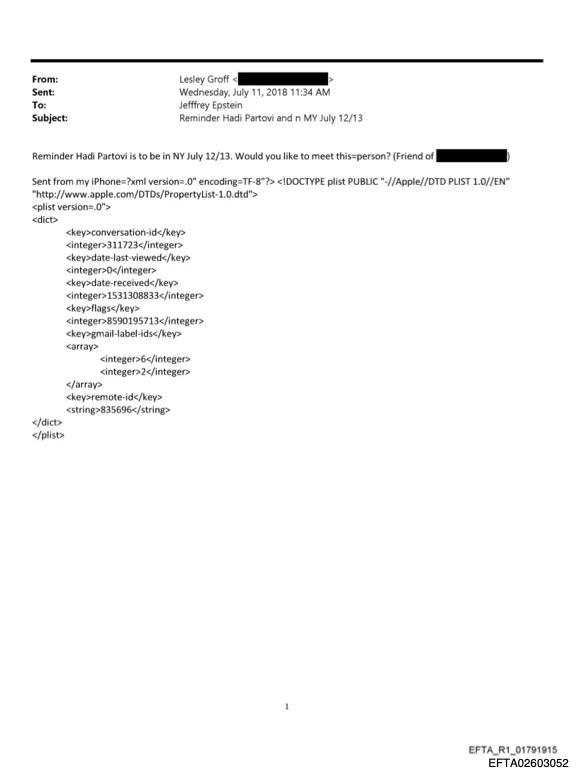
By 2018, Epstein’s 2008 conviction was a matter of public record. While the full scale of his crimes would not come into national focus until 2019, his history was not hidden. For any leader operating in K-12 education—particularly one whose organization partners with school districts, influences curriculum policy, and receives support from state and federal sources—the due-diligence threshold is high. Code.org’s reach extends into thousands of classrooms and millions of students. It works alongside departments of education and advocates for public policy changes in computer science graduation requirements. In that sphere, judgment is not merely personal; it is institutional. When repeated documented communications appear with a figure whose reputation, even then, carried serious red flags, transparency becomes the rational course.
Most Notable Emails and Communications
Among the forty-three references, several communications stand out because they move beyond passive mention and reflect direct coordination. On May 21, 2018, emails document scheduling arrangements for a Skype call, including confirmation that a conversation would take place on May 29 at 2:00 p.m. Pacific Time. Reminders were sent on the day of the call stating, “Reminder: SKYPE call w/Hadi Partovi at 5pm EST…today.” Metadata logs from Skype reflect an outgoing call from Epstein’s account (“jeevacation”) to “Hadi Partovi,” with a recorded duration of approximately twelve minutes and thirty seconds.
Correspondence dated May 29 and May 31, 2018 includes Partovi acknowledging scheduling delays and indicating, “I’m running about 15–20 mins late. Can we start at 2:20pt today?” Additional email threads show cordial exchanges following introductions, including statements such as, “Jeff it’s a please to meet.” These are direct communications, not secondhand references.
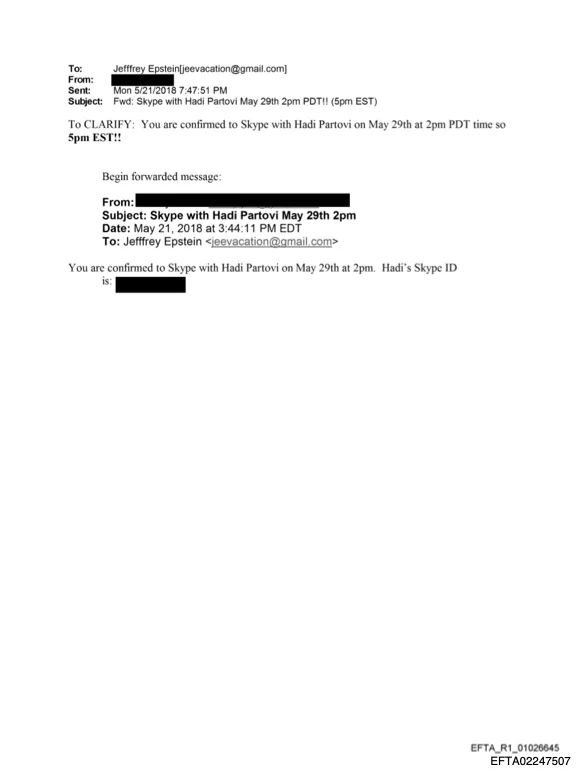
The concentration of reminders, confirmations, and logistical follow-ups over this period suggests more than incidental contact. It reflects organized communication.
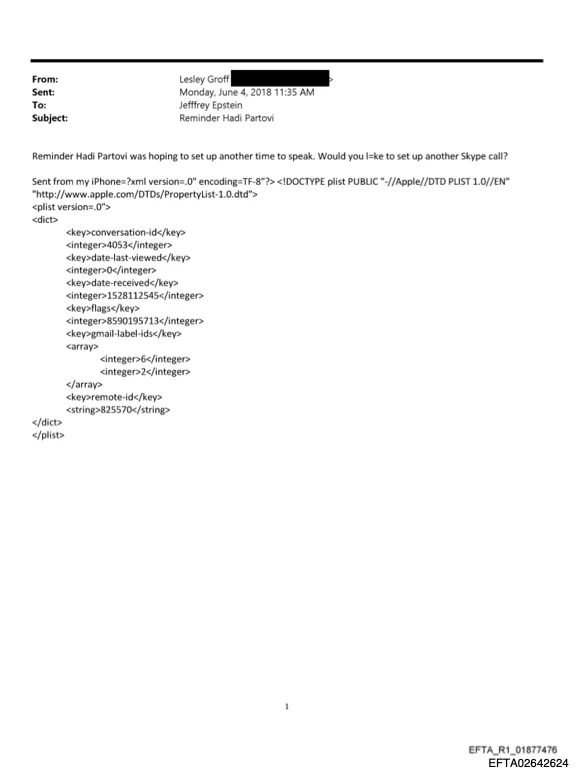
None of these entries disclose the substance of the conversations. They confirm that contact occurred. They confirm that it was scheduled, acknowledged, and in at least one instance executed. The absence of content is precisely what makes clarification necessary.
The Responsibility of Leadership
The absence of public explanation fuels speculation more effectively than any adversarial headline ever could. Were these exploratory philanthropic conversations? Was funding sought or declined? Did introductions occur to other education leaders? Did contact cease after initial engagement? Or was the exchange limited, superficial, and inconsequential? None of those possibilities constitutes wrongdoing. But each requires clarification because public confidence in educational stewardship depends upon it. Organizations that serve children operate under a higher fiduciary and moral obligation than most sectors. They are entrusted not only with resources but with formative influence.
It is essential to state plainly what this inquiry is not. It is not an allegation of criminal conduct. It is not a claim that association equals complicity. It is not an attempt to collapse nuance into insinuation. It is a recognition that in education—particularly in publicly funded, policy-shaping education—standards of disclosure must exceed the minimum required in private enterprise. The documents confirm contact. They confirm coordination. They confirm at least one direct conversation. They do not reveal substance. That gap is precisely where leadership must speak.
Transparency as Safeguard
Measured disclosure would serve both institutional integrity and the broader education ecosystem. A clear timeline of interactions, a description of their purpose, and confirmation that no financial or advisory relationship materialized would not weaken an organization; it would fortify it. In a climate where public confidence in institutions is fragile, sunlight remains the least costly safeguard. Silence, by contrast, allows narratives to harden in the absence of context.
The stakes extend beyond a single nonprofit. Computer science education has become central to workforce policy, economic competitiveness, and federal funding debates. Leaders in that space shape legislative conversations and influence state standards. When those leaders’ names appear dozens of times in the files of one of the most notorious, underage sex-traffickers of the modern era, the questions belong not to gossip but to governance. What was the nature of the engagement? What diligence preceded it? What safeguards were in place?
Education is built on credibility. Parents, teachers, and policymakers grant access to classrooms because they trust that those who design programs exercise sound judgment. That trust is sustained not by defensiveness but by clarity. The records exist. The entries are documented. The calls were scheduled and confirmed. The public is entitled to a direct account of why.
In matters involving children and public institutions, transparency is not adversarial. It is foundational.
Citizens Rule Book: A Palladium of Liberty (Hardcopies) 🇺🇸
Reconciling Public Statements with the Email Record 🚨
Update (02/18/2026): In a recently-updated, September 8th, 2019 LinkedIn post, Hadi Partovi stated that when introduced to Jeffrey Epstein as a potential Code.org donor, he “Googled him,” discovered his status as a convicted sex offender, and “abruptly ended talks. End of story.”
But documentation reported in multiple outlets complicates that account.
According to released correspondence, the interaction did not end with an immediate moral severance. Emails indicate follow-up communication, including a request for an additional meeting and an attempt by Lesley Groff to coordinate time in New York. That record materially alters the framing. There is a categorical difference between terminating contact upon discovery and continuing engagement until the prospective donor disengages.
If the emails are authentic — and they have not been credibly disputed — then the public narrative presented on LinkedIn does not fully align with the documentary trail.
The Framing Problem
Partovi’s post positions his decision in contrast to Joi Ito and the MIT Media Lab, suggesting a clean ethical break: “I abruptly ended talks. End of story.”
Yet the documentary record suggests something closer to conditional engagement rather than categorical rejection. That distinction matters. It moves the episode from moral clarity to reputational management.
Rejecting a convicted felon is not ethically complex. It is straightforward. Especially when the conviction involves crimes against minors and the organization’s stated mission centers on serving youth.
The subsequent portion of Partovi’s post pivots into a broader meditation on the difficulty nonprofits face in evaluating controversial donors — raising hypotheticals about “unpopular” donors, “politically controversial” donors, and those with “exotic foreign ties.”
But Jeffrey Epstein was not an abstract case study in reputational ambiguity. He was a registered sex offender whose crimes were already a matter of public record.
Equating that scenario with ambiguous political controversy risks blurring moral categories that should remain distinct.
The Donation Policy Defense
Partovi notes that Code.org drafted a Donation Policy “for this very reason,” emphasizing transparency and limits on donor influence.
That is commendable in theory. But policies do not resolve inconsistencies in public statements. Transparency is not merely listing donors; it is ensuring that public explanations match private correspondence.
If emails show continued engagement after awareness of Epstein’s conviction, then the “abruptly ended talks” narrative becomes at minimum incomplete.
Transparency requires congruence between documentation and declaration.
The Financial Argument
Partovi argues that rejecting donors is financially equivalent to “taking money away from education.”
This framing deserves scrutiny.
Declining funds from a convicted sex offender is not the removal of resources from children. It is a boundary. Philanthropy is not a moral entitlement for donors; it is a privilege extended by institutions.
Nonprofits do face immense fundraising pressure. That reality is undeniable. But financial difficulty does not convert ethical clarity into ethical ambiguity.
If anything, organizations serving youth carry a heightened obligation to ensure that fundraising decisions reflect that mission in both fact and perception.
The Core Question
This addendum does not allege wrongdoing beyond what documentation supports. It raises a narrower question:
Did the public statement fully and accurately characterize the sequence of events?
If Epstein rejected the overture rather than being rejected immediately upon discovery of his conviction, then the LinkedIn account omits relevant context.
In reputational crises, the difference between “we ended it immediately” and “it did not progress further” is not semantic. It is substantive.
Public trust depends on precision, honesty and FULL transparency.
And thus that trust begins with aligning narrative to record.
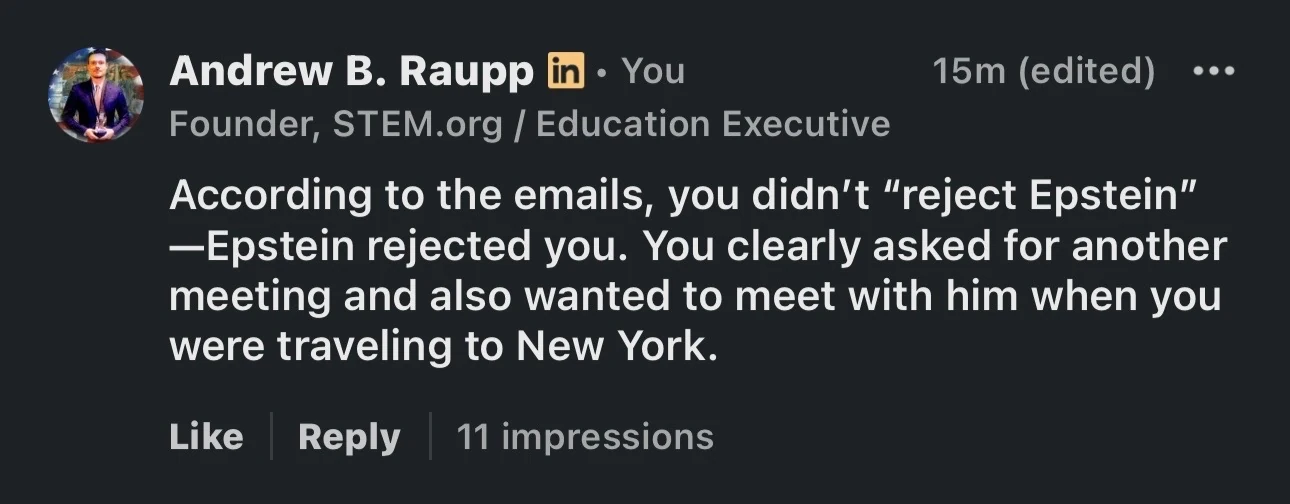
Hadi responded to my comment later in the day with:
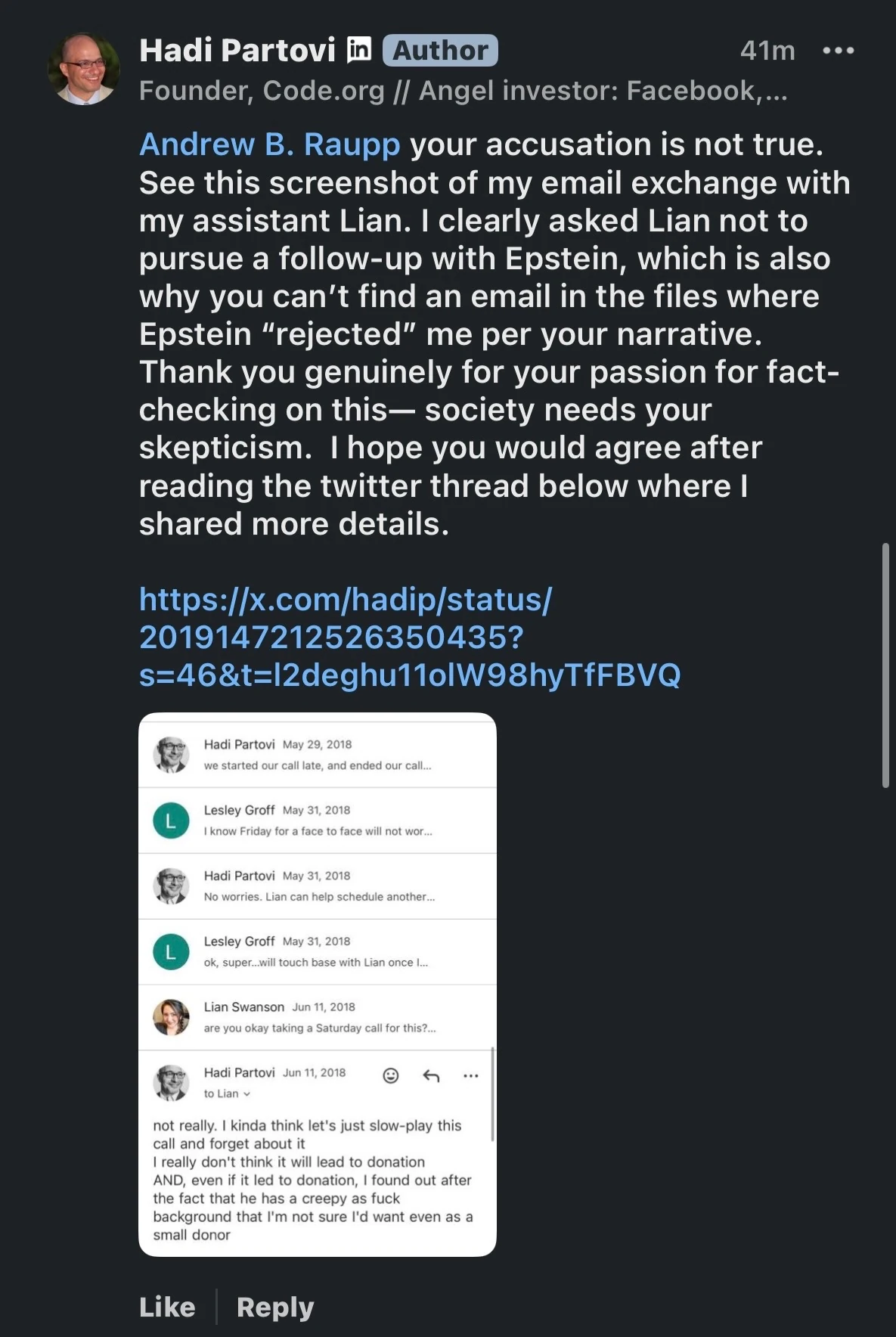
🚨 More information can be found in an X post he provided, here. In which I subsequently responded back with:
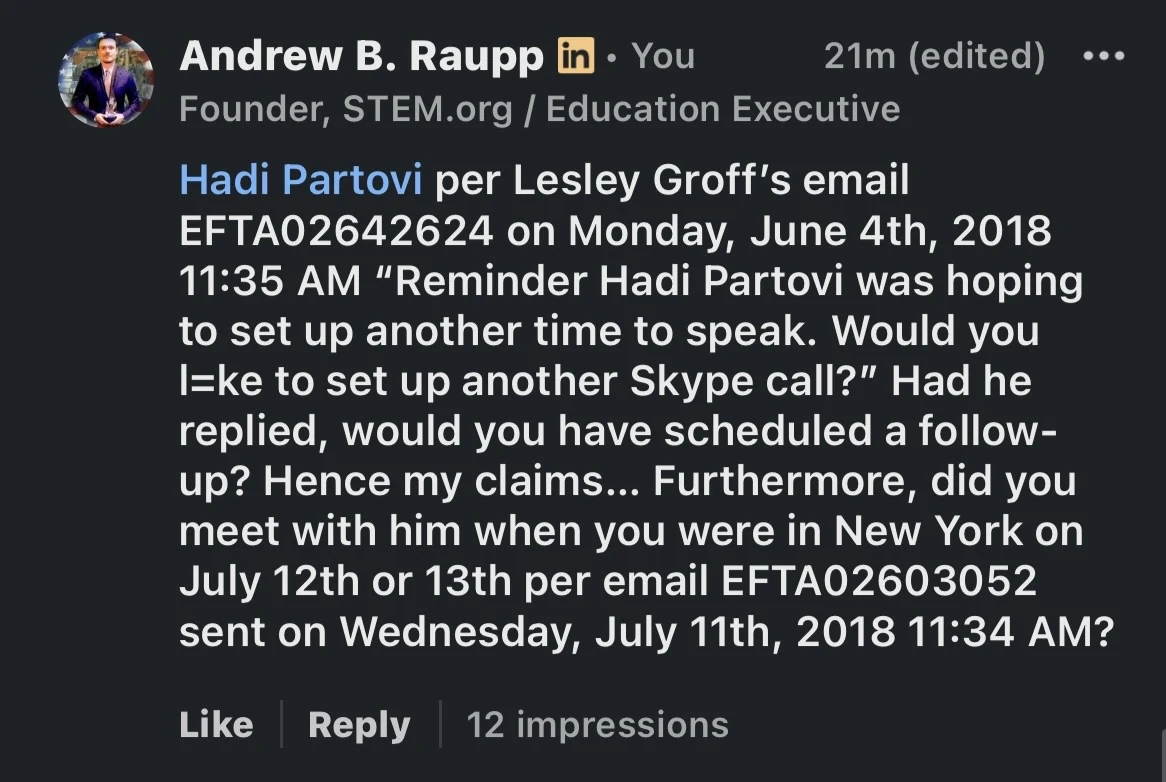
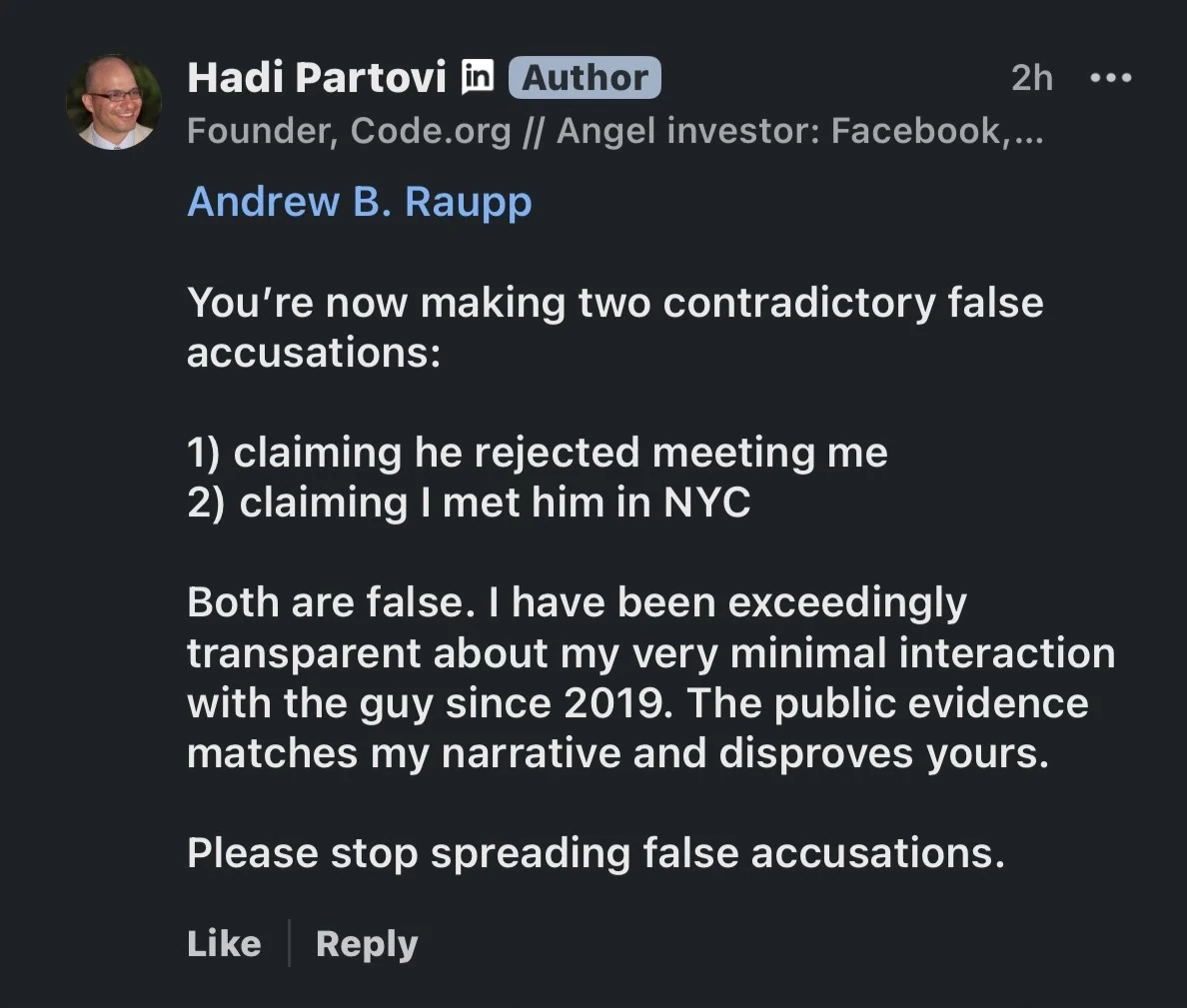
After drawing attention to the discrepancies, he resorts to false accusations:
Again, I bring the receipts:
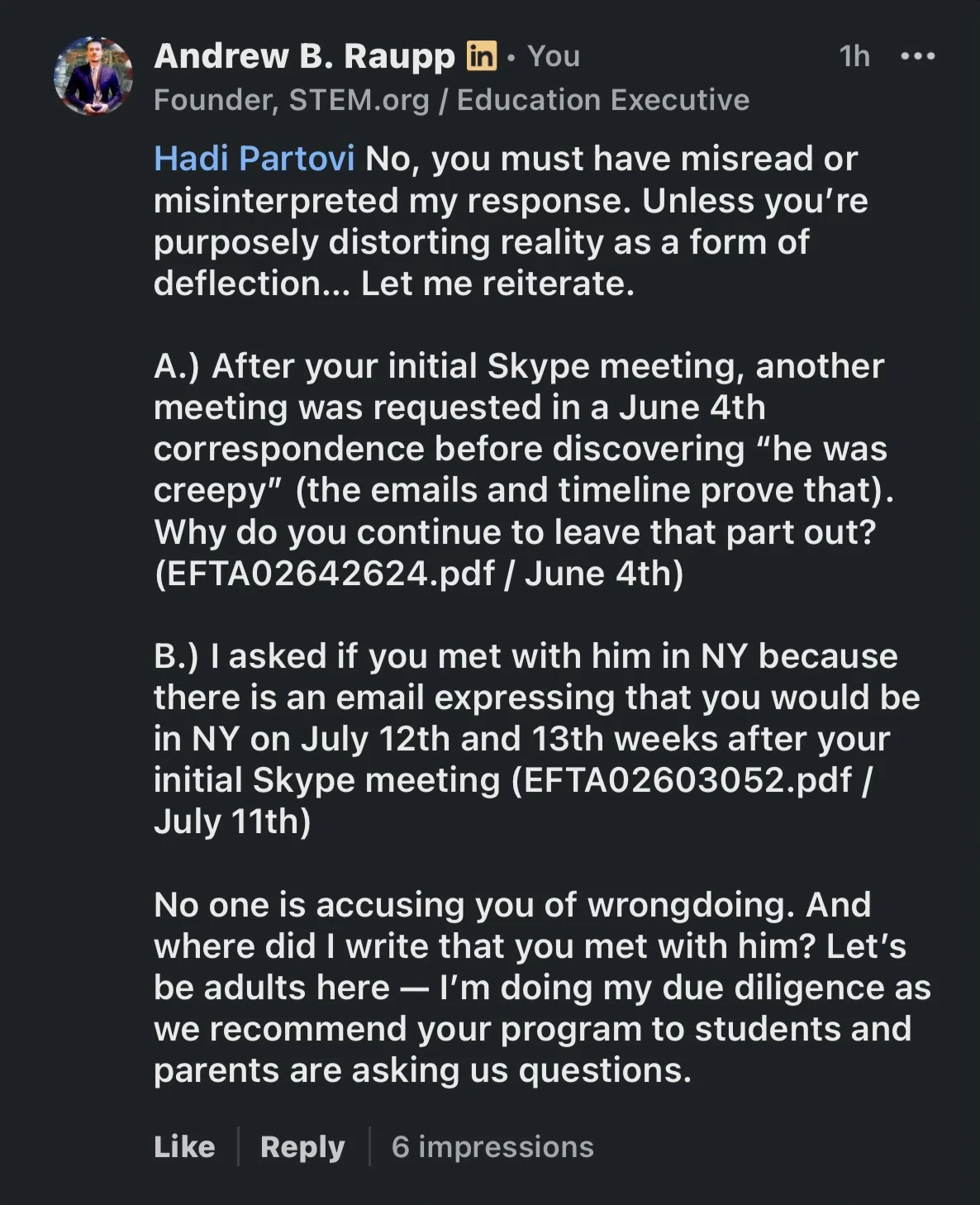
Following a barrage of “off the record” personal messages sent to me—triggered by a question I was unable to capture via screenshot regarding the NY email referenced above—much of the original LinkedIn diatribe was subsequently removed after he deleted his own comments. In their place, the following statement was posted:
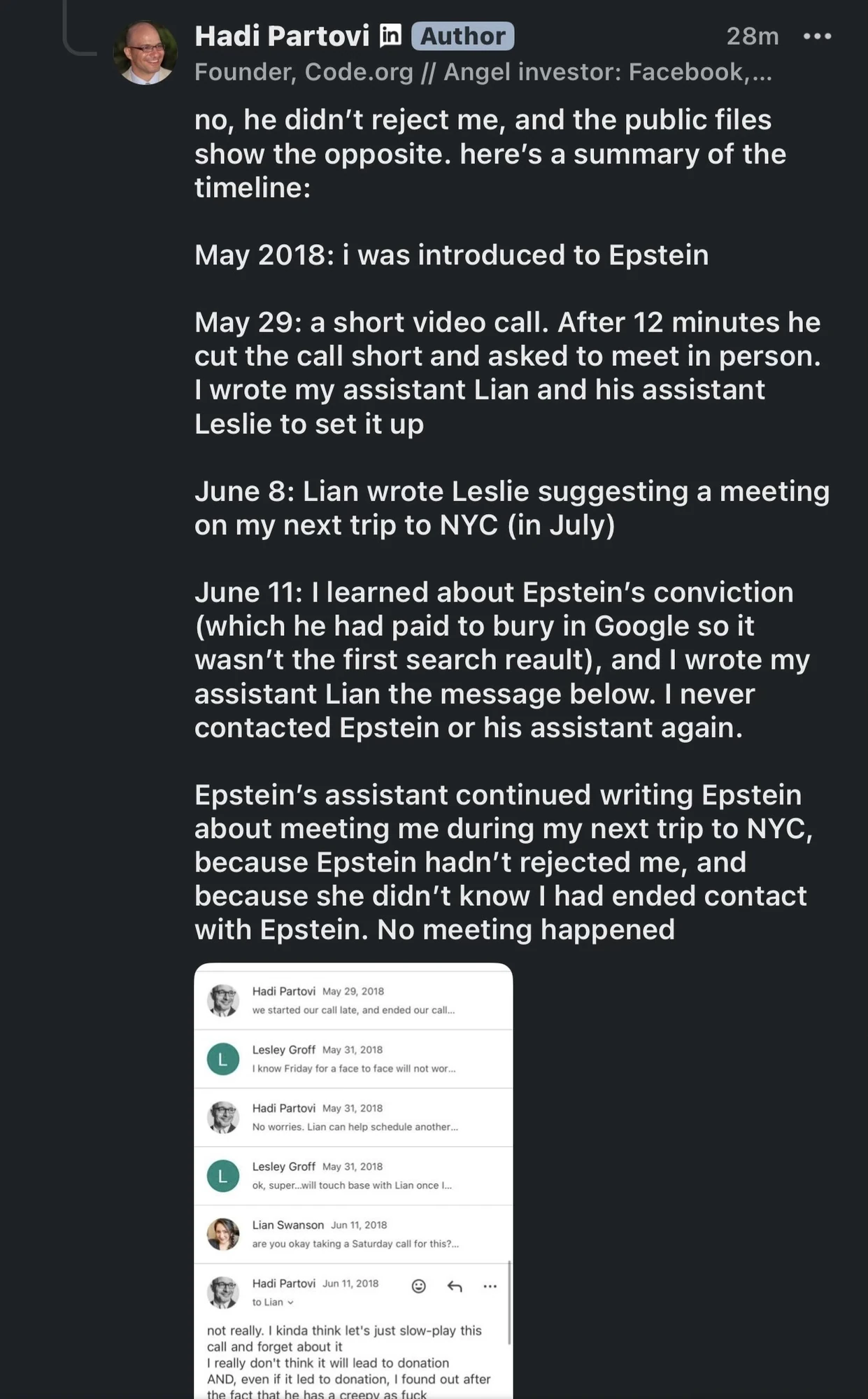
I’ll leave it to you to draw your own conclusions. That’s his story and he’s sticking to it!
🚨 Update (02/27/2026): Congresswoman Anna Paulina Luna publicly names Leslie Groff as an Epstein co-conspirator, here.
Legal Disclaimer: The statements, commentary, and materials referenced herein reflect the personal opinions, interpretations, and publicly available information known to the author at the time of publication. All assertions are made in good faith and are intended for informational, journalistic, and educational purposes only.
Nothing contained herein is intended to defame, disparage, or harm the reputation of any individual or entity. To the extent any statements reference third parties, such references are based on publicly accessible records, published materials, or firsthand communications believed to be authentic. Readers are encouraged to independently verify all information.
This publication constitutes protected opinion and commentary under applicable federal and state laws, including the First Amendment to the United States Constitution. It does not constitute legal advice, and no attorney-client relationship is formed by its publication or distribution.
By accessing or sharing this material, readers acknowledge that they understand it is presented as opinion-based commentary grounded in publicly available information, and not as a definitive adjudication of fact.
Citizens Rule Book: A Palladium of Liberty (Hardcopies) 🇺🇸
Keywords
First published February 18, 2026. Originally published in Liberty or Deathwire.