The Roll-Up Coup Comes for STEM
Private equity did not build the STEM education movement. It arrived after the work was done, with a spreadsheet and a debt facility, to collect.
 Andrew B. Raupp
The STEM education movement was not founded in a boardroom. It was built over decades by teachers running robotics clubs on donated hardware, by nonprofits stretching grant dollars, by parents, mentors, makers, and small program operators who measured success in students reached rather than EBITDA multiples. That is precisely what makes it attractive now. In private equity vocabulary, a field built by thousands of independent operators is not a movement. It is a fragmented market — and fragmented markets are what roll-ups are built to consume.
STEM Education’s Lost Decade And Tenor
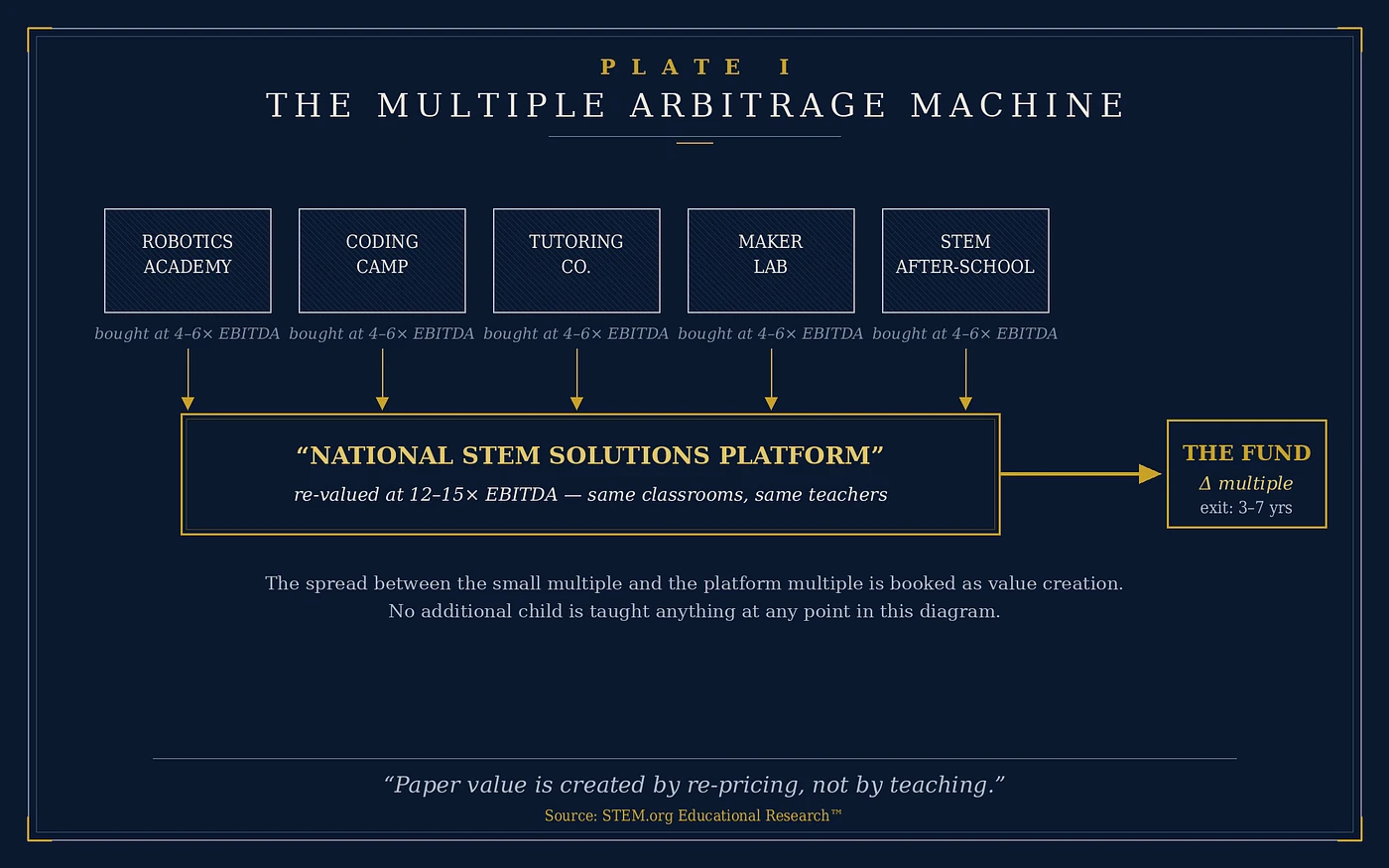
The mechanics deserve to be stated plainly, because the strategy depends on most people never learning them. In a roll-up, a private equity sponsor acquires a “platform” company, then bolts on smaller competitors purchased at low valuation multiples. Once absorbed, each small operator’s earnings are re-valued at the platform’s higher multiple. The sponsor has created paper value not by teaching a single additional child anything, but by arbitraging the difference between what a founder-owned tutoring company sells for and what a consolidated “education solutions platform” sells for. The value creation is financial engineering. The classroom is the collateral.
This is not a hypothetical threat circling the perimeter. It is already inside the building. By one recent analysis of the L.E.K. education M&A data, nearly three-quarters of EdTech acquisitions are now driven by investment firms, with roughly half of all deals coming directly from private equity rather than education companies — and many of the remaining “strategic” buyers are themselves PE portfolio companies. Bain Capital took PowerSchool, the operational backbone of thousands of school districts. Vista Equity took Pluralsight. Industry deal shops now openly market education as a target-rich environment for buy-and-build strategies, praising the sector’s “recurring revenue characteristics.” Read that phrase again. The recurring revenue is your school district’s budget. It is your family’s tuition check. It recurs because children keep needing to learn.
The record is not ambiguous
We do not need to speculate about how this ends, because it has already ended badly, repeatedly, in adjacent rooms of the same house.
In higher education, private equity capital fueled the for-profit college boom — a debt-financed acquisition wave that crested during the recession, extracted federal aid dollars at industrial scale, and left behind campus closures, collapsed credential value, and students holding loans for institutions that no longer exist. Education Management Corporation, once a Wall Street darling, sold its assets on the brink of bankruptcy to an organization that itself collapsed within two years.
In EdTech proper, Anthology — a company assembled through exactly the aggressive acquisition strategy now being pitched across the sector — filed for bankruptcy after its integration “challenges” bled $80 million in revenue. The same analysis notes the broader pattern: in 2024, private equity firms played a role in the majority of large U.S. corporate bankruptcies. Brendan Ballou’s research, cited in reporting on the child care sector, puts the base rate starkly — roughly one in five large companies acquired by private equity goes bankrupt within a decade, against about two percent of comparable firms.
Consider what happened when the acquisition machine met the commons directly. edX was founded by Harvard and MIT in 2012 as a nonprofit, built to expand access to education — a public-good asset in the purest sense. In 2021, 2U bought it for $800 million, with assurances that the nonprofit “DNA would be preserved.” The acquisition loaded 2U with debt it could not escape; the stock fell 86 percent, the layoffs came in rounds, and in July 2024 the company filed for Chapter 11 — with a class action alleging it had used manipulated data to recruit students into a paid program along the way. A decade of nonprofit institution-building was converted into a marketing channel, then into a bankruptcy estate, in three years.
Then there is BYJU’S — not a private equity fund, but the same acquisition arithmetic run at maximum velocity, and the clearest preview of what a leveraged consolidation of children’s STEM education looks like in ruins. Flush with capital from backers including Blackstone, Sequoia, and Prosus, the Indian edtech firm reached a $22 billion valuation and went on a pandemic-era buying spree: Epic! for $500 million, the kids’ coding platform Tynker for roughly $200 million, the STEM learning-games maker Osmo for $120 million, Aakash for $1 billion, Great Learning for $600 million, WhiteHat Jr for $300 million. The expansion was financed in part by a $1.2 billion term loan — with the American children’s-education subsidiaries pledged as guarantors. When BYJU’S defaulted on that loan, those subsidiaries were dragged into Delaware bankruptcy court amid allegations of fund diversion and fraudulent transfers. In the fire sale, Epic! went for $95 million and Tynker — a coding platform used by tens of millions of children — sold for $2.2 million, roughly one percent of its purchase price, in an auction so fraught that the U.S. Department of Justice raised foreign-ownership concerns over where the student data might land. The parent company itself entered insolvency, its valuation marked to zero. Tens of millions of learners were, for a period measured in years, line items in a creditor dispute. That is what it means when children’s education becomes loan collateral.
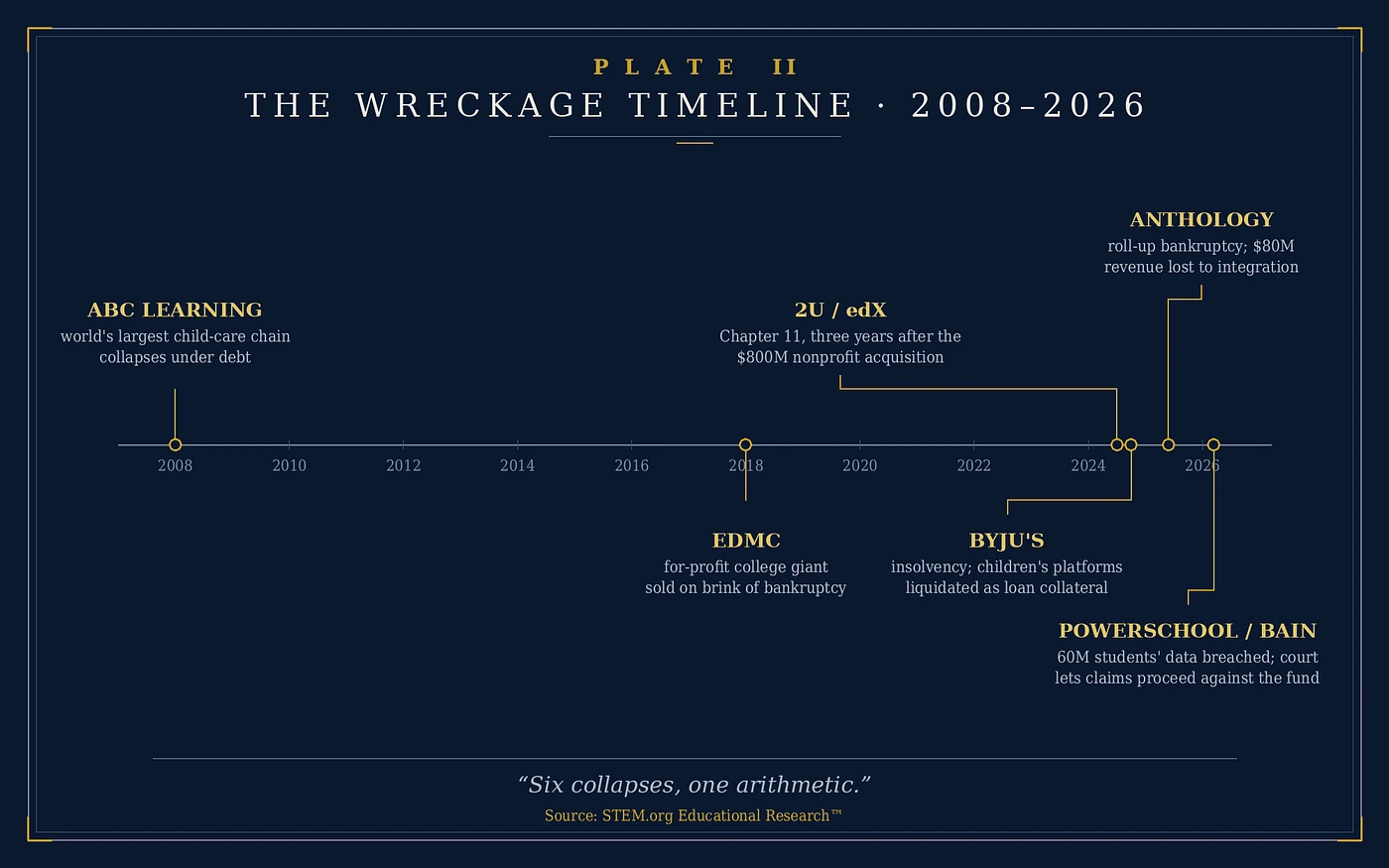
And the flagship K-12 deal of the current wave has already produced its own cautionary exhibit. Bain Capital closed its $5.6 billion acquisition of PowerSchool — the student information system serving the majority of North American K-12 students — in October 2024. Within months, PowerSchool disclosed that a threat actor had exfiltrated data on roughly 60 million students and 10 million teachers, including Social Security numbers, medical information, disability records, and custody information, and the company reportedly paid the extortionists for a promise not to leak it. The consolidated class action alleges that Bain directed the offshoring of cybersecurity, engineering, and IT functions to contractors whose tooling bypassed consent protocols — and in March 2026, a federal court allowed claims to proceed against Bain itself, finding the complaint adequately alleged that the fund exercised control over the portfolio company’s cybersecurity and workforce decisions. Whatever the litigation ultimately establishes, the structural point stands on the pleadings: when a fund controls the plumbing of the school system, the fund’s cost decisions become the children’s risk exposure.
And in early education — the sector most structurally similar to grassroots STEM programming — the consolidation is nearly complete. Private equity firms now own eight of the eleven largest U.S. child care chains by capacity. The National Women’s Law Center warns that the model carries no structural incentive to care about the long-term health of the companies it holds, let alone the children inside them. The cautionary tale is Australia’s ABC Learning: the largest child care provider on Earth in 2008, over 2,200 centers — then a debt-driven collapse that turned a nation’s child care infrastructure into a systemic-risk event. When a roll-up fails, it does not fail like one small program closing. It fails like a bank.
Lawmakers have noticed. At least five states have introduced or passed legislation writing ownership structure into child care oversight, and Colorado moved to require disclosure of tuition practices, staffing cuts, and the sale-leaseback real estate maneuvers that strip operators of their own buildings and then charge them rent to stand in them. Advocacy groups have further documented the endgame: capture local market share fast enough that regulators conclude the chains are too embedded to remove without harming families. Embed, then dare the public to object.
What the buyers get right
Education is chronically undercapitalized. Thousands of small STEM providers run on fumes — no succession plans, no cybersecurity budgets, no ability to negotiate with districts, founders approaching retirement with no buyer in sight except a competitor or a fund. Private equity offers real money, professional operations, and scale. Fragmentation has genuine costs: districts juggling forty incompatible vendors, duplicated back offices, quality that varies wildly from one strip-mall academy to the next. Consolidation can standardize safety practices, fund product development no small operator could afford, and give good programs a national footprint. Even critics of the model concede that some specialty investors treat schools as a core competency and run them well, and practitioners inside EdTech argue that when acquisitions fail, the seeds were often planted by founders and VCs who prioritized the exit long before the fund arrived. A founder who sells is not a victim. He is a party to the transaction.
All of that is true. None of it answers the structural objection.
The problem is not that private equity people are villains. The problem is that the roll-up model is indifferent — constitutionally, mathematically indifferent — to the thing being rolled up. The fund must return capital in three to seven years. Multiple arbitrage works whether the add-ons are HVAC companies or robotics academies. When quality investment competes with the exit timeline, the documentary record across hospitals, nursing homes, newspapers, and child care shows which one yields. A model that produced Toys ‘R’ Us and a graveyard of local papers does not become gentle because the acquisition target teaches children to solder. Nor is the objection confined to private equity by name — BYJU’S was venture-backed, 2U was public — which is precisely the point: it is the leveraged consolidation arithmetic that fails, whoever operates it. Change the letterhead and the collapse looks the same.
And STEM education carries a specific, aggravating vulnerability: trust is the product. A credential, a curriculum, a mentorship program — these are worth exactly as much as the integrity behind them. A roll-up that acquires twelve STEM program brands does not acquire twelve reputations. It acquires the option to spend them. Cut instructor pay, thin the curriculum, sweat the assets, and the decay will not show up in the quarterly numbers for years — long after the fund has exited. The students absorb the loss. The movement absorbs the reputational damage. The sponsor absorbs the carry.
What the movement owes itself
The STEM education movement is a commons. It was built by people who gave away lesson plans, open-sourced their hardware, and trained their own future competitors because the mission demanded it. A commons can be defended, but only by people who recognize the enclosure while it is happening.

That means founders refusing to treat the first term sheet as an inevitability, and asking who owns the buyer of the buyer. It means districts and parents asking a question they have never had to ask before: who owns the company that owns this program, and when do they need to sell it? It means state legislators extending the ownership-transparency framework now emerging in child care to the broader education services sector before, not after, the platform companies are assembled. And it means naming the strategy in public, in plain language, every time it appears — because the roll-up depends on being boring, technical, and invisible until it is irreversible.
The Investment-Industrial Complex and STEM Education
Private equity did not show up to join the STEM education movement. It showed up to become it — to stand between the child and the knowledge and charge a toll. The movement’s answer should be the one every commons gives to enclosure: not on our watch, not with our name, and not with our children as the recurring revenue.
Andrew B. Raupp is the Founder / Executive Director @stemdotorg. “Resolutely preserving the rights and freedoms of the STEM education community through sound policy & practice…
Andrew B. Raupp
First published September 1, 2026. Original publication